Page 2
Sonic air blowers have some of the largest turndown ratios of any blower in their
performance range. At 10:1, a Sonic 150’s range is from 120 cfm 57 (lps) to 1,200 cfm
(566 lps) without overheating or surging. Outside of those ranges the air surging is mild
and continuous operation may shorten the bearing life.
The blower inlet must also be hose coupled to an inlet filter-silencer, inlet air safety
screen or piped to a delivery system. Sonic inlet filter-silencers should be used in every
application where the inlet air is not piped directly to the blower inlet. Sonic standard
filters are rated at 2 microns with a paper element or 5 microns with a polyester element.
Inlet air temperature must not exceed 125°F (52°C) unless a Sonic 150C water-cooled
unit is used. If the blower is in an enclosed space and the inlet air is piped from another
area, make sure that the ambient temperature around the blower / motor does not exceed
110°F (43°C). When air is re-circulated from an air knife zone, in-line filters and water
separators must be used to prevent water from entering the blower.
The blower outlet must always be hose coupled to a discharge silencer, system piping, or
otherwise directed away from personnel. Discharged air should be silenced to levels as
required by applicable occupational safety standards or corporate standards as applicable.
In order to minimize pressure drop and noise transmission, Sonic recommends using
smooth bore tubing (hard plastic or metal).
Flex hose can induce a large pressure drop and should only be used when absolutely
necessary. Flex hose should be rated to handle a pressure of 10 psig (0.7 bar) at 200°F
(93°C). Flex hose can be used for connecting misaligned piping and bend radii that do
not match standard elbows. Be aware that flex hose can collapse inside and should be
inspected if flow problems occur. Short rubber sleeves with band clamps are standard for
blower and piping connections.
Sonic butterfly valves have a wafer design that is designed to regulate flow, but will not
seal when closed. Air will always leak around the wafer to help minimize blower
cavitations.
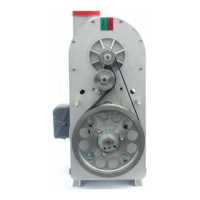
The Patent Pending Sonic Belt Tensioner is used to maintain a constant low tension on
the drive belt and reduces the maintenance schedule for the blower unit. Belt life is
optimized and belt replacement typically takes only 5 to 10 minutes to perform.
Typical blower noise is approximately 80db to 95db. Sonic Blower Acoustical
Enclosures can be used to reduce blower noise to within 75 db to 85 db depending on the
blower model. Additional noise reduction is available; contact Sonic for details.
1.3 Product Profile
The Sonic 150 blower with the Sonic Automatic Belt Tensioning assembly requires no
periodic belt adjustment. The blower shaft and impeller assembly is supported by two
duplex pair (4 bearings) ABEC 9 permanently greased packed bearings. With operating
speeds of 11,000 to 20,000 RPM, a single Sonic 150 head assembly can be powered by a
15 to 25 horsepower (11.2 to 18.6 kW) motor. The inter-connecting support bracket


 To Next Page