Season switch
Only appears, if "heating and cooling" mode is selected. Heating circuits separately, or switching system-wide between heating and
cooling.
S/W Day
Summer / Winter changeover in daytime mode
If this value is exceeded at the outdoor sensor the controller automatically switches the heating circuit off = Summer mode. If the out-
door temperature drops below this value, the heating circuit is switched on again = Winter mode.
In addition to the operating times in normal daytime operation, this setting is also valid for times with activated comfort.
S/W Night
Summer/Winter changeover in night-time mode
If this value is exceeded at outdoor sensor S1 during the nighttime mode times, the controller automatically switches the heating circuit
off = Summer mode. If the outdoor temperature drops below this value, the heating circuit is switched on again = Winter mode.
Curve
Type and slope of the heating characteristic curve
The characteristic curve is used to control the heat dissipation of the heating circuit relative to the outdoor temperature. The demand
for heat differs due to factors such as the type of building, heating, insulation and outdoor temperature. For this reason, the controller
can operate with a normal straight curve (setting ‚simple‘) or split curve (setting ‚split‘).
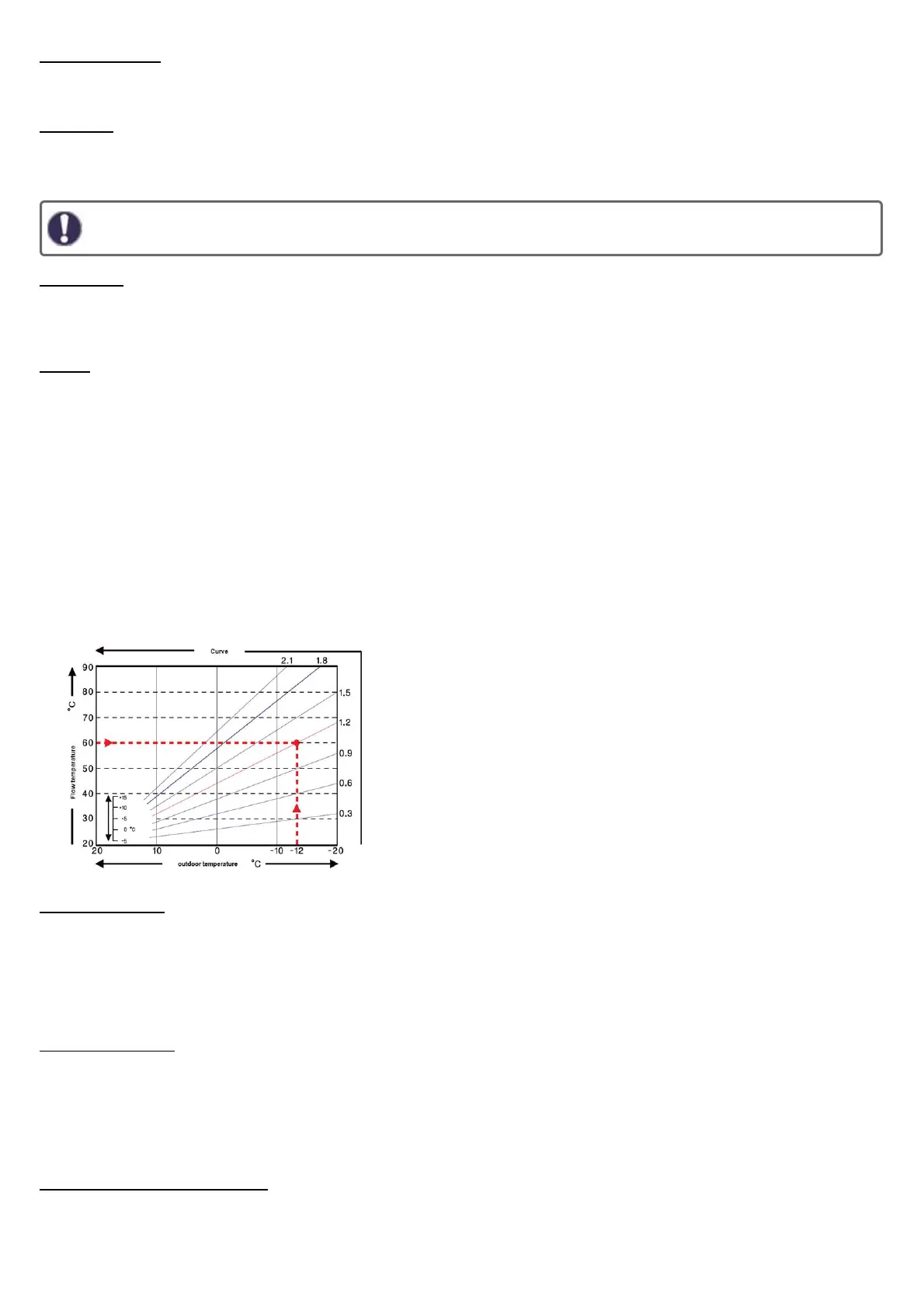
If ‚simple‘ is selected, the curve is adjusted using the graphic diagram. While setting the slope, the controller also shows the slope
value and the calculated target flow temperature at -12 °C as a reference point.
If ‚split is selected, the curve is set in the following steps:
1. Outdoor temperature for slope change
2. Slope over outdoor temperature for change
3. Slope below outdoor temperature for change
While setting the slope, the controller also shows the slope value and the calculated target flow temperature at -12 °C as a reference
point. In case of repeated adjustment of the split curve, the settings appear in reverse order.
The diagram shows the influence of the selected characteristic curve steep-
ness (standard curve) on the calculated reference flow
temperature of the heating unit. The correct characteristic curve is determined
by defining the intersection point of the maximal calculated flow temperature
(=design temperature) at minimal outdoor temperature.
Example: The design temperature of the heater 60 °C flow at lowest outdoor
temperature according to calculation of heat requirement
-12 °C. The intersection point renders a slope of 1.2 as the setting.
Day Correction
Parallel characteristic translation
The day correction causes a parallel shift of the heating curve during daytime operating hours, because with certain outdoor tem-
peratures the building might not be optimally heated with the set heating curve. With a non-optimised heating curve, the following situ-
ations frequently occur: hot weather = room too cold/cold weather = room too hot. In this case, the slope of the curve should be
reduced stepwise by 0.2 points and increases the day correction
by 2 ... 4 °C each.
Night Correction
Parallel characteristic translation
The night correction produces a parallel translation of the heating characteristic during the nighttime operating hours. If a negative
value is set for the night correction, the reference flow temperature is lowered accordingly during the nighttime operating hours. In this
manner, primarily at night, but also during the day when no-one is at home, the room temperature is lowered, thus saving energy.
Example: A day correction of +5 °C and a night correction of -2 °C produces a reference flow temperature in nighttime operation that is
7 °C lower.
Comfort Temperature Boost
Parallel characteristic translation
33



 To Next Page