The following muscle groups shouldbe stretched/warmedup for any walking orrunning program:
.:.
Quadriceps
.:.
Hamstrings
-:.
Calves
.:.
Outer hips
.:.
Groin muscles
.:.
Back muscles
.:.
Chest
.:.
Shoulder muscles
.:.
Shins
Determining
Your
Target
Heart
Rate
Range
LOWER
TARGET
HEART
RATE
220
Your
Age
=
Estimated
Max.
Heart
Rate
Resting
=
Value
x
60%
=
Estimated
Target
+
Resting
=
Target
Heart
Rate
@
60%
UPPER
TARGET
HEART
RATE
220
Your
Age
=
Estimated
Max.
Heart
Rate
Resting
=
Value
x
80010
=
Estimated
Target
+
Resting
=
Target
Heart
Rate
@
80%
Lower
Target
Heart
Rate
I
===~
Upper
Target
Heart
Rate
II-
__
---J
F.I.
T.
Principle
Every
cardiovascular
program
should
be
developed based on frequency, intensity and
duration.
I)
Frequency- the number
of
exercise sessions
per week.
Regular exercise should be performed at
least
three
or
four
days
week
to
be
beneficial, although fewer sessions may be
sufficient for some. Those
in
superior
physical condition typically train five to
seven days per week.
2)
Intensity - how hard each exercise is.
Intensity is dependent upon one's fitness
level. The range established by American
College
of
Sports Medicine
is
60% to 90%
of
maximal heart rate.
If
you are abeginning
exerciser maintaining an intensity level
around 60% is beneficial. Typically, an
estimated heart rate range is determined
using a formula
of
nO-Age,
factoring in
resting heart rate, then multiplying by the
desired percentage. See the chart below.
If
your
§TAR
TRAC4S00
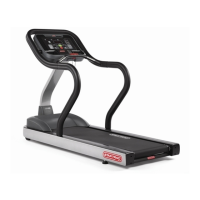
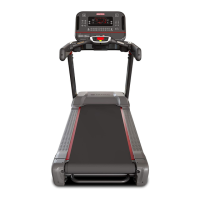
TREADMILL
has contact heart rate or
Polar®
compatibility,
monitoring
your
heart
rate
will
be
easy.
However,
if
your need
to
monitor your pulse
manually, find the carotid or radial artery with
your index finger, take a ten second count and
multiply by six to determine heart rate.
§TAR
TRAC
4S00
TREADMILL
Owner"s
Manual
47




 To Next Page