5. MEASUREMENT STRATEGY
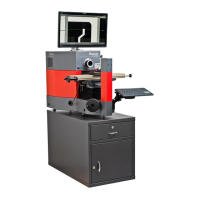
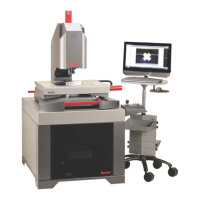
HDV300 and HDV400 systems can be operated with any of 7 telecentric fixed-focus lenses with
magnification from 0.14X to 4.0X and with 6.5:1 zoom optics with continuously adjustable magni-
fication from 0.7X to 4.5X. Here magnification is the image size at the camera CCD detector
divided by the object size. Since the CCD size is fixed (namely 9.93 x 8.70 mm), each magnifi-
cation has a corresponding field of view (FOV), which is the CCD size divided by magnification.
The higher the magnification, the higher the resolution but the smaller the field of view.
The 6 telecentric optics with magnifications from 0.3X to 4.0X and the 6.5:1 zoom optics are
mounted via a bayonet fitting and can be changed by the user in seconds. Note that the centering
of the optical axis of different optics may vary by a small amount, so that all measurements on the
same part need to be taken with the same optics. The larger 0.14X telecentric optics are not
bayonet mounted, but are part of a dedicated machine.
In addition to magnification, focus and lighting, factors that affect resolution and accuracy include
keeping the optics clean, using the full calibration and shape correction algorithms available with
M3 software (Tech Bulletin 080713), and having a well stabilized system free from vibration.
5.1 Telecentric Lens Measurement Strategy
Select telecentric optics to perform high accuracy, high throughput FOV measurements. In
general, select the largest lens whose field of view encompasses the entire part. The 0.14X lens
accommodates parts up to 2.47” x 1.86” (63 x 47 mm). If the entire part cannot fit into the FOV, no
problem. Simply move the stage by up to 12" (300 mm) with the HDV300 or up to 16” (400 mm)
with the HDV400, and the M3 software will seamlessly integrate FOV measurements with encoder
readings from stage motion.
5.2 Zoom Optics Measurement Strategy
The 6.5:1 zoom optics allows magnification to be continuously adjusted from 0.7X to 4.5X. While
the zoom optics can provide the same FOV as the four higher magnification telecentric lenses,
they do not offer the same low optical distortion that is required for accurate FOV measurements.
Select zoom optics to measure large parts which would not fit into a single FOV, also for smaller
parts where extremely high magnification is required. The lowest magnification range accommo-
dates parts up to 0.44" x 0.37" (11.2 x 9.4 mm) in the FOV. To measure large parts, locate the
edge of interest at minimum magnification, then take the actual measurement at maximum magni-
fication using the system's crosshairs. The zoom optics’ parcentricity feature will ensure that a
feature will remain at the optical center of the video image throughout the magnification range.
5.3 Lighting Strategy
Once the image has been properly focused and magnification has been set, adjust front lighting
and back lighting using the on-screen sliders provided by M3 software. You may also utilize room
lighting, or shield the system from room lighting, as appropriate.
Correct lighting is paramount to accurate measurement with any video-based measurement
system. A clear image with lighting toward the low side is recommended. Lighting that is too
low will result in a dark, low-contrast image with indiscernible features. Lighting that is too bright
may result in a washed-out image and in hot spots (blooms) that distort features
.
When adjusting lighting, start with light that is lower than desired, then increase lighting while
viewing the image on the computer monitor. Maintain constant lighting for consistent results.
Do not to change light levels between points used to measure the same geometrical feature.
Depending on the part characteristics and the feature being measured, the right combination
of lighting from the available sources may aid in bringing out a particular feature. Take time to
experiment by balancing the available light sources.
Zoom optics
come with a dedicated 64 mm (2.5”) diameter LED ring light for front illumination
and a 50 mm (2”) diameter LED back light for silhouette illumination. The back light is built into






 To Next Page