WARNING: When diving with multiple gases, remember that the ascent time is always
calculated with the assumption that you use all the gases found in the Gases menu. Always
check that you have only the gases for your current planned dive
defined before you dive.
Remove the gases that are not available for the dive.
4.25.1. Modifying gases during a dive
Modifying gases is for emergency cases only. For example, due to unforeseen events, you
might lose a gas mixture, in which case you could adjust to the situation by deleting that gas
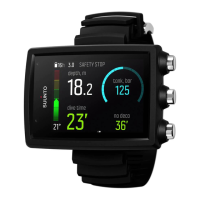
mixture from the gas list of Suunto EON Steel Black. This allows you to continue diving and
get correct decompression information calculated by the dive computer.
In another case, if for some reason you run out of gas and need to use a gas mixture from a
dive buddy, it is possible to adapt Suunto EON Steel Black to the situation by adding the new
gas mixture to the list. Suunto EON Steel Black re-calculates decompression and shows the
correct information.
NOTE: This feature is not enabled by default, it must be activated and creates an
additional step to the gas menu during the dive. It is only available if multiple gases are
selected for the dive mode.
To enable modifying gases, turn the feature on in the settings menu under Dive settings »
Parameters » Modify gases.
When enabled, during a multi-gas dive, you can add a new gas as well as select an existing
gas from the gas list to remove it.
NOTE: You cannot modify or remove the gas currently in use (active gas).
When Modify gases is turned on, you can remove gases which are not in use from the gas
list, add new gases to the list, and modify parameters (O
2
, He, pO
2
) of nonactive gases.
4.25.2. Isobaric counterdiusion (ICD)
Isobaric counterdiusion (ICD) occurs when dierent inert gases (such as nitrogen and
helium) diuse in dierent directions during a dive. In other words, one gas is being absorbed
by the body while the other is being released. ICD is a risk when diving with trimix mixtures.
This may happen during a dive, for example, when trimix gas is switched to nitrox or light
trimix. When the switch is made, helium and nitrogen rapidly diuse in opposite directions.
This produces a transient increase in total inert gas pressure which can lead to
decompression sickness (DCS).
Currently there are no algorithms that can address ICD. Therefore, you need to take it into
account when planning trimix dives.
You can use Suunto EON Steel Black to plan your trimix usage safely. Under the Gases menu,
you can adjust oxygen (O
2
) and helium (He) percentages to see the change in partial pressure
of nitrogen (ppN2) and the partial pressure of helium (ppHe) values.
Suunto EON Steel Black
37


 To Next Page