WARNING: YOUR ACTUAL ASCENT TIME MAY BE LONGER THAN DISPLAYED BY THE
DIVE COMPUTER! The ascent time will increase if you: (1) remain at depth, (2) ascend slower
than 10 m/min (33 ft/min), (3) make your decompression stop deeper than at the ceiling,
and/or (4) forget to change the used gas mixture. These factors might also increase the
amount of breathing gas required to reach the surface.
4.11.1. Last stop depth
You can adjust the last stop depth for decompression dives under Dive settings »
Parameters » Last stop depth. There are two options: 3 m and 6 m (9.8 ft and 19.6 ft).
By default, the last stop depth is 3 m (9.8 ft). This is the recommended last stop depth.
NOTE: This setting does not aect the ceiling depth on a decompression dive. The last
ceiling depth is always 3 m (9.8 ft).
TIP: Consider setting the last stop depth to 6 m (19.6 ft) when you dive in rough sea
conditions and stopping at 3 m (9.8 ft) is challenging.
4.12. Deco
profile
Deco profile can be selected in Dive settings » Parameters » Deco profile.
Continuous decompression profile
Traditionally, since Haldane’s 1908 tables, decompression stops have always been deployed
in fixed steps such as 15 m, 12 m, 9 m, 6 m and 3 m. This practical method was introduced
before the advent of dive computers. However, when ascending, a diver actually
decompresses in a series of more gradual ministeps,
eectively creating a smooth
decompression curve.
The advent of microprocessors has allowed Suunto to more accurately model the actual
decompression behavior. A continuous decompression curve is included in the Suunto
Fused™ RGBM 2's working assumption.
During any ascent involving decompression stops, Suunto dive computers calculate the point
at which the control compartment crosses the ambient pressure line (that is the point at which
the tissue’s pressure is greater than the ambient pressure), and
o-gassing starts. This is
referred to as the decompression
floor. Above this floor depth and below the ceiling depth is
the decompression window. The range of the decompression window is dependent on the
dive profile.
O-gassing in the leading fast tissues will be slow at or near the floor because the outward
gradient is small. Slower tissues may be still on-gassing and given enough time, the
decompression obligation may increase, in which case the ceiling may move down and the
floor may move up.
Suunto RGBMs optimize these two contradictory issues through a combination of a slow
ascent rate and continuous decompression curve. It all comes down to proper control of the
expanding gas during an ascent. This is why all Suunto RGBMs use a maximum ascent rate at
10 m/minute, which has proven over the years to be an eective protective measure.
The decompression floor represents the point at which the Suunto RGBM is seeking to
maximize bubble compression, while the decompression ceiling is maximizing o-gassing.
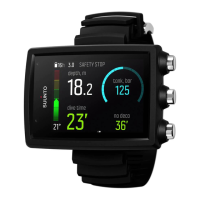
Suunto EON Steel Black
28


 To Next Page