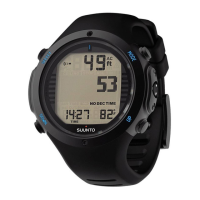
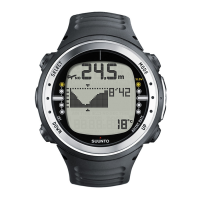
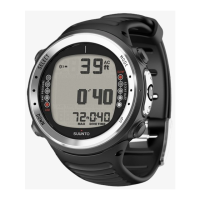
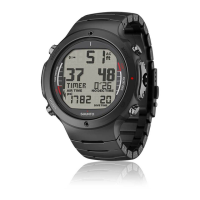
Decompression display examples
Suunto EON Steel Black shows the ceiling value always from the deepest of these stops.
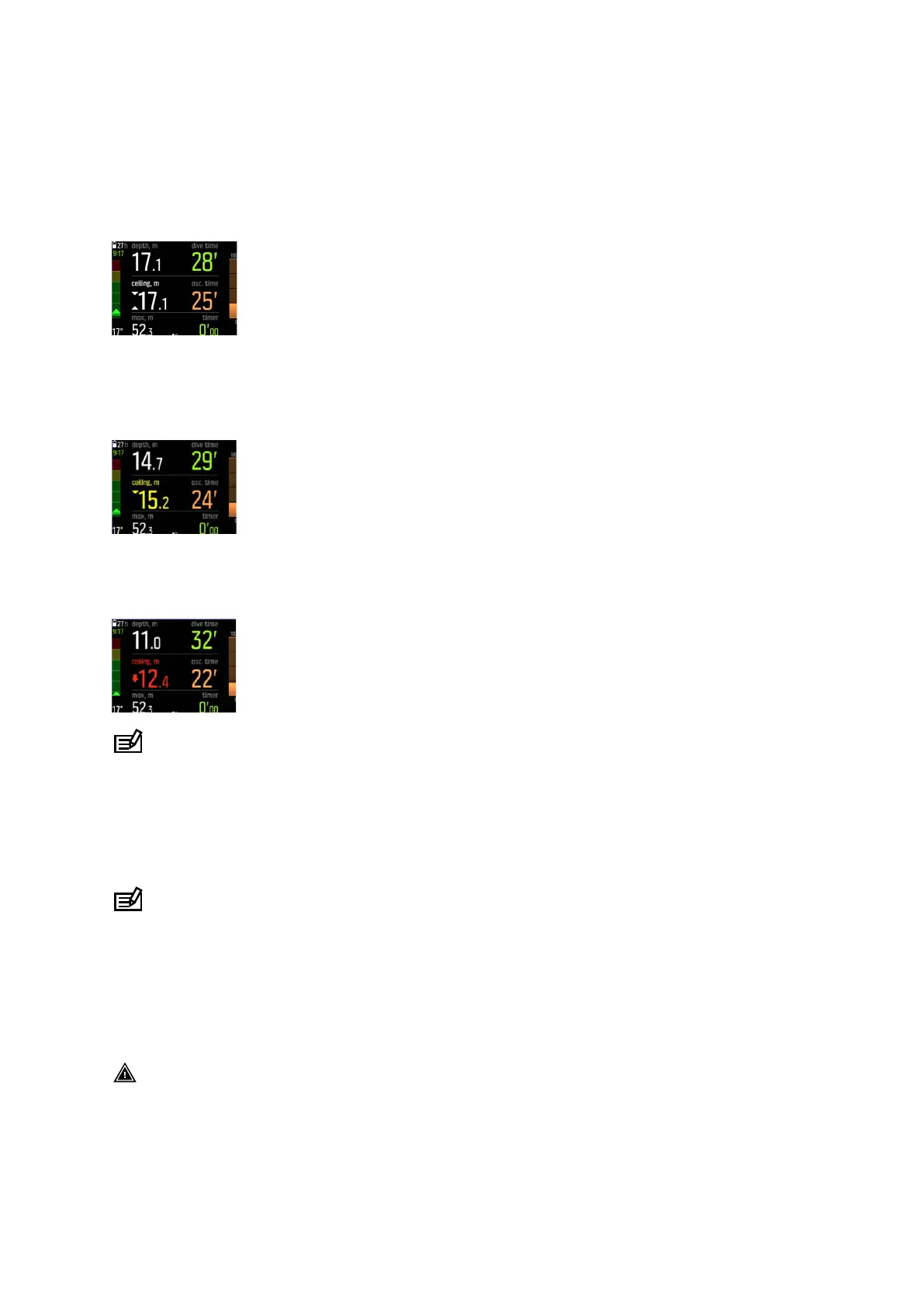
In the below display, the ceiling depth is set to 17.1 m and the diver is currently at 17.1 m. White
arrows beside the ceiling depth value show the diver is inside the decompression window.
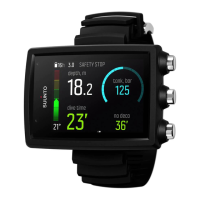
The following example shows that the decompression ceiling depth is at 15.2 m and diver is at
14.7 m. Diver is still inside the decompression window but above the optimal limit. A yellow
downward pointing arrow indicates the diver is recommended to descend to be at optimal
depth.
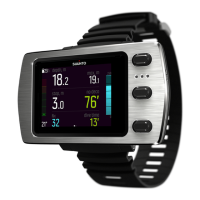
The following example shows that the decompression ceiling depth is at 12.4 m and diver is at
11.0 m. The diver is outside of the decompression window and must descend. A red arrow and
an alarm sound prompt the diver to dive deeper and the ceiling depth is indicated in red.
NOTE: When you dive with the Suunto Fused™ RGBM 2 algorithm and the ceiling is
broken for more than 3 minutes, the decompression algorithm gets locked.
With decompression stops, in the continuous ascent mode the ceiling is constantly
decreasing while you are near the ceiling depth, providing continuous decompression with
optimum ascent time. While in the stepped ascent mode, the ceiling is the same for a
specific
time and then moves upwards 3 m (9.8 ft) at a time.
NOTE: It is always recommended to keep close to the decompression ceiling when
ascending.
Ascent time is always the minimum time needed to reach the surface. It includes:
•
Time required for deepstops
•
Ascent time from depth at 10 m (33.0 ft) per minute
•
Time needed for decompression
WARNING: When diving with multiple gases, remember that the ascent time is always
calculated with the assumption that you use all the gases found in the Gases menu. Always
check that you have only the gases for your current planned dive
defined before you dive.
Remove the gases that are not available for the dive.
Suunto EON Steel Black
27


 To Next Page