Equipment details
72
Residues of frozen water can prevent filling
if there is a frost. The water heater can be
defrosted by switching on the heater for a
short period (max 2 mins). Frozen pipes can be
defrosted by heating the room.
Note: If just the cold water system is being
used, without water heater, the heater tank
is also filled up with water. In order to avoid
damage through frost, the water contents
must be drained by actuating the safety/drain
valve, also when the heater has not been
used. As an alternative, two shutoff valves,
resistant to hot water, can be fitted in front of
the cold and hot water connection.
Draining the water heater
1. Disconnect power for water pump
(control panel).
2. Open hot water taps in bathroom
and kitchen.
3. Open safety/drain valve: Lever in vertical
position, position (f).
4. The water heater is now drained directly
to the outside via the safety/drain valve.
Check that the water contents have been
completely drained (10 litres).
GAS OPERATING INSTRUCTIONS
Attention: Never operate the water heater
without water in it! If the wall cowl is
positioned close to an opening window (or
hatch) - in particular directly under it - it
must remain closed when the water heater
is in use (see warning plate).
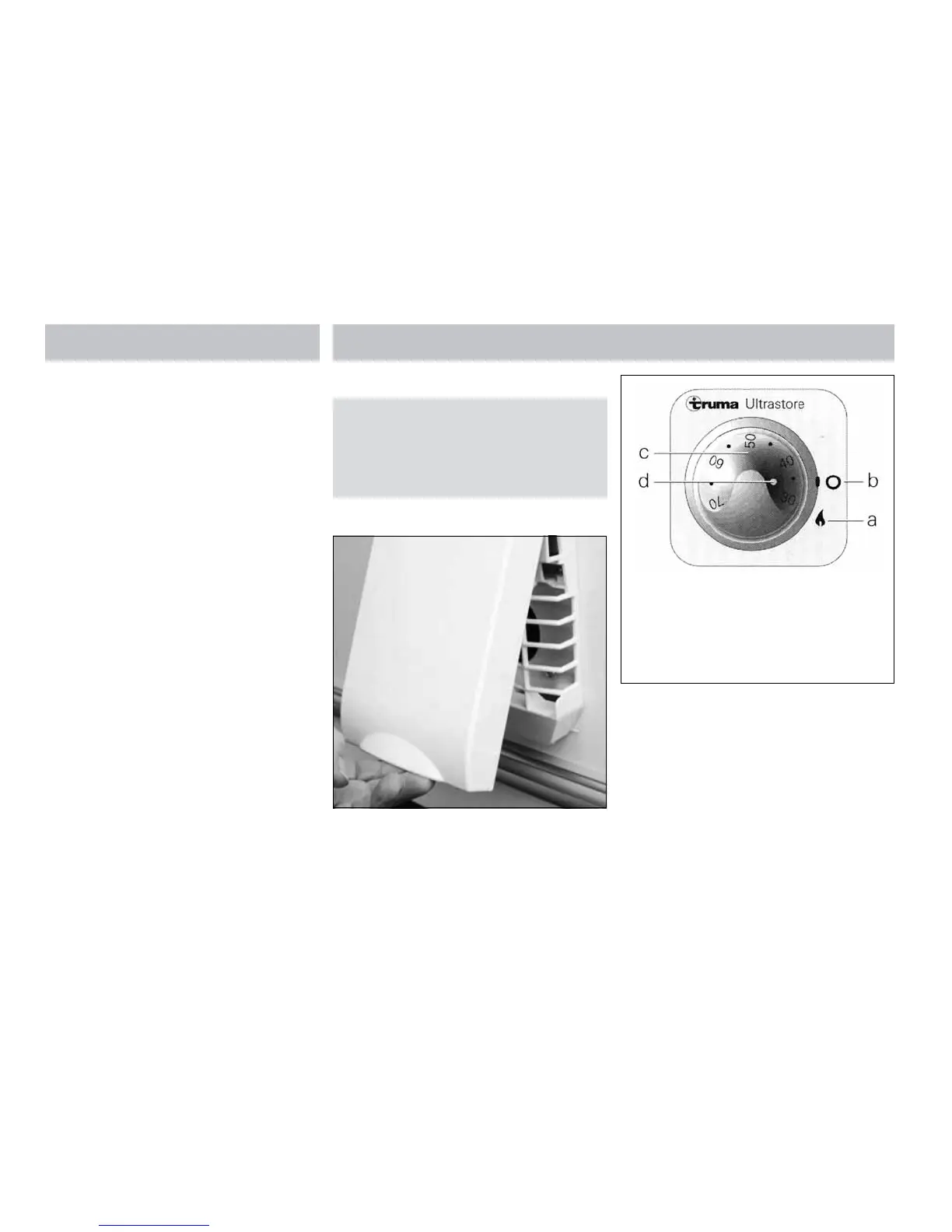
1. Remove cowl cover.
Fig. 2
2. Open gas cylinder and open quick-acting
valve in the gas supply line.
a = Rotary switch ‘On’ ‘Gas operation’
b = Rotary switch ‘Off’
c = Rotary knob for temperature
selection (illuminated by green
lamp ‘Operation’)
d = Red indicator lamp ‘Failure’
3. Switch the water heater on at the rotary
switch (a) of the control panel, and the
green monitor lamp will light up. Set the
desired water temperature at the rotary
knob (c) (steplessly adjustable from about
30°C to 70°C).
4. If there is air in the gas supply line, it may
take up to a minute before the gas is
available for combustion. If the appliance
switches to ‘Failure’ during this period,
switch off the appliance - wait 5 minutes -
and switch on again!





 To Next Page