TAC 2112, Manual Functional Description
7:16 (22), 0-004-7459-3 (GB) 1999-08-01, TAC AB
7.3.12 Reduced daytime operation (optimised stop)
In systems with a reference sensor, the controller can determine
whether a transition to night operation can take place earlier than the
time set. The controller calculates a new transition time on the basis
of the deviation in room temperature.
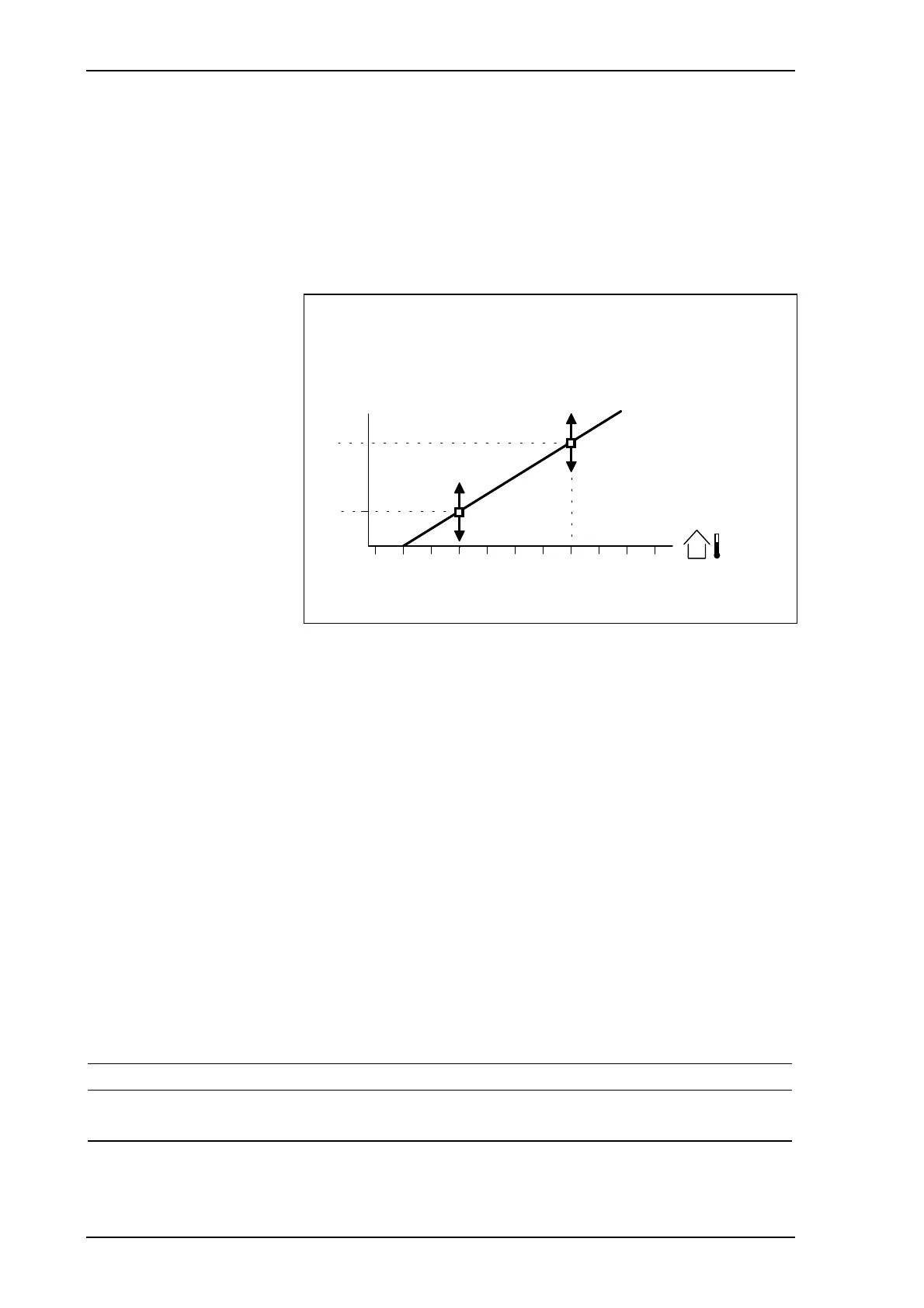
The curve below is used when calculating reduced daytime operation.
10
30
-10 0 5-5 10 15 20-15 25-20-25
P 41
y1
(minutes)
of excess temperature
y0
P 42
ptimisation time per de
ree
Damped
in the room
Curve for reduced daytime operation
The time by which daytime operation is reduced is calculated as:
t = (y-value from curve) • (room temperature + dead zone room - setpoint room)
Example
Setpoint room=20
°
C
Dead zone room=1
°
C
Room temperature=21
°
C
Damped outdoor temperature=10
°
C
The above results in an excess temperature in the room of
21+1–20=2
°
C. The y-value of the curve at +10
°
C is 30 minutes,
which gives an optimisation time of 60 minutes (2 × 30).
The function for reduced daytime operation is blocked when the
equipment is delivered by setting the stop times in the curve to
0 minutes.
Parameters
P No. Parameter Min. Max. Step Default Comments
P 41 Opt. time at –10°C (y0) 0 min. 240 min. 1 min. 0 min.
P 42 Opt. time at +10°C (y1) 0 min. 240 min. 1 min. 0 min.



 To Next Page