
 To Next Page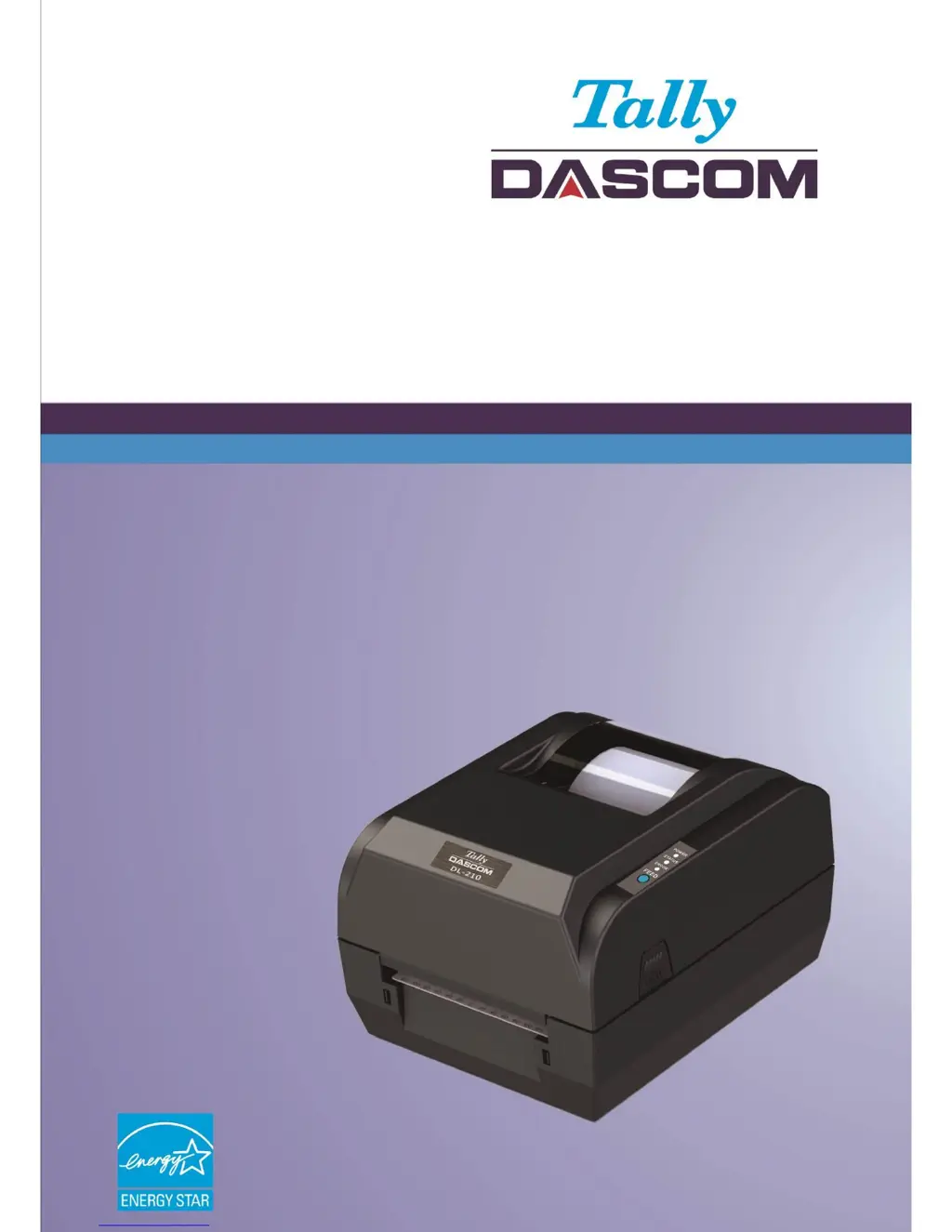

J
Joseph KiddSep 9, 2025
What causes a media jam in the Tally Dascom DL-210?
- JJennifer CastroSep 9, 2025
A media jam in your Tally Dascom Label Maker can occur if a label is stuck. Check the media path and remove any jammed labels.

What causes a media jam in the Tally Dascom DL-210?
A media jam in your Tally Dascom Label Maker can occur if a label is stuck. Check the media path and remove any jammed labels.
What to do if the Error LED blinks and the buzzer alarms on my Tally Dascom Label Maker?
If the Error LED blinks and the buzzer alarms on your Tally Dascom Label Maker, it could be due to the following reasons: * The thermal print head has overheated: turn the printer off and wait a few minutes before resuming. * Over-voltage or Low-voltage: print using the specified voltage.
What to do if no LEDs are on on my Tally Dascom DL-210 Label Maker?
If no LEDs are illuminated on your Tally Dascom Label Maker, consider these potential causes and solutions: * The power cord may be unplugged: check the power cord and plug it in properly. * The printer might be turned off: turn the printer on. * The power source is unavailable: check the cable and adapter, or try another cable and/or adapter. * The device is shut down: check the cable and adapter, or try another cable and/or adapter. * If the PCB is damaged: contact service representatives.
Why does the Tally Dascom DL-210 Label Maker skip labels?
The Tally Dascom Label Maker might skip labels because of a label positioning problem, or the label size setting exceeds the physical size. Execute label calibration. If that doesn't work, verify that the label size setting is correct.
Why does my Tally Dascom Label Maker feed blank labels?
If your Tally Dascom Label Maker is feeding blank labels, it might be because you are printing without a ribbon on transfer thermal paper. Install a ribbon to resolve this.
What does it mean when the Status LED blinks on my Tally Dascom Label Maker?
If the Status LED is blinking on your Tally Dascom Label Maker, it could indicate: * A label remains in the peeler: remove the label. * The ribbon has ended: replace the ribbon.
How to resolve a communications error on a Tally Dascom Label Maker?
If your Tally Dascom Label Maker is experiencing communication errors, start by ensuring the communication cable is securely connected to both the label maker and your device. If the connection is good, verify that you are using the correct communication cable. If the issue persists, the communication cable or connector may be damaged and require replacement.
Why is the LED not working on my Tally Dascom DL-210 Label Maker?
If the LED on your Tally Dascom Label Maker is not working, first check all cable connections and reconnect any that are loose. If the connections are secure, inspect the cable and connector for damage, and replace them if necessary. If the cable and connector are fine, the key or LED indicator itself may be damaged and require replacement.
What does it mean when the Error LED slowly blinks once and then fast blinks three times; buzzer alarms four times on my Tally Dascom DL-210?
When you press the feed button after powering on, and the Error LED slowly blinks once then fast blinks three times, accompanied by four buzzer alarms on your Tally Dascom Label Maker, it indicates a cutter error alarm. This occurs when the cutter function is enabled, but without cutter installation. Disable the cutter in the tool to resolve this.
What does it mean when the Status LED is always on on my Tally Dascom DL-210?
If the Status LED is always on on your Tally Dascom Label Maker, it means that the media end has been reached. Reload the media.
Explains symbols used in the manual to indicate importance and instructions.
Lists associated software and documents for the printer, including manuals.
Highlights key features of the DL-210 printer, including connectivity and options.
Lists available fonts and code pages supported by the printer for character display.
Outlines the supported 1D and 2D barcode types for printing.
Describes media specifications, types, and how the printer handles them.
Details the printer's control panel components like keys and LEDs.
Lists sensors used by the printer for detection, such as black mark and media sensors.
Specifies printer emulation modes supported, like Zebra and Epson.
Specifies the printer's internal memory capacities for SDRAM and FLASH.
Lists the available standard and optional interface types for connecting the printer.
Mentions software required for the printer, such as drivers and Bartender.
Provides physical specifications like dimensions, weight, and operating conditions.
Indicates safety and EMC certifications obtained by the printer.
Lists product certifications such as CCC, CE, FCC, UL, and Energy Star.
Specifies the reliability metric, such as TPH lifetime.
Describes roll media with gaps, holes, notches, or black marks for label separation.
Explains fan-fold media folded in a zigzag pattern for label separation.
Details continuous roll media without separations, used for receipt or ticket printing.
Describes the different interface types supported by the printer, such as USB, Serial, and Ethernet.
Details the components of the printer's control panel and their functions.
Describes the USB interface for connecting the printer to a host.
Covers optional interface types like Serial, Parallel, Ethernet, and Wi-Fi.
Explains the status and behavior of the printer's LED indicators.
Describes how to use the Feed Key for advancing media.
Outlines the sequence of steps for setting up the printer and its components.
Guides on selecting an appropriate location for installing the printer.
Provides step-by-step instructions for calibrating the gap sensor.
Offers instructions for calibrating the reflective sensor.
Details the process of connecting the printer using a USB interface.
Explains how to connect the printer using a serial (RS-232) interface.
Provides instructions for connecting the printer using an Ethernet interface.
Guides on installing the necessary printer driver for operation.
Guides on selecting the printer model and interface within the setup tool.
Explains various configuration items available in the printer setup tool.
Window for configuring network settings, including IP address and MAC address.
Window for configuring Wi-Fi settings like mode, SSID, and encryption.
Lists prerequisites for firmware update, including cables and software.
Details how to connect the printer to the computer for firmware update.
Explains how to print a self-test page to check printer status.
Lists common printer issues, their possible causes, and solutions based on LED indications.
Explains how to reset the printer settings to factory defaults.
Provides instructions for safely removing jammed labels from the printer.
Outlines recommended periodic maintenance for the printer to ensure optimal performance.
Provides pin assignments and connector diagrams for the USB interface.
Specifies the standards supported by the Wi-Fi interface.
Details the pin assignments for the Ethernet interface.
Shows the connector diagram for the Ethernet interface.
Shows the common character configuration table for the USA international character set.
Details ESC/POS command sets for print control, position, and miscellaneous functions.
Commands for handling bit images and downloading graphics.
Guides on how to remove the tear bar from the printer.
 General
| Type | Label Maker |
|---|---|
| Print Method | Thermal Transfer / Direct Thermal |
| Print Resolution | 203 dpi |
| Connectivity | USB |
| Supported Label Materials | Fan-fold |