This tool
is
not cheap and is just as important as the
test tapes. Without a good reference meter, you can do
very
little in the way of accurate adjustment. Spend as
much as you can here. It's worth it. Next. . . .
3)
Signal Generator or Oscillator.
Here you get a break. A simple oscillator will do
al1 the
work and won't send you to the poor house. There are
severa1 on the market for less than $100. lf you get one
with a meter on it, you won't
have
19
calibrate
its
output with the big meter as often. TI
,
device is very
useful in a studio for troubleshooting a good
invest-
ment. It should have at least the following frequencies.
Sine wave is al1 that is required, at a distortion of no
more than
.5%.
Most modern units do better than this
easily. This unit is the workhorse on the equipment
list. Whether you are reading the big meter (FETI or
the meters on the recorder. you will need a signal to
read, this instrument or the
test
tapes will provide you
with signals.
Test tapes, tone generator, VTVM or FET meter
.
. .
This is the basic package and will do almost every
adjustment in the sequence
-
except the first one .
.
.
4)
The Oscilloscope.
Even a simple one
is
not cheap. Fortunately, a simple
one
is al1 you need. You can spend $6,000 and more
for the big ones, but for this purpose $100
-
$200 will
be more than enough.
It must have a "vertical" and a
"horizontal" amplifier and an X-Y mode. That's
al1
you use to do the one adjustment you need
it
for.
Tilt, height and tangency adjustments on the 80-8
are
virtually unnecessary. The precision head block mount-
ing plate practically guarantees long term accuracy in
these areas. Only major
physical force will disturb the
relationship of the head block to the tape path. As long
as you don't drop the recorder
"facedown"or strikethe
head
assembly with a hammer al1 should be well. A
small azimuth adjustment (I0.5degrees)
is
provided for
fine tuning. This adjustment
is
accomplished by apply-
ing screw thread pressure to a slot in the base of the
head itself. (See Fig. 21, pg
10.)
Assuming that the motors are not in need of attention
(that's for Dealer Service), Azimuth, or head alignment
is
the number one step in maintenance.
.
. . so let's
begin.
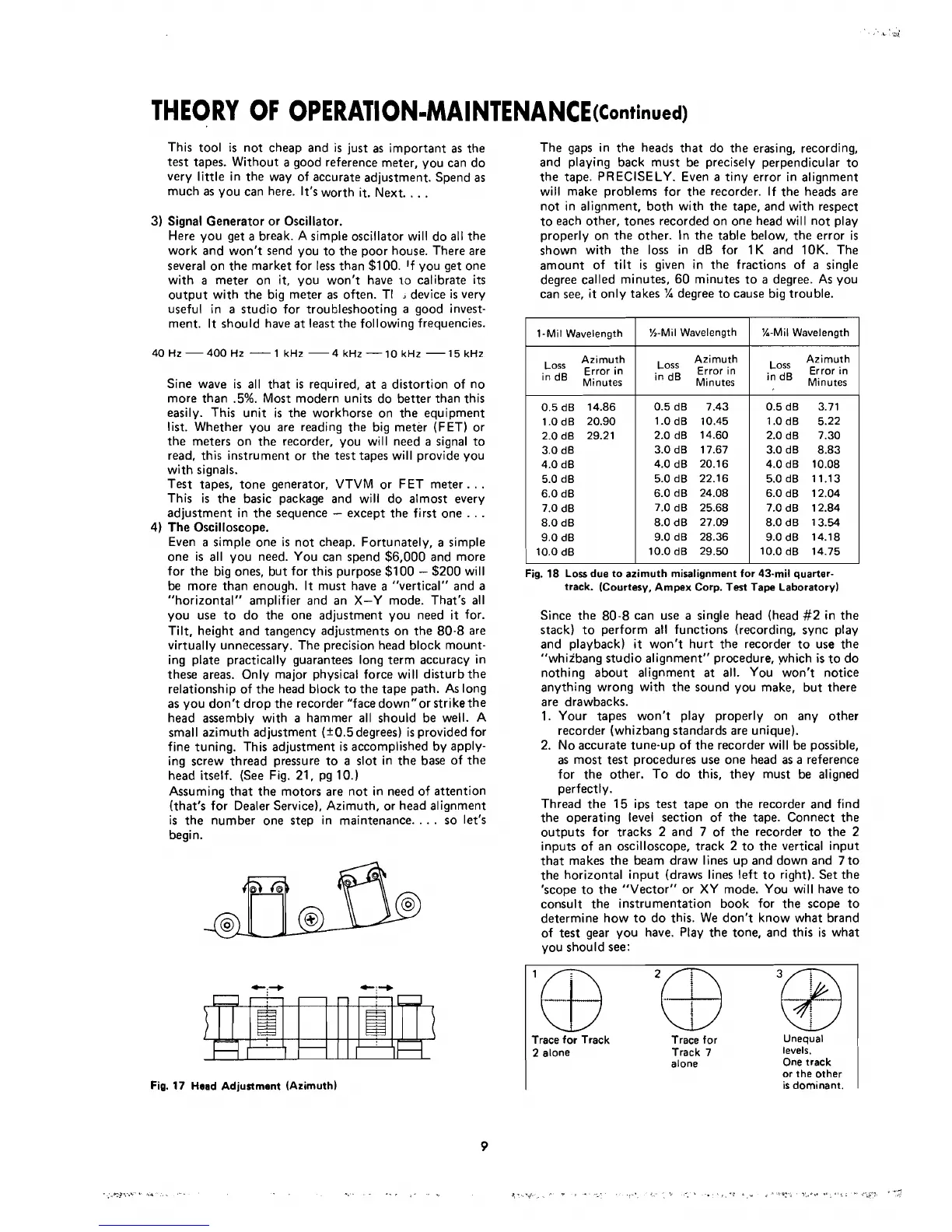
Fig.
17
Haad Adjurtment (Azimuth)
The gaps in the heads that do the erasing, recording,
and playing back must be precisely perpendicular to
the tape. PRECISELY. Even a tiny error in alignment
will
rnake problems for the recorder. If the heads are
not in alignment, both with the tape, and with respect
to each other, tones
recorded on one head will not play
properly on the other. In the table below, the error
is
shown with the loss in dB for 1K and 10K. The
amount of tilt
is
given in the fractions of a single
degree
called minutes, 60 minutes to a degree. As you
can see,
it
only takes
'/4
degree to cause big trouble.
Fig.
18
Loss due to azimuth misalignment for 43-mi1 quarter-
track. (Courtesy, Ampex Corp. Test Tape Laboratory)
Since the 80-8 can use a single head (head #2 in the
stack) to perform al1 functions (recording, sync play
and
playback)
it
won't hurt the recorder to use the
"whiibang studio alignment" procedure, which is to do
nothing about alignment at
all. You won't notice
anything wrong with the sound you make, but there
are drawbacks.
1. Your tapes won't play properly on any other
recorder
(whizbang standards are unique).
2. No accurate tune-up of the recorder will be possible,
as most test procedures use one head as a reference
for the other. To do this, they must be aligned
perfectly.
Thread the 15 ips test tape on the recorder and find
the operating
level section
of the tape. Connect the
outputs for tracks 2 and
7
of the recorder to the 2
inputs of an oscilloscope, track 2 to the vertical input
that makes the beam draw lines up and down and
7
to
the horizontal input (draws lines left to right). Set the
'scope to the "Vector" or XY mode. You will have to
consult the instrumentation book for the scope to
determine how to do this. We don't know what brand
of test gear you
have. Play the tone, and this is what
you should see:
%-Mi1 Wavelength
LOSS
Azimuth
Error in
in
dB
Minutes
0.5 dB 3.71
1
.O dB 5.22
2.0
dB 7.30
3.0
dB 8.83
4.0
dB 10.08
5.0dB
11.13
6.0
dB 12.04
7.0
dB 12.84
8.0
dB 13.54
9.0
dB 14.18
10.0
dB 14.75
l-Mil Wavelength
Loss
Azimuth
Error in
in
dB
Minutes
0.5 dB 14.86
1.0 dB 20.90
2.0
dB 29.21
3.0
dB
4.0 dB
5.0 dB
6.0 dB
7.0 dB
8.0 dB
9.0 dB
10.0 dB
2
alone
%-Mi1 Wavelength
Loss
Azimuth
Error in
in
dB
Minutes
0.5 dB 7.43
1.0 dB 10.45
2.0
dB 14.60
3.0
dB 17.67
4.0
dB 20.16
5.0
dB 22.16
6.0
dB 24.08
7.0
dB 25.68
8.0
dB 27.09
9.0
dB 28.36
10.0
dB 29.50
Track
7
levels.
alone One track
or the other
is dominant.



 To Next Page