P
HOW THE
DX-8
WORKS-THEORY
L$
i
k.
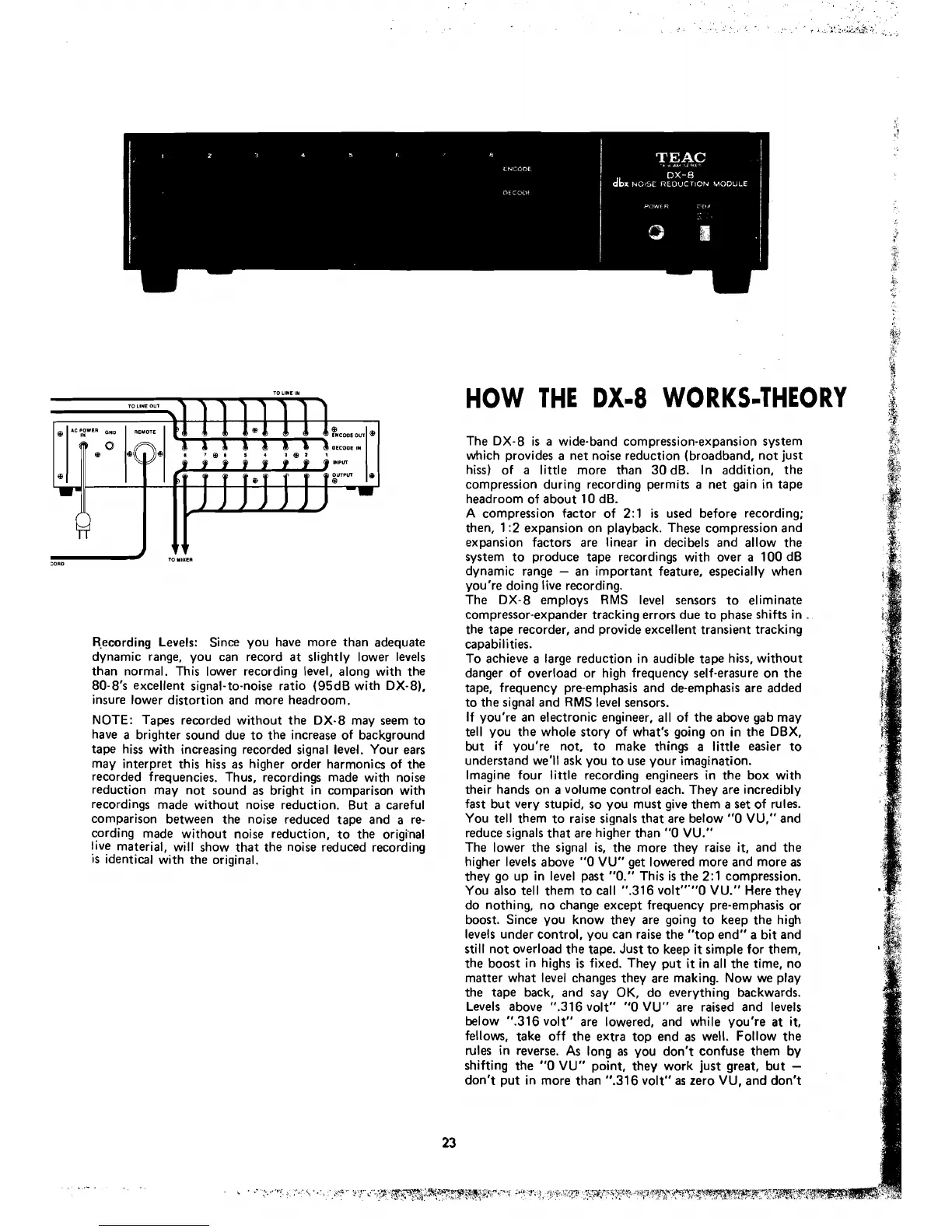
The
DX-8
is
a wide-band compression-expansion system
$3
which provides a net noise reduction (broadband, not just
.&t,
hiss) of a little more than 30dB. In addition, the
compression during recording permits a net gain in tape
headroom of about 10
dB.
A
compression factor of 2:l
is
used before recording;
then, 1
:2 expansion on playback. These compression and
expansion factors are linear in
decibels and allow the
system to produce tape recordings with over a 100 dB
dynamic range
-
an important feature, especially when
you're doing
live recording.
The
DX-8
employs RMS level sensors to eliminate
compressor-expander tracking
errors due to phase shifts in
.
the tape recorder, and provide excellent transient tracking
R.ecording Levels: Since you have more than adequate capabilities.
dynamic range, you can record
at
slightly lower levels
To achieve
a
large reduction in audible tape hiss, without
than normal. This lower recording
level, along with the
danger of overload or high frequency
self-erasure on the
80-8's excellent signal-to-noise ratio
(95dB with
DX-8).
tape, frequency pre-emphasis and de-emphasis are added
insure lower distortion and more headroom.
to the signal and RMS
level sensors.
NOTE:
Tapes recorded without the
DX-8
may seern to
If you're an electronic engineer, al1 of the above gab rnay
have
a
brighter sound due to the increase of background
tell you the whole story of what's going on in the
DBX,
tape hiss with increasing recorded signal level. Your ears
kt
if
~ou're not. t0 make things a little easier t0
may interpret this hiss as higher
arder
harmonics of the
understand we'll ask you to use your imagination.
Imagine four little recording engineers in the box with
recorded frequencies. Thus, recordings made with noise
reduction may not sound
as
bright in comparison with
their hands on a volume
contro1 each. They are incredibly
recordings made without
noise reduction. But
a
careful
fast but very stupid, so you must give them a
set
of rules.
comparison between the noise reduced tape and
a
re-
You tell thern to raise signals that are below
"O
VU,"
and
cording made without
noise reduction, to the original
reduce signals that are higher than
"O
VU."
live material, will show that the noise reduced recording
The lower the signal
is,
the more they raise
it,
and the
is
identica1 with the original.
higher
levels above
"O
VU"
get lowered more and more as
they go up in
level past "0." This
is
the 2:l compression.
You also tell them to call ".316 volt""'0
VU."
Here they
do nothing, no change except frequency pre-emphasis or
boost.
Since you know they are going to keep the high
levels under
control, you can raise the "top end" a bit and
still
not overload the tape. Just to keep
it
sirnple for thern,
the boost in highs
is
fixed. They put
it
in al1 the time, no
matter what
level changes they are making. Now we play
the tape back, and say OK, do everything backwards.
Levels above ".316 volt"
"O
VU"
are raised and levels
below ".316 volt" are lowered, and while you're at
it,
fellows, take off the extra top end as well. Follow the
rules in reverse. As long as you don't confuse thern by
shifting the
"O
VU"
point, they work just great, but
-
don't put in more than ".316 volt" as zero
VU,
and don't
23
,
,
.'
..'.'l,
:.
'
,..;
.
.
,+-i,-
.
:+'::-<:;'
.<
."!%W
:i.-
-?:J-"':
'%is'ic-~;~~~.@-,--y
:::*i..
..,..i
-
4'
:>.i-?:
.
;
yfs.:lip
ir+;7.~~+L%~7y~~k~~<p;
.
,
,..



 To Next Page