If it is not possible to obtain
a
tape that has both the
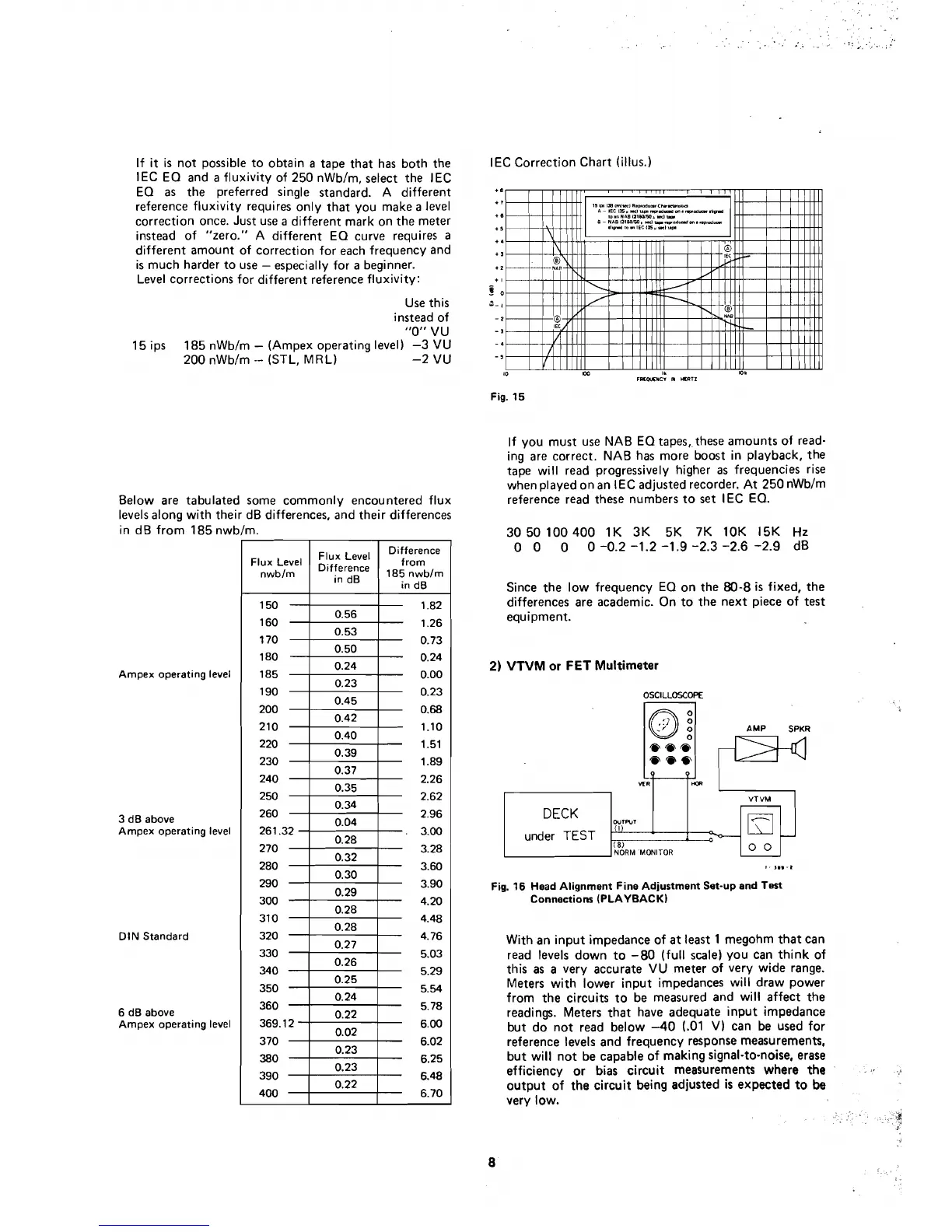
IEC Correction Chart
(illus.)
IEC EQ and a fluxivity of 250 nWb/m, select the IEC
EQ as the preferred single standard. A different
reference fluxivity requires only that you make a level
correction once. Just use a different mark on the meter
instead of "zero." A different EQ curve requires a
different amount of correction for each frequency and
is much harder to use
-
especially for a beginner.
Level corrections for different reference fluxivity:
Use this
instead of
"O"
VU
15 ips
185
nWb/m
-
(Ampex operating level)
-3
VU
200 nWb/m
--
(STL, M RL)
-2
VU
Below are tabulated some commonly encountered flux
levels along with their
dB differences, and their differences
in
dB from 185 nwb/m.
Ampex operating level
3
dB above
Ampex operating level
DIN
Standard
6
dB above
Ampex operating level
+a
+
7
+e
+l
+
4
+
3
t2
+I
0
o
5-,
-2
-
3
-
4
-5
O
m
FROXmCI
IN
URIZ
Fig.
15
If you must use NAB EQ tapes, these amounts of read-
ing are correct. NAB has more boost in playback, the
tape will read progressively higher as frequencies rise
when played on an IEC
adjusted recorder. At 250 nWb/m
reference read these numbers to set IEC EQ.
Since the low frequency EQ on the 80-8
is
fixed, the
differences are academic. On to the next
piece of test
equipment.
2)
VTVM or FET Multimeter
Fig.
16
Head Alignment Fine Adjustment Set-up and
Test
Connections (PLAYBACK)
DECK
under
TEST
With an input impedance of at least
1
megohm that can
read levels down to -80 (full scale) you can think of
this as a very accurate VU rneter of very wide range.
Meters with lower input impedances will draw power
from the circuits to be measured and will affect the
readings. Meters that
have adequate input impedance
but do not
read below -40 (.O1 V) can
be
used for
reference levels
and frequency response measurements,
but will not be capable of making
signal-to-noise, erase
efficiency or bias circuit measurements where the
output of the circuit being
adjusted is expected to
be
very low.
,I
J
WTIUT
((i:
,o
1
NORM
MONITOR
o o



 To Next Page