THEORY
OF
OPERATION-MAINTENANCE(C~~~~~~~~)
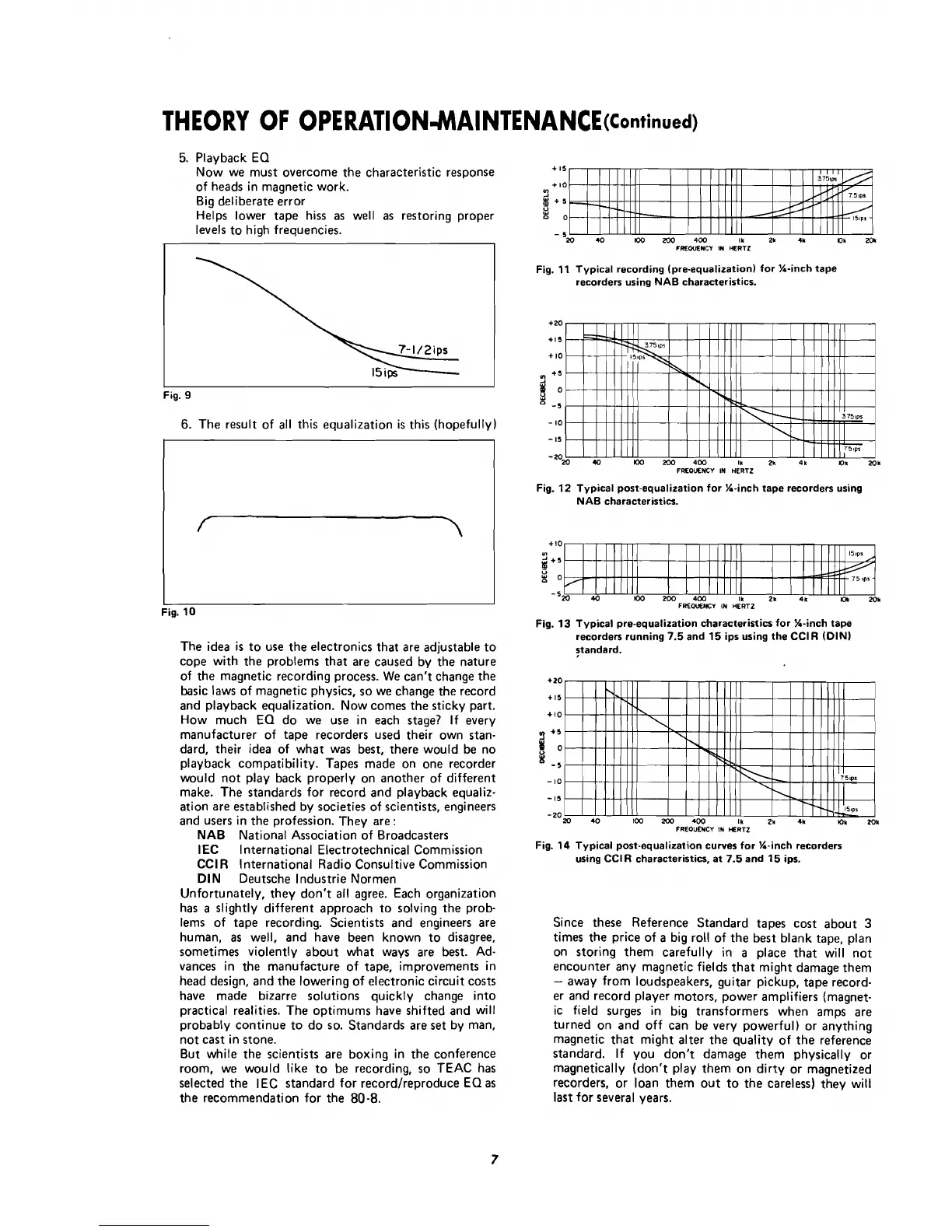
5.
Playback EQ
Now we must overcome the characteristic response
of heads in magnetic work.
Big deliberate error
Helps lower tape hiss
as
well
as
restoring proper
levels to high frequencies.
Fig.
9
6.
The result of al1 this equalization is this (hopefully)
Fig. 10
The idea
is
to use the electronics that are adjustable to
cope with the problems that are caused by the nature
of the magnetic recording process. We can't change the
basic laws of magnetic physics, so we change the record
and playback equalization. Now comes the sticky part.
How much EQ do we use in each stage?
If every
manufacturer of tape recorders used their own stan-
dard, their idea of what was best, there would be no
playback compatibility. Tapes made on one recorder
would not play back properly on another of different
make. The standards for record and playback equaliz-
ation are established by societies of scientists, engineers
and users in the profession. They are:
NAB
National Association of Broadcasters
IEC International Electrotechnical Commission
CCIR International Radio Consultive Commission
DIN
Deutsche Industrie Normen
Unfortunately, they don't
al1
agree. Each organization
has
a
slightly different approach to solving the prob-
lems of tape recording. Scientists and engineers are
human,
as
well, and have been known to disagree,
sometimes violently about what ways are best. Ad-
vances in the manufacture of tape, improvements in
head design, and the lowering of electronic circuit costs
have made bizarre solutions quickly change into
practical realities. The optimums
have shifted and will
probably continue to do so. Standards are set by man,
not cast in
stone.
But while the scientists are boxing in the conference
room, we would like to be recording, so TEAC has
selected the I EC standard for
recordlreproduce EQ
as
the recommendation for the
80-8.
+
1s
+
10
V)
i
+s
I,
-
s
20
40
100
Zoo
400 Ih 2h 4h Oh 2-
FRfOUENCY IN HERTZ
Fig. 11 Typical recording (pre-equalization) for %-inch tape
recorders using NAB characteristics.
FREOVENCY IN HERTZ
Fig. 12 Typical post-equalization for %-inch tape recorden using
NAB
characteristics.
100
200
400
Ih 2h 4k
FREOUEWCY
IN
HERTZ
Fig.
13
Typical pre-equalization characteristia for %-inch tape
recorders running 7.5 and 15 ips using the CCIR
(DIN)
!tandard.
Fig. 14 Typical post-equalization curves for %-inch recorders
using
CC1
R
characteristia, at 7.5 and 15 ips.
Since these Reference Standard tapes cost about
3
times the price of
a
big roll of the best blank tape, plan
on storing them carefully in
a
place that will not
encounter any magnetic fields that might damage them
-
away from loudspeakers, guitar pickup, tape record-
er and record player motors, power amplifiers (magnet-
ic field surges in big transformers when amps are
turned on and off
can be very powerful) or anything
magnetic that might alter the quality of the reference
standard.
If you don't damage them physically or
magnetically (don't play them on dirty or magnetized
recorders, or loan them out to the
carelessl they will
last
for severa1 years.



 To Next Page