Need help?
Do you have a question about the Televic D-CERNO and is the answer not in the manual?
Legal notice regarding the reproduction and use of the publication's content.
Information about trademarks mentioned in the manual and Televic Conference NV's position.
Details on the D-Cerno Wired Conference system's compliance with various industry standards.
General safety guidelines and precautions to ensure safe operation and prevent hazards.
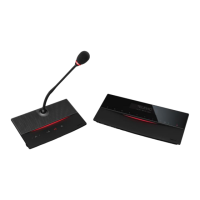
Lists and briefly describes the main hardware components that make up the D-Cerno system.
Explains how the D-Cerno units can be connected in different network configurations like branch or loop.
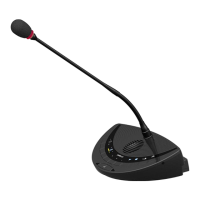
Details the features, controls, indicators, installation, and maintenance of delegate and chairman units.
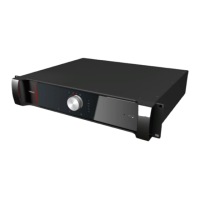
Describes the central control unit, its introduction, controls, indicators, and external connections.
Technical specifications for the power supply unit used with the D-Cerno system.
Information on the type of shielded cables required for connecting system components.
Explains how to navigate through the system's menu structure using the control buttons.
Provides a high-level overview of the menu structure for quick reference during configuration.
Introduces the main menu interface and its primary functions for system operation.
Details how to adjust the loudspeaker volume for delegate and chairman units.
Describes various conference modes like Direct Access, Push to Talk, Override, and Request.
Explains the Voice Activated (VOX) settings, including Pencil Drop and Sensitivity adjustments.
Covers the different microphone sensitivity presets and their effect on distance and output level.
Specifies the maximum number of open microphones that can be active simultaneously.
Describes the ECO function for power saving when no sound is detected for a period.
Outlines options for factory settings reset and viewing system information.
Details how to adjust the headphone volume on the central unit.
Explains the chime function, which can be enabled or disabled for chairman actions.
Covers settings for external audio processing, including auxiliary inputs/outputs and remote conferencing.
Describes the two auxiliary RCA output connectors and their adjustment capabilities.
Details the two auxiliary line input connectors (RCA and XLR) and their overload indication.
Explains how to extend the system capacity using multiple central units in a master-slave setup.
Introduction to accessing and using the web-browser interface for system control and monitoring.
Step-by-step guide on setting up TCP/IP on a PC or MAC to connect to the D-Cerno CU-R webserver.
Instructions on how to adjust volume settings directly from the web-browser interface.
Details on using the built-in recording functionality, including USB storage and browser controls.
Describes configuration settings accessible via both the central unit and the web-browser.
A table listing the default values for various system settings and parameters.
A detailed guide on how to perform firmware updates for the D-Cerno system components.
Explanation of the UDP packet format used for camera control and communication with delegate units.
Information on the two startup triggers (On/Off button vs. power supply) for the D-Cerno CUR.
Comprehensive technical specifications for electrical, acoustical, mechanical, environmental, and system limits.
Specifies file system, USB type, and device type requirements for USB storage devices.
 General
| Microphone Type | Electret condenser |
|---|---|
| THD | < 0.1 % |
| S/N | > 70 dB |
| Headphone Output | 3.5 mm jack |
| Signal-to-Noise Ratio | > 70 dB |
| Operating Voltage | 48 V DC |
| Frequency Response | 100 Hz - 16 kHz |
| Headphone Impedance | 32 Ω |
| Loudspeaker | Built-in |
| Connection Type | Wired |
| Storage Temperature | -20 °C to 60 °C |

 To Next Page