eZ-FET Debug
Probe
Isolation
Jumper Block
Spy-Bi-Wire (SBW)
Emulation
Application UART
3.3-V Power
5-V Power
Target
MSP430FR2355
eZ-FETMSP430 Target
USB Connector
in out
LDO
BoosterPack Header
BoosterPack Header
USB
EnergyTrace
Technology
Hardware
www.ti.com
10
SLAU680–May 2018
Submit Documentation Feedback
Copyright © 2018, Texas Instruments Incorporated
MSP430FR2355 LaunchPad™ Development Kit (MSP
‑
EXP430FR2355)
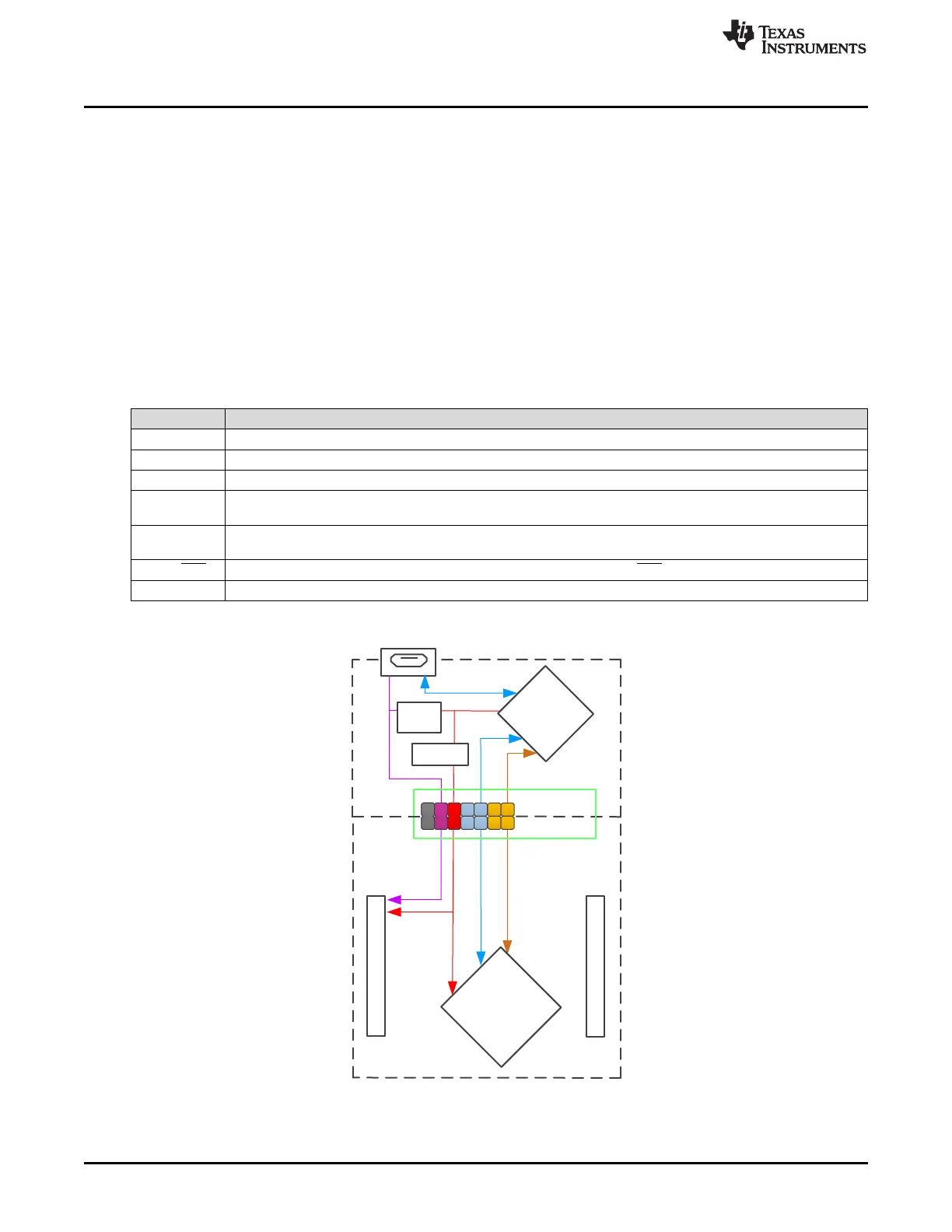
2.2.3 Debug Probe Connection: Isolation Jumper Block
The isolation jumper block at jumper J101 allows the user to connect or disconnect signals that cross from
the eZ-FET domain into the MSP430FR2355 target domain. This includes eZ-FET Spy-Bi-Wire signals,
application UART signals, and 3.3-V and 5-V power.
Reasons to open these connections:
• To remove any and all influence from the eZ-FET debug probe for high accuracy target power
measurements
• To control 3-V and 5-V power flow between the eZ-FET and target domains
• To expose the target MCU pins for other use than onboard debugging and application UART
communication
• To expose the programming and UART interface of the eZ-FET so that it can be used for devices other
than the onboard MCU.
Table 2. Isolation Block Connections
Jumper Description
GND Ground
5V 5-V VBUS from USB
3V3 3.3-V rail, derived from VBUS in the eZ-FET domain
RXD <<
Backchannel UART: The target FR2355 receives data through this signal. The arrows indicate the direction of the
signal.
TXD >>
Backchannel UART: The target FR2355 sends data through this signal. The arrows indicate the direction of the
signal.
SBW RST Spy-Bi-Wire debug: SBWTDIO data signal. This pin also functions as the RST signal (active low).
SBW TST Spy-Bi-Wire debug: SBWTCK clock signal. This pin also functions as the TST signal.
Figure 6. eZ-FET Isolation Jumper Block Diagram



 To Next Page