Chapter 2
Bridged Ethernet
E-DOC-CTC-20051017-0167 v1.0
12
Local Network TCP/IP
configuration
Two TCP/IP scenarios are used for Bridged Ethernet implementations:
1 The Service Provider requires the use of DHCP for local node(s).
Local DHCP clients receive their IP configuration from a remote DHCP server
across the DSL line.
2 The Service Provider provides static public IP addresses to be configured on
the local node(s) to globally uniquely identify the local end.
In both cases, alternatively, an additional private IP address can be manually
configured (per local node) to allow Local Networking communication.
Using Bridged Ethernet Using Bridged Ethernet is rather straightforward:
1 Make sure that the SpeedTouch™ is turned on first.
2 Turn on the computer(s).
3 Make sure that the Ethernet interface of the host computer is properly
configured.
4 Start a web browser.
You are now on the Internet or you have Corporate Intranet access.
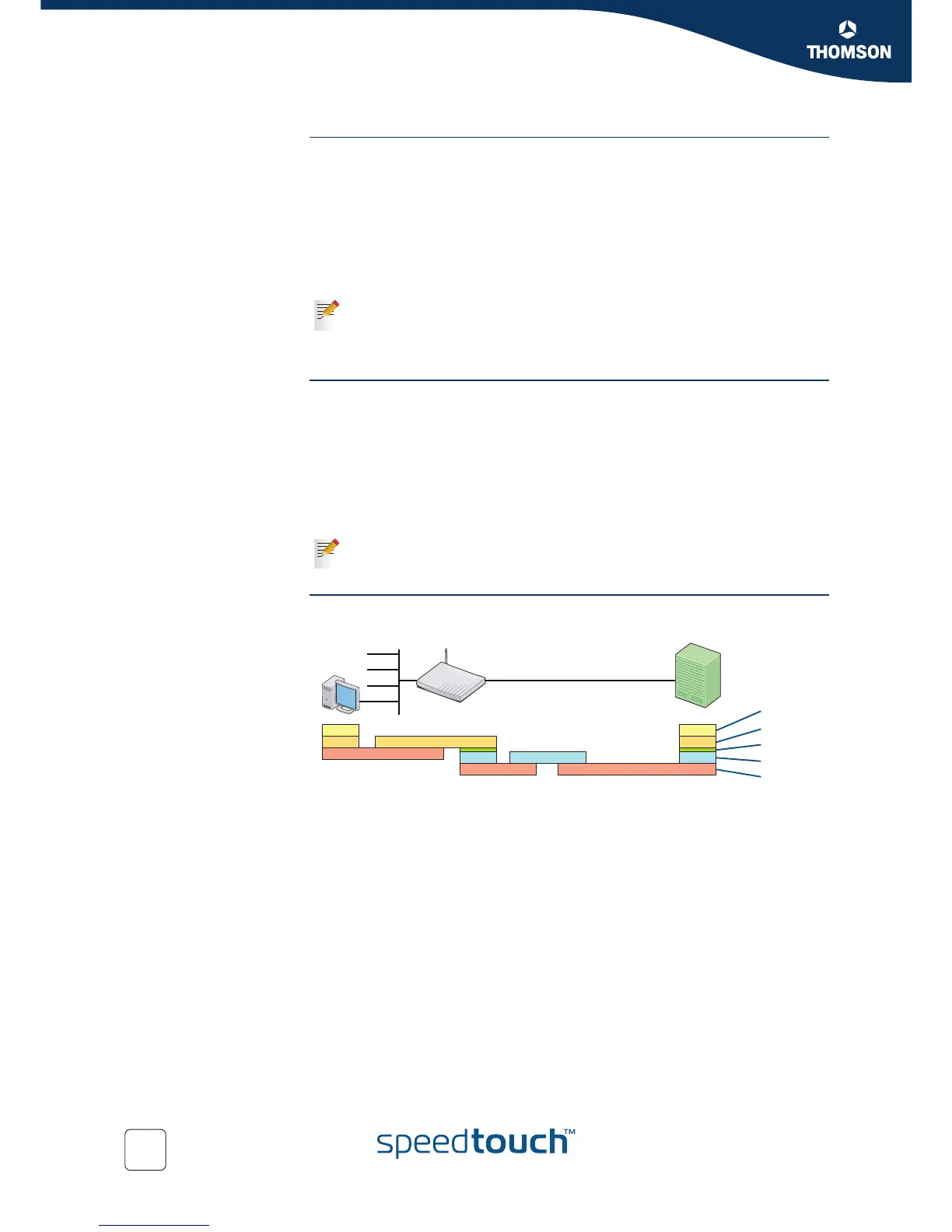
Protocol stack The figure below shows the Bridged Ethernet protocol stack.
If the first scenario is used, the SpeedTouch™ DHCP server must be
disabled to avoid two DHCP servers (i.e. the SpeedTouch™ DHCP server
and the remote DHCP server) being active towards the local node(s) at the
same time.
Although the access method of the bridge is Always–On, the remote
organization might ask for a user name and password.
ip
mac
eth
adsl
CPE DSLAMPC
Service
Gateway
RFC1483b
AAL5/ATM
PHY
IP
mac






 To Next Page