3-1
3 PREPARATION
Refer to information pack supplied with the
Motorhome prior to using or driving the unit. Read,
understand and follow instructions in the chassis,
motorhome, appliance and system manuals. Also
follow the safety tips provided in Section 2.
Motorhomes can be used many ways and in many
conditions or circumstances. We have tried to com-
pile operational and safety instructions to cover the
normal conditions encountered with the unit. How-
ever these instructions are not all-inclusive. Each
user or operator has the responsibility to use common
sense around the unit and to consult a dealer if you
have any questions.
3.1 VEHICLE PREPARATION
The (NCC) Net Carrying Capacity, is the maximum
weight of all occupants including the driver, personal
belongings, food, fresh water, LP Gas, Tools, Dealer
Installed Accessories, etc., that can be carried by this
motorhome. (NCC is equal to or less than the GVWR
minus UVW).
The (GCWR) Gross Combination Weight Rating, is the
value specified by the Chassis manufacturer as the
maximum allowable loaded weight of this motorhome
with its towed trailer or towed vehicle.
To check that your motorhome is properly loaded,
drive the fully loaded vehicle to a scale and weigh as
follows:
a. Drive only the front wheels onto the scale to
obtain the front gross axle weight.
b. Next, place the entire vehicle (both axles)
onto the scale to obtain the gross vehicle
weight.
c. Drive forward till only the rear wheels are on
the scale and obtain the rear gross axle
weight.
Compare the gross vehicle weight with the GVWR on
the sticker. If the gross vehicle weight exceeds the
GVWR, you will have to reduce the total vehicle load.
If the gross vehicle weight is less than the GVWR on
the sticker, check the front and rear gross axle
weights against the front and rear GAWR's on the
sticker. If either axle weight exceeds the GAWR for
that axle, redistribute the load to ensure that loads on
front and rear axles are within the required limit.
Heavier items should be loaded as centrally and as
low as possible. Lighter items may be stored in
cabinets, closets and drawers. Luggage or similar
cargo inside your RV should be secured to prevent it
from causing damage.
Take note of this label in all exterior storage compart-
ments.
3.1.1 KEYS
Several number coded keys are supplied with the
vehicle and include ignition, side door, baggage com-
partment, generator compartment and others de-
pending upon the features of your unit. Always keep
a list of these numbers in a safe place (not in the
vehicle) for easy reference should you misplace any
of the key(s). Supplying a locksmith with these
numbers will allow them to cut a key to fit your lock.
3.1.2 VEHICLE LOADING
The components of your vehicle are designed to
provide satisfactory service if the vehicle is not loaded
in excess of either the gross vehicle weight rating
(GVWR) or the maximum front and rear gross axle
weight ratings (GAWR's). These ratings are listed on
the Canada or U.S. Department of Transport Sticker
located on the driver door post.
The (GVWR) Gross Vehicle Weight Rating, is the
maximum permissible weight of the motorhome. The
GVWR is equal to or greater than the sum of the
unloaded vehicle weight plus the net carrying capac-
ity.
The (UVW) Unloaded Vehicle Weight is the weight of
the motorhome as built at the factory. It includes full
fuel, engine oil and coolants. The UVW does not
include cargo, fresh water, LP Gas, Occupants, or
dealer installed options.
CAUTION
Do not overload Baggage Compartments
Total Vehicle Load Not to Exceed The
Maximum GVWR/GAWR/GCWR Of The
Chassis.
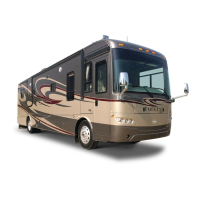
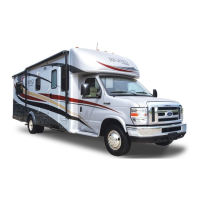
CLASS C & B
+
MOTORHOME



 To Next Page