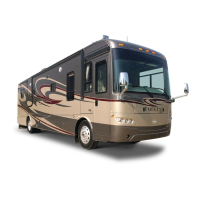
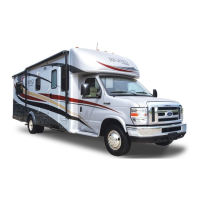
CLASS B
+
& C MOTORHOME
18
2.2 DRIVING SAFETY
1. Only trained and licensed drivers are allowed to drive this vehicle.
2. Observe all applicable road and driving regulations. Check with local transport authorities if you have any questions.
3. Inspect the vehicle before driving. Adjust, repair or replace components or systems to maintain vehicle in good driving
condition. Do not drive the motorhome unless it is in good condition.
4. Do not make adjustments such as seat position, tilt steering wheel etc. while driving.
5. A motorhome is considerably larger and heavier than an automobile and results in dierent handling characteristics.
Allow more space for stopping, turning, passing, parking, accelerating etc. during operation. The extra height results in
dierent stability characteristics. Drive at a slower speed when turning, cornering or on rough terrain. Use extra care
in adverse conditions such as rain, darkness, snow, sleet, icy surface, hilly terrain, rough roads or soft surfaces. When
towing a vehicle or trailer allow for extra starting and stopping time. See Section 3.1.3 for vehicle or trailer towing.
6. Maintain brakes in top condition at all times. Allow extra distance for stopping. Be extra vigilant in adverse surface
conditions such as wet, icy, slushy, rough or a soft surface when applying the brakes. After going through water, slush
or snow, apply the brakes carefully in an open area to check if one side grabs. Use gentle pedal pressure to dry the
brakes and restore uniform operation. Do not operate vehicle if uneven brake action persists.
2.3 FUEL
(MOTOR AND LP GAS)
1. Do not smoke when lling vehicle fuel tank, generator fuel tank or LP gas tank.
2. Extinguish all pilot lights before refuelling.
3. Do not ll the LP gas tank when the generator is running.
4. Do not bring or store fuel or LP gas containers, gasoline or other ammable liquids in the vehicle. Vapours can be released
causing breathing diculties or an explosion or re. LP gas containers vent excess pressure into the atmosphere.
5. Do not ll LP gas containers more than 80% of capacity. Overlling can lead to excessive venting or gas ow and result
in an explosion or re.
6. Do not use an open ame to check for an LP gas leak. Use soapy water and watch for the bubbles. Close valve on tank
and latch all covers, caps and doors after lling system.
7. Do not connect natural gas to the LP system.
8. Install LP gas regulators with the pressure regulator vent facing downward. Do not obstruct vent hole. In cold weather,
condensation can get into the regulator and cause freeze-up. Use a light bulb to thaw out. Do not use an open ame
or heat lamp to thaw out.
9. Turn igniter knob to create a spark at the burner when burner is turned on. Large volumes of gas can lead to an explosion
and re if igniter is not turned when the burner is turned on. Turn burner o and let gas dissipate before trying to relight
if it does not light immediately.
10. Do not use the furnace when the vehicle is moving. Turn the gas o at the LP container.
11. Do not obstruct LP gas compartment when parking to provide access to master valve to gas system. Open access allows
emergency workers to close master valve if an emergency occurs.



 To Next Page