CLASS B
+
& C MOTORHOME
55
9 HOME USE
The motorhome is designed to be your home on wheels while traveling in comfort. This section will cover items that must
be done or considered in order to obtain the maximum satisfaction from your unit.
9.1 PARKING
1. Parking
The motorhome requires more stopping distance and parking space than an automobile. Always remember that the
unit is longer, wider, higher and heavier than a car and more room and clearance must be provided.
2. Backing Up:
a. Mirrors:
Large mirrors are mounted on both sides of the cab to provide rearward visibility for the drivers. However, they do
not provide visibility directly behind or on top (clearance) of the unit.
b. Spotters:
The best results are obtained when another person helps guide the driver in backing the unit into position. The
driver and spotter should agree to the meaning of hand signals before starting the backing process. The spotter
should always be in a position that is visible to the driver while backing.
3. Always set the parking brake and place chocks in front of and behind the wheels to prevent the unit from rolling.
9.2 MOTORHOME LEVELLING
Your motorhome must be level for some appliances to function properly.
IMPORTANT
When parking your motorhome on a uneven site, always park with the front of your motorhome facing downhill. This allows you
to raise the front of your motorhome in order to level it. When you place your transmission lever in PARK, this locks only the rear
wheels. If you raise the rear wheels with levelling jacks your vehicle could roll o the jacks or cause undue pressure on the jacks.
1. Inspect the area where the motorhome will be parked. Select if possible an area that has a rm prepared surface. Most
campgrounds provide this type of parking area for motorhomes.
2. Select an area that is level or as near to level as possible.
3. Use a carpenters level on the oor to determine where to place blocks to level the frame.
4. Level from side to side rst. Place planks under the low side and drive the motorhome forward until the tires are resting
on the planks. Check that the frame is level from side-to-side. Add or remove blocking as required to level the frame.
5. Place chocks in front of and behind the tires to prevent motorhome movement.
6. Check that the frame is not twisted by checking that all doors, drawers, etc. open and close easily. Adjust blocking to
eliminate twisting.
7. Attach and connect all utilities as appropriate.
8. Reverse the above procedure when preparing to leave.
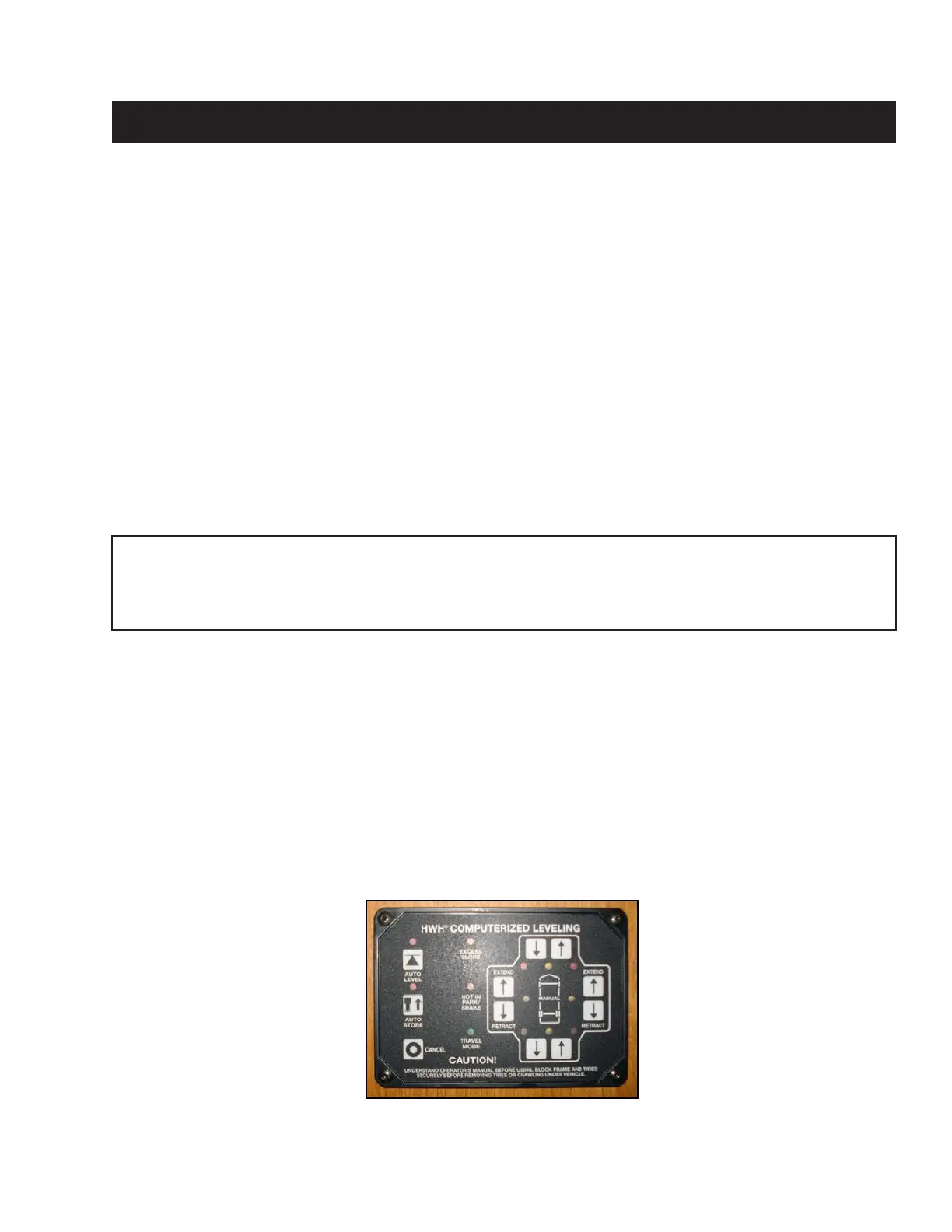
Your vehicle may be equipped with a powered levelling system. See Operating Instructions in the Owner Information Pack-
age for further information.
LEVELING JACK TOUCH PAD



 To Next Page