CLASS B
+
& C MOTORHOME
45
6 SAFETY EQUIPMENT OPERATION
Triple E has made every eort to design the vehicle to promote safe driving, use and occupancy. In addition, it has several
pieces of safety equipment that the drivers and users should be aware of and trained it their use. Review these instructions
with all new people prior to using the motorhome.
6.1 FIRE PREVENTION
Fires can be started in a variety of ways with your vehicle including but not limited to careless smoking, malfunction of
appliances or equipment, ammable material on hot surfaces, etc. Fires are best prevented rather than put out. Prevent
but anticipate what to do if they occur. Review the following sections with everyone on a regular basis.
6.1.1 FIRE SAFETY TIPS
1. Establish and maintain good housekeeping practices. Never allow combustible materials to accumulate. Make sure
you store ammable liquids in approved containers in a well-ventilated space.
2. Make sure you have fully charged re extinguishers readily accessible.
3. Avoid using ammable products in the motorhome.
4. Never smoke in bed or when relaxing on the couch.
5. Do not overload electrical outlets.
6. Do not leave cooking food unattended.
7. Keep children away from electrical outlets and LP gas controls.
8. Never use matches to check for LP gas leaks. If there is a re, get everyone out of the motorhome. If possible, use your
re extinguisher. Close all LP gas valves if possible. Call the re department and stay a safe distance away from your
unit. Do not re-enter your motorhome until the re ocials declare that its safe to do so.
9. Formulate a plan for escape from the vehicle should an emergency arise. It is particularly important that the escape
plan be rehearsed with everyone, especially children, who will be travelling in or using the motorhome.
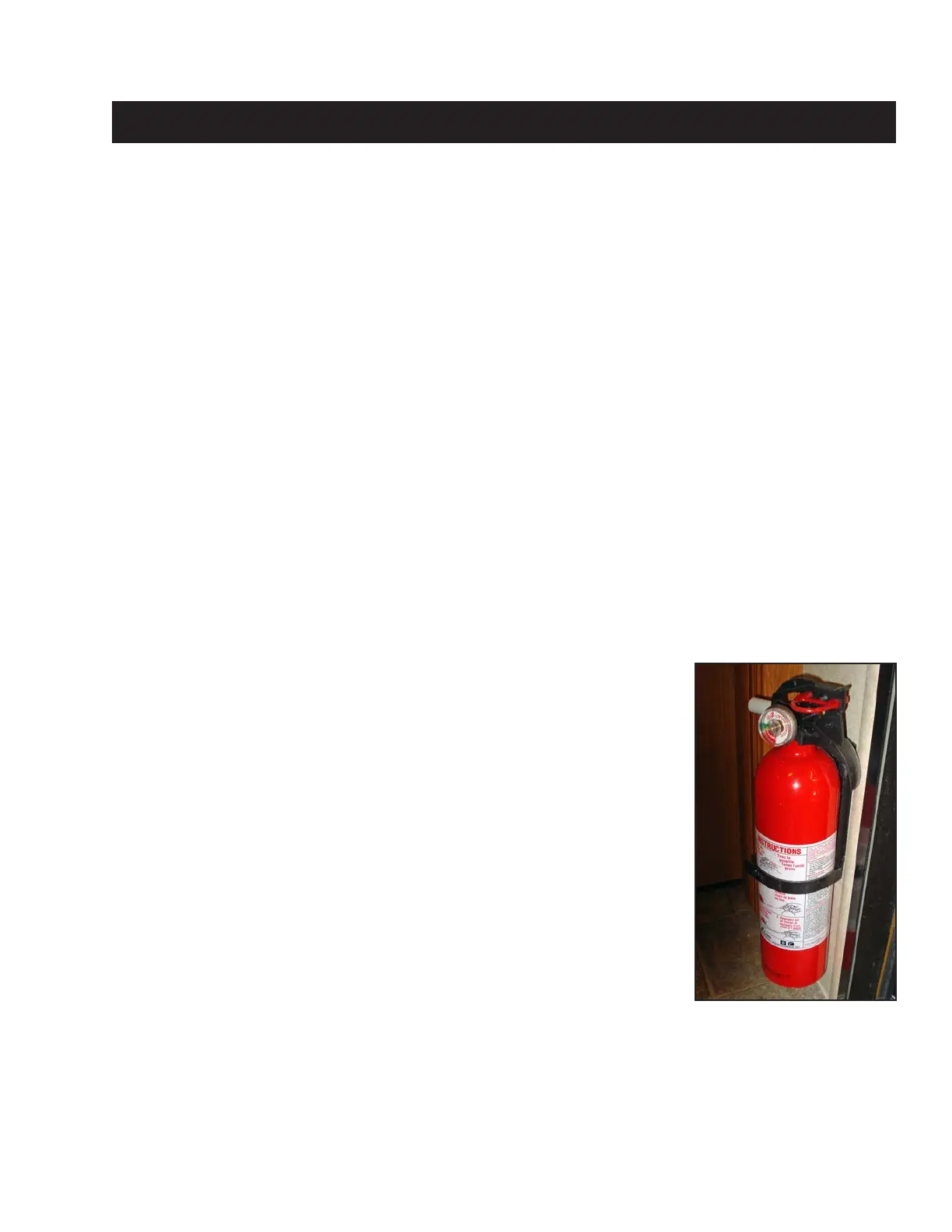
6.1.2 FIRE EXTINGUISHER
1. Function:
a. Fire extinguishers are designed to put out a re in its initial stages. Once a re is
out of control and you cannot get within ten feet, it is probably too big to ght
with your extinguisher.
b. Do not discharge your re extinguisher to test it. Once it is discharged even for
a few seconds it will lose pressure and become useless.
c. Check the pressure indicator on your re extinguisher periodically. It if loses
pressure, the dry chemical cannot be discharged eectively. If the pointer does
not indicate in the green, replace the extinguisher immediately. Record the
inspection date on the tag provided.
2. Operation:
a. Stay at least 6 feet away from the re and near an exit. The chemical from the
re extinguisher will shoot at least 10 feet. Stay close to the oor to avoid heat
and fumes.
b. Break the seal; grasp the re extinguisher rmly holding it in an upright posi-
tion.
c. Aim at the base of the re while pressing down the top lever, spraying the entire
base area.
d. After the re is out, watch for “ashback”.
e. Discharge the re extinguisher entirely and get it recharged or replaced imme-
diately.
f. For additional information, check in the manual that is provided with the Fire
Extinguisher.
FIRE EXTINGUISHER



 To Next Page