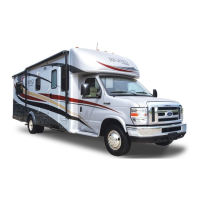
CLASS B
+
& C MOTORHOME
40
5.2 EMERGENCY EQUIPMENT CHECKLIST
Use this list as a guide to identify the minimum amount of emergency or safety equipment. Take more as appropriate for
your travel or personal needs.
1. First Aid Kit
2. Emergency Flares
3. Tool Box and Tools
4. Plastic Bucket
5. Tow Rope or Chain
6. Wheel Blocks or Jacks
7. Water Hose
8. Electrical Cord Extension (100 ft minimum 3 wire/30 amp)
9. Fire Extinguisher
10. Hydraulic Jack and Lug Wrench (Jack not supplied)
11. Spare Tire
5.3 ENTERING VEHICLE
1. Retract side door steps. Be sure automatic step retract system is turned on to retract step when side door is closed.
2. Check that TV antenna is retracted, stowed and secured.
3. Fully retract and lock vehicle levelling legs (if so equipped).
4. Secure all objects in vehicle. Tie, latch or lock all loose objects as appropriate. Unsecured objects can become a
dangerous projectile in a sudden maneuvre or accident.
5. Securely close and lock all doors to prevent intruders and minimize the chance of a door coming open in an accident.
6. Adjust the rearview mirrors to provide the best rearward visibility.
7. Set the drivers seat to provide the desired leg to pedal spacing for your personal comfort.
8. Fasten seat belts low on the torso and be sure they are snug. All passengers should be in a seat that is equipped with
a seat belt. All pregnant riders should be in a seat equipped with a shoulder strap for maximum safety.
9. Do not carry any passengers unless they are in a seat equipped with a seat belt and the belt is fastened.
5.4 ENGINE OPERATION
Refer to the chassis manufacturer manual in the Owner's Information Package for engine starting and stopping
instructions.
5.5
DRIVING CHARACTERISTICS
1. Controls:
The motorhome driver controls are automotive type and the steering and braking controls are power assisted to help
make driving as comfortable as possible. However it must be remembered that the motorhome is much higher, wider
and heavier than a family automobile.
2. Handling:
The motorhome power-to-weight ratio is lower than that of the average automobile. Therefore it is essential to
compensate for less acceleration when moving into trac or when passing another vehicle. Allow extra room to run a
corner and to change lanes. When going underneath a bridge or similar overhang you must be aware of your maximum
height. (Measurement must include the air conditioner plus 6 inches. Height may vary depending on chassis, make,
suspension and air conditioner).
3. Mountain Driving:
When driving in hilly or mountainous terrain you should employ dierent driving techniques than those used when
driving under normal, at conditions.
a. Climbing a Hill:
The transmission is designed to down-shift automatically when required during a longer uphill climb. If you nd
that the transmission shifts up and down rather frequently, it is a good idea to select a lower gear for the duration
of the climb to prevent this repeated shifting. This will prevent unnecessary wear and tear on your transmission.



 To Next Page