6
Connecting the ductwork
6.1
Ducts
Ducts of combustible or non-combustible materials may
be connected to fire dampers.
6.2
Removing the transport/installation
protection
Fire dampers with nominal size 315 and above and
without installation block are shipped with a transport/
installation protection. In case of mortar-based installa-
tion this protection must not be removed until the mortar
has hardened. To remove the transport/installation pro-
tection, pull it out of the fire damper on the operating
side.
6.3
Limiting duct expansion
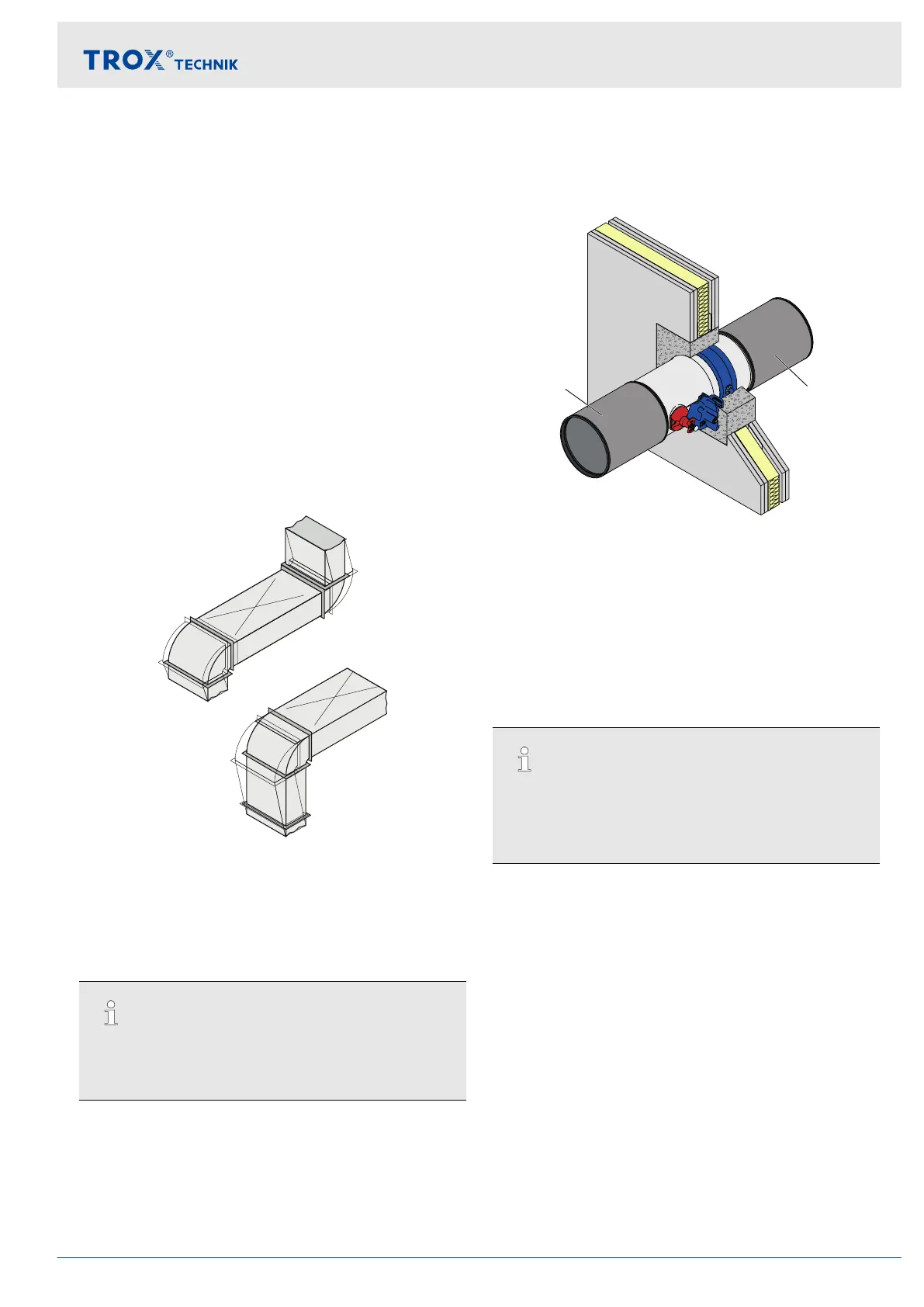
Fig. 35: Limiting loads
Ducting must be installed in such a manner that it does
not impose any significant loads on the fire damper in
the event of a fire.
The expansion of ducts in the event of a fire can be
compensated by brackets and turns, Fig. 35.
Note
For further information please refer to the guideline
regarding fire protection requirements on ventilation
systems (Lüftungsanlagen-Richtlinie, LüAR).
As ducts may expand and walls may become deformed
in the event of a fire, we recommend for the following
applications using flexible connectors when connecting
the fire damper to rigid ducts:
in lightweight partition walls
in lightweight shaft walls
with fire batt
6.3.1
Flexible connectors
Fig. 36: Fire damper with flexible connector
①
Flexible connector
Ⓐ
Installation side
Ⓑ
Operating side
The flexible connectors should be installed in such a
way that they can compensate both tension and com-
pression. Flexible ducts can be used as an alternative. If
flexible connectors are used, equipotential bonding
must be ensured
Ä
Chapter 7.3 ‘Equipotential bonding’
on page 51.
Note
To ensure that the open fire damper blade is con-
tained within the fire damper casing on the installa-
tion side, an extension piece is required for nominal
size 224 and above.
Connecting the ductwork
Limiting duct expansion > Flexible connectors
Fire damper Type FKRS-EU 49


 To Next Page