5-1
C H A P T E R 5
Technical Description
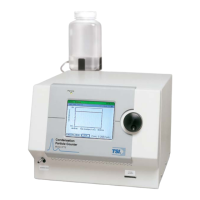
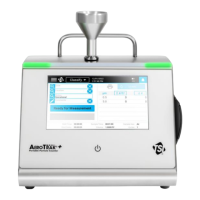
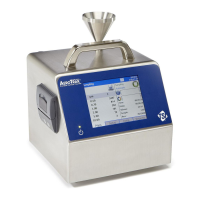
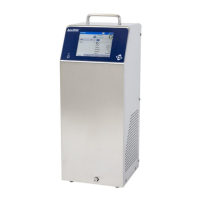
The Model 3772/3771 CPC is a continuous-flow condensation particle
counter that detects particles as small as 10 nanometers (50% detection
efficiency) in diameter. This section describes the function of the CPC, its
subsystems and its components. A discussion of operation theory and
history is given first.
Theor y
The CPC acts very much like an optical particle counter. However, the
particles are first enlarged by a condensing vapor to form easily detectable
droplets. The science behind the counter, therefore, is focused on how to
condense the vapor onto the particles. Portions of the following discussion
are taken from a paper by Keady et al. [1986].
When the vapor surrounding particles reaches a certain degree of
supersaturation, the vapor begins to condense onto the particles. This is
called heterogeneous condensation. If supersaturation is too high,
condensation can take place even if no particles are present. This is
referred to as homogeneous nucleation or self-nucleation, whereby
molecules of the vapor form clusters due to the natural motion of the gas
and attractive van der Waals forces to form nucleation sites. This condition
is avoided by accurately controlling operating temperatures. The CPC
operates below the supersaturation ratio to avoid homogenous nucleation.
The degree of supersaturation is measured as a saturation ratio (P/P
s
),
which is defined as the actual vapor partial-pressure divided by the
saturation vapor pressure for a given temperature:
P
supersaturation =
__
P
s
For a given saturation ratio, the vapor can condense onto particles only if
they are large enough. The minimum particle size capable of acting as a
condensation nucleus is called the Kelvin diameter and is evaluated from
the following relationship:
P (4
M)
saturation ratio =
__
= exp
_____
P
s
RTd


 To Next Page