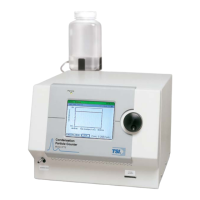
8-10 Model 3772/3771 Condensation Particle Counter
16. Turn on the instrument and use the Auto-Fill option to refill the
reservoir with butanol. See “User Settings” in Chapter 4.
Verify i n g Flow R ate
To measure the instrument sample flow rate, connect a low pressure-drop
flowmeter to the CPC inlet. A bubble flowmeter or a thermal flowmeter
works best. A TSI mass flowmeter also works because it is corrected for
atmospheric pressure to give volumetric flow. The flow rate should be
1.0 L/min (0.035 cfm) ±5 percent. If the flow rate is too low, the orifice or
nozzle may be plugged, the vacuum may be less than 18 inches of
mercury, or the pressure drop of the test flowmeter may be too high. A
clogged orifice or nozzle can be further verified by the pressure drop
across the orifice or nozzle which can be read on the front panel display for
the 3772 or through serial command for both 3772 and 3771. If you
suspect a clogged orifice or nozzle, contact TSI for instructions.
Calibr a t i o n
Aside from the optics alignment, the initial factory checkout of the
electronics, and the periodic flow verification, the CPC requires no
calibration. The flow is controlled by a critical orifice, and thus, no
adjustments are needed. The minimum detectable particle size is
controlled by the supersaturation ratio of the fluid vapor in the condenser.
Since the fluid droplets grow to nearly the same size, there is no particle
size discrimination by electrical pulse-height. Finally, the CPC is a single-
particle counter, there is no photometric calibration for concentration.


 To Next Page