5-8 Model 3775 Condensation Particle Counter
Countin g Efficienc y a n d Res p o n s e Time of
the 37 7 2 / 3 771 CPC
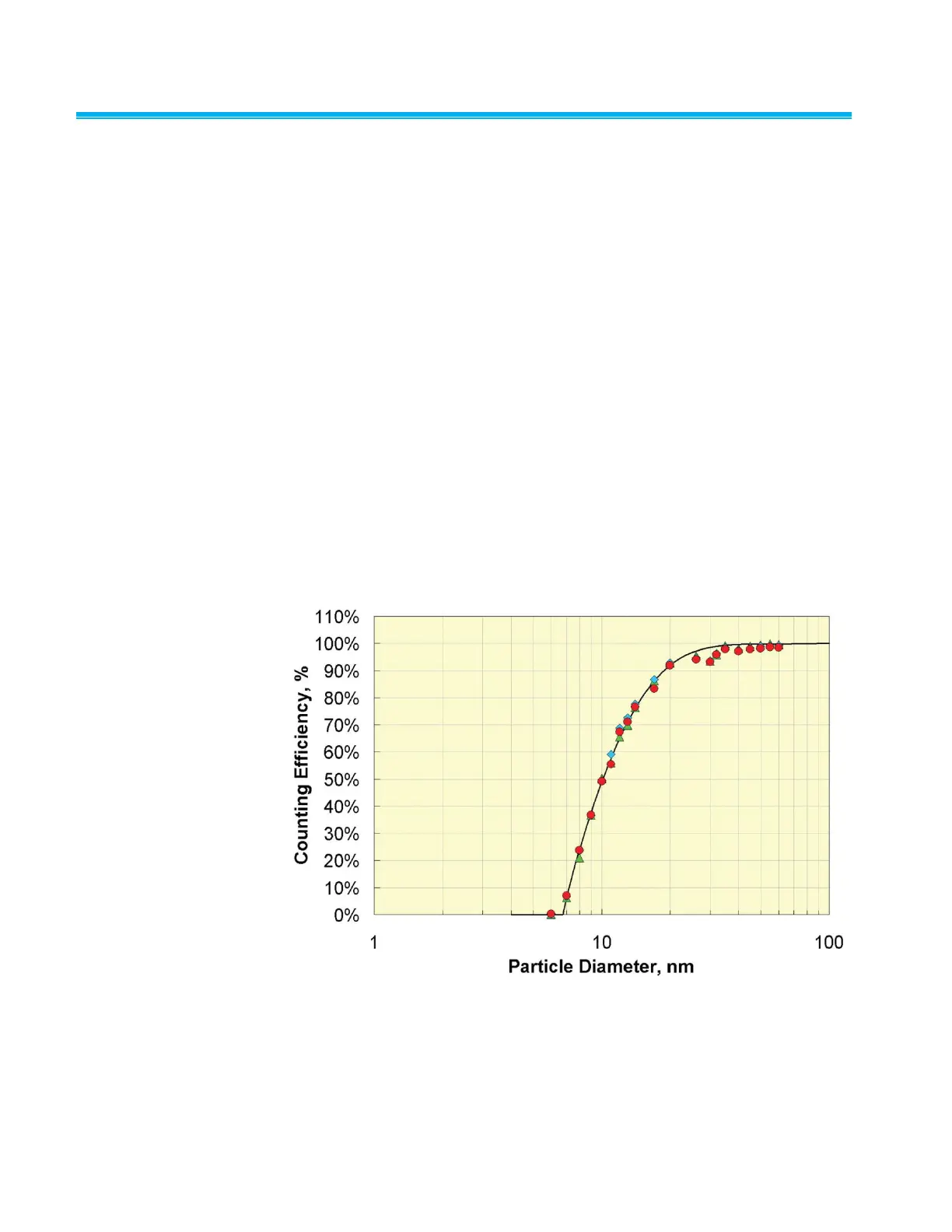
The 3772/3771 CPC has a D
50
of 10 nm. D
50
is defined as the particle
diameter at which 50% of particles are detected. The curve fit shown in
Figure 5-2 is based on testing of three 3772/3771 CPCs using sucrose
particles generated by TSI Model 3480 Electrospray Aerosol Generator
and size classified with TSI Model 3080 Electrostatic Classifier and Model
3085 Nano Differential Mobility Analyzer (DMA) . The counting efficiency is
calculated by comparing the CPC readings to TSI Model 3068A Aerosol
Electrometer readings.
Note the particle concentration measured by the CPC is the total number
concentration of all particles that a CPC can detect. This measurement
provides no size differentiation and it is not corrected using the CPC
counting efficiency curve. When the 3772 CPC is used as part of a
Scanning Mobility Particle Sizer (TSI Model 3936 SMPS), the counting
efficiency curve is used to correct particle count data to provide particle
size distribution.
The 3772/3771 CPC has a fast response time. T
95
, defined as the time it
takes for the CPC reading to reach 95% of a concentration step change, is
about 3 sec for the 3772/3771 CPC. Figure 5-3 shows the response time
curves. The curves are based on averaging of three CPCs.
Figure 5-2
Counting Efficiency Curve of 3772/3771 CPC


 To Next Page