Technical Description 5-3
Other significant developments in adiabatic-expansion CNCs include the
use of electrical photodetectors to measure the light attenuation from cloud
formation (Bradbury and Meuron [1938], Nolan and Pollak [1946], Rich
[1955], Pollak and Metneiks [1959]); the use of under- and overpressure
systems; and automation using electrically controlled valves and flow
systems. The amount of light attenuated from the droplet cloud is
monotonically related to the concentration of particles and is calibrated
either by manual counting techniques, calculated from theory of particle
light-scattering, or by using an electrical classification and counting method
(Liu and Pui [1974]). A historical review of the expansion CNCs is given by
Nolan [1972], Hogan [1979], and Miller and Bodhaine [1982].
Two-Flow Mixing CNC
Another cooling method turbulently mixes two vapor-saturated flows, one
hot and one cold, to rapidly cool and supersaturate the vapor (Kousaka et
al. [1982]). The condensation and droplet growth are fairly rapid and
uniform. The flows can be passed continuously (that is, non-pulsating)
through the mixing chamber onto a single-particle-counting optical
detector.
Diffusional Thermal CNC
A continuous-flow, diffusional, alcohol-based, thermal-cooling CNC
(Bricard et al. [1976], Sinclair and Hoopes [1975], Agarwal and Sem
[1980]) first saturates the air sample with alcohol vapor as the sample
passes over a heated pool of liquid alcohol. The vapor-saturated air stream
flows into a cold condenser tube where the air is cooled by thermal
diffusion. The alcohol condenses onto the particles and the droplets grow
to about 10 to 12 micrometers. The droplets are counted by a single-
particle-counting optical detector.
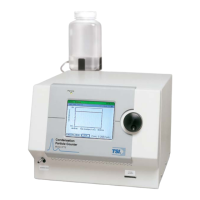
Continuous-flow, diffusional, water-based CPCs (TSI Model 3781, 3785,
and 3786 WCPCs) were developed between 2003 and 2006. Using a
patented technique (Technology from Aerosol Dynamic Inc., U.S. Patent
No. 6,712,881), an aerosol sample is drawn continuously through a cooled
saturator and then into a heated condenser, where water vapor diffuses to
the centerline of the condenser faster than heat is transferred from the
warm walls, producing supersaturated conditions for water vapor
condensing onto the particles.
Model 3760, 3762, and 3010 was introduced in early 90s and was replaced
by Model 3772/3771 in 2005. The 3772/3771 CPC works only in the single
count mode at relatively high aerosol flow rates of 1.0 and 0.6 L/min
respectively. The 3772/3771 CPC uses n-butyl alcohol as the working fluid
and an external vacuum pump or source to drive the 1 L/min aerosol flow
rate. The 3772/3771 can detect 10 nm particles at 50% detection
efficiency.
For high-concentration measurements, a classical photometric light-
scattering technique is used. The first commercial version of this type of
CNC (TSI Model 3020) used n-butyl alcohol as the condensing fluid and


 To Next Page