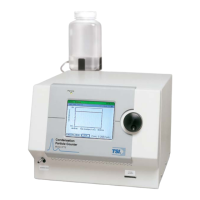
5-2 Model 3775 Condensation Particle Counter
where
= surface tension of the condensing fluid
M = molecular weight of the condensing fluid
= density of the condensing fluid
R = universal gas constant
T = absolute temperature
d = Kelvin diameter
The higher the saturation ratio, the smaller the Kelvin diameter.
The saturation vapor pressure P
s
is defined for a flat liquid surface. For a
round liquid surface, such as the surface of a droplet, the actual saturation
vapor pressure is greater. In other words, the smaller the droplet, the
easier it is for the vapor molecules to escape the liquid surface. The Kelvin
diameter defines the critical equilibrium diameter at which a pure droplet is
stable—there is neither condensation nor evaporation. Smaller liquid
particles will evaporate and larger particles grow even larger by
condensation. The larger particle will grow until the vapor is depleted,
causing the saturation ratio to fall until it is in equilibrium with the particle
droplet.
If the saturation ratio is controlled to a level below the critical saturation
ratio—the point at which homogeneous nucleation takes place—
condensation will not take place in a particle-free environment.
The lower size sensitivity of the counter is determined by the operating
saturation ratio. For the counter this ratio is several hundred percent,
whereas in the atmosphere, this ratio is only a few percent for water.
Histor y
Historically, the counter has been called a condensation nucleus counter
(CNC). CNC technology uses three techniques to cool and supersaturate
the condensing vapor: adiabatic expansion, two-flow mixing, and
diffusional thermal cooling. The Model 3772/3771 CPC uses the latter.
Adiabatic Expansion CNC
The first CNC was developed over a century ago by John Aitken [1888].
His simple and completely mechanical device cooled water-saturated air by
adiabatic expansion using a pump. The droplets were counted as they fell
onto a counting grid and a calculation was made to determine the
concentration of dust particles in the sample volume. He made several
improvements to his invention and his portable dust counter was used for
many years (Aitken [1890–91]).


 To Next Page