Following is the list of Critical and Secondary fault alarms:
1. Critical fault alarms: High pressure locking alarm, Low pressure locking alarm, Air discharge high temperature
locking alarm, Air discharge low superheat locking alarm, Low pressure sensor failure locking, CP drive
protection U00~U15, Floor water overflow alarm (setting shut down), Fan fault alarm (setting shutdown).
2. Secondary fault alarms: Humidity sensor failure, Air return temperature sensor failure, Air supply temperature
sensor failure, Remote temperature sensor failure, Air discharge high temperature alarm, Phase failure
alarm, Air flow loss alarm, Air flow temperature sensor failure, Air discharge temperature sensor failure,
Electronic expansion valve communication failure, Suction air temperature sensor failure, Low pressure sensor
failure, Compressor drive communication failure
When the active/standby switchover is performed, the running unit enters the standby state after delays the "active /
standby delay time”.
3.7.2 Typical Standby Function
One or several units can be set to ‘standby’, and the standby unit is generally off (the fan is off).
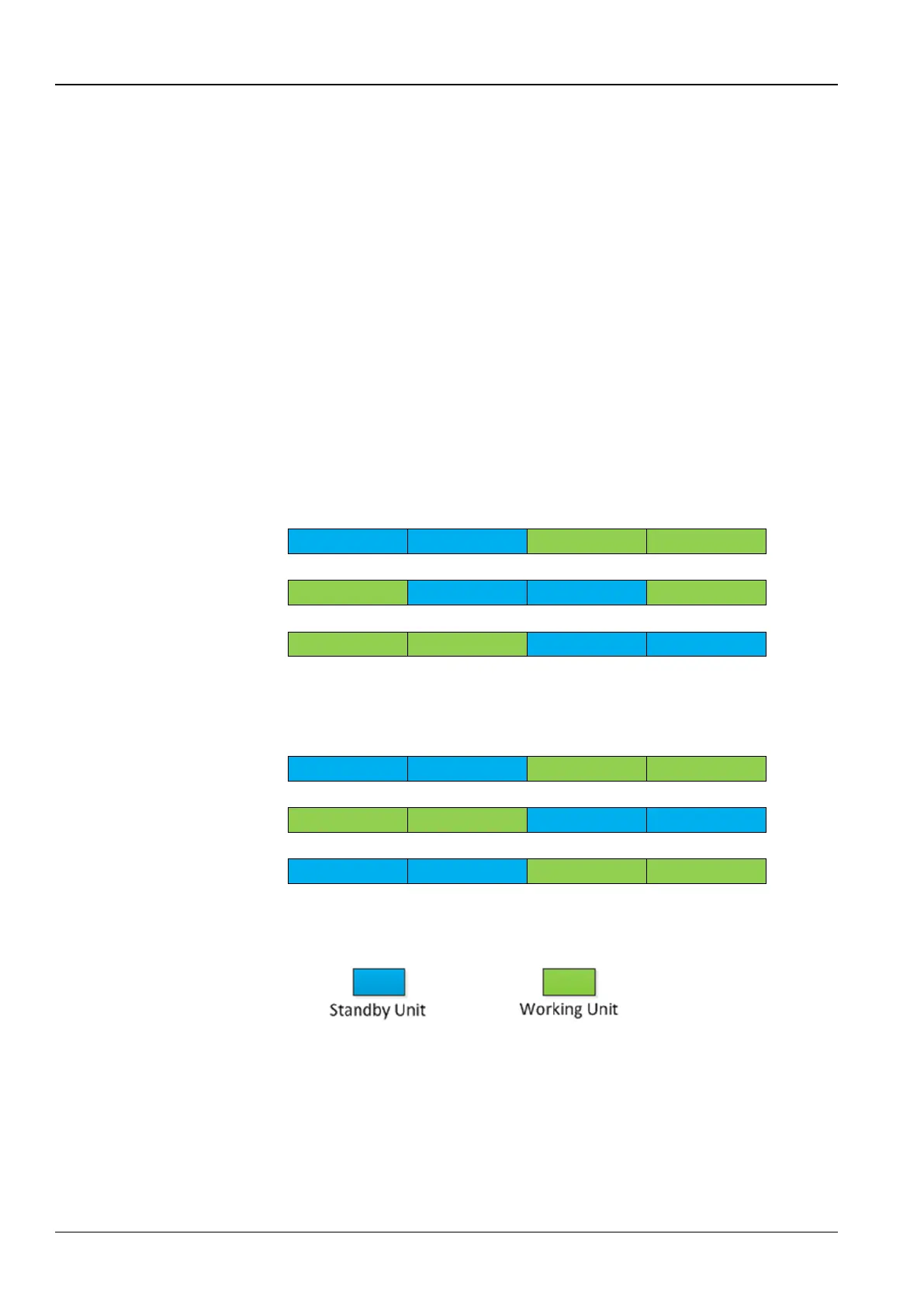
The backup function rotates on the day (the time can be set). The rotation can be done according to a selectable
number. For example, when two units are backup in four units, if the rotation number is 1, the backup rotation
sequence is 1-2 to 2-3 to 3-4; if the rotation number is 2; the backup rotation sequence is 1-2 to 3-4.
If some unit in the teamwork cannot be contacted or the compressor is locked or a high-temperature alarm or
temperature sensor fault is triggered, start one backup unit till all backup units start.
Mode: Teamwork Unit Quantity: 4 Standby Unit: 2 Rotation Number: 2
Rotation Frequency: Wednesday Rotation Time: 10:00
Figure 3-37 Standby functions
3.7.3 Rotation functions
Rotation function is utilized to ensure that all the installed units have an equal run-time. This helps to prolong the life
of the installed equipment with an assurance that all the units are working effectively. Figure 3-38 depicts the rotation
function.



 To Next Page