
 Need help?
Do you have a question about the Vertiv Liebert EXL and is the answer not in the manual?
Conformity to European directives and standards for electrical equipment.
Explanation of symbols and pictograms used throughout the manual.
Definitions of essential terms and abbreviations for understanding the UPS.
Definition of the switch providing continuous supply during maintenance.
Definition of the thyristor switch connecting load to the power line.
Definition of personnel authorized for installation and operation.
Description of the operator interface for control and testing.
List of abbreviations and their meanings (MSS, RAU, TCE, SBS, MBSM).
Information on how the manual is supplemented with additional sheets.
Warnings on risks posed by foreign materials in UPS equipment installations.
Guidelines for safe transport and handling of the UPS equipment.
Procedures for checking received goods and proper storage conditions.
Instructions for carefully removing packaging and unloading UPS cabinets.
Step-by-step guide for assembling Liebert EXL S1 1000/1200kVA cabinets.
Requirements for installation environment: temperature, humidity, and altitude.
Guidance on load reduction at altitudes above 1000m.
Requirements for space around the UPS for service and airflow.
Information on physical dimensions, floor requirements, and cable entry.
Safety warnings and requirements for electrical connections before UPS installation.
Guidelines for selecting conductor sizes based on current ratings and local regulations.
Identification of main switches (QS1, QS2, QS3, QS4) and their functions.
Mandatory external protection devices for UPS installation and system safety.
Considerations for selecting and installing differential protection devices.
Requirements for protecting the primary AC line power input.
Characteristics for bypass line power input protection devices.
Protection requirements for the battery input against short-circuits.
Considerations for designing output line protection systems.
Requirement for an external disconnector to prevent backfeed shock hazards.
Instructions for connecting ground and power cables to the UPS.
Identification of UPS power connection terminals (U, V, W, N, PE, D-, C+).
Mandatory precautions and procedures for safely connecting batteries to the UPS.
Details on connecting UPS to battery cabinets and temperature sensors.
Safety guidelines and procedures for handling, recharging, and replacing UPS batteries.
Instructions for recharging batteries, including packaging guidelines.
Guidance on ensuring new batteries are fully charged before replacement.
Warning and procedure for reconnecting batteries after disconnection.
Description of the LCD touch screen interface on the UPS door.
Information on ETHERNET 2 port as a provision for future options.
Details on ETHERNET 1 RJ-45 interface for service and setup.
Overview of the customer connectivity panel and its interfaces.
Description of the recommended interface for SNMP Adapter ManageUPS NET.
Details on the reserved interface for LIFETM modem cards.
Description of the SUB-D 9pin connector for RS232 communication.
Connection details for the Emergency Power Off (EPO) connector.
Information on the 12-wire connector for dry contacts and inputs.
Details on the 18-wire connector for customer plant output signals.
Interface for synchronization with external devices like MBSM.
Connector for Backfeed Protection output, used to trip external contactors.
Input for the battery area temperature sensor via a 2-pole screw terminal.
Connectors for paralleling multiple UPS units and data exchange.
Explanation of UPS connection between line power and load for protection.
Description of how the UPS converts AC to DC and back to clean AC power.
How the UPS manages battery charging, discharging, and monitoring for lifespan.
How the UPS handles overloads by transferring to bypass or interrupting supply.
Information on UPS interfaces for computer communication.
Overview of key features enhancing UPS performance and usability.
Highlights on real on-line functioning and static bypass reliability.
Features that simplify UPS setup, parameterization, and day-to-day use.
Details on automatic battery management, circuit tests, and charging.
Compliance with EMC limits, energy savings, and noise level.
Key technological aspects like IGBTs, ASICs, and software interfaces.
Schematic representation of the UPS internal components and their connections.
Functionality of the Maintenance Bypass Switch for servicing without load interruption.
Description of the UPS's four different operating modes.
Normal operating mode where loads are supplied via the inverter.
Mode where loads are supplied from batteries via the inverter during power failure.
Mode where loads are supplied from line power via the Static Bypass Switch.
Mode where loads are directly supplied from line power for maintenance.
Procedures for putting the UPS into operation, including initial checks.
Procedure to reform intermediate circuit capacitors if UPS is unused for over a year.
Steps for safely switching on the UPS after installation checks.
Critical safety steps for connecting batteries, emphasizing correct polarity.
Procedure to set the UPS to its normal operating mode.
Step-by-step guides for switching the UPS between different operating states.
Detailed steps to turn on the UPS and set it to Normal Operating Mode.
Detailed steps to switch off the UPS, ensuring output is completely turned off.
Steps to transfer the load to Maintenance Bypass and shut down the UPS.
Steps to transfer the load from Maintenance Bypass to Normal Mode.
Instructions for starting and stopping the inverter in single and parallel UPS systems.
Procedure to start the inverter from Bypass mode.
Procedure to stop the inverter from Normal mode.
Procedure to start all inverters in a parallel system from Bypass mode.
Procedure to stop all inverters in a parallel system from Normal mode.
Recommendations for regular maintenance checks by authorized service personnel.
Guidelines for the proper and environmentally compliant disposal of used batteries.
Information on how to find worldwide service telephone and fax numbers.
Procedures for safely taking the UPS out of service.
Steps to switch to Maintenance Bypass, disconnect batteries, and ensure de-energization.
Requirements for placing multiple UPS blocks into service by trained technicians.
Illustration of multiple-block system configurations with SBS.
Details on how UPS units exchange information via a 37-pin connector cable.
Step-by-step guides for switching UPS units in a parallel configuration.
Procedure to turn on UPS units and set them to Normal Operation Mode in parallel.
Procedure to switch off UPS units in a parallel system.
Steps to transfer load to Maintenance Bypass and shut down UPS in parallel.
Steps to transfer load from Maintenance Bypass to Normal Mode in parallel.
Description of the Remote Alarm Panel for displaying UPS messages.
Information on the Top Cable Entry (TCE) option for routing power cables.
Details on the components included in empty battery compartments.
Information source for MopUPS software for shutdown and monitoring.
Information source for the ManageUPS adapter.
Description of the MBSM device for frequency reference signal and synchronization.
Device for synchronization between different UPS systems and external sources.
Option for maintenance continuity in parallel systems with multiple UPS.
Adapter for parallel connection between EXL S1 and legacy 80-NET.
Cable used for connecting two or more UPS units in parallel.
Option for synch distribution management from MSS to UPS via a top switch.
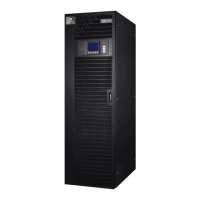
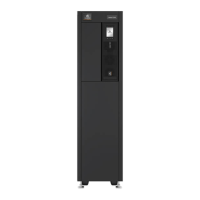
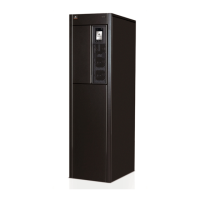
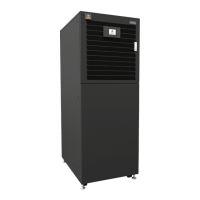
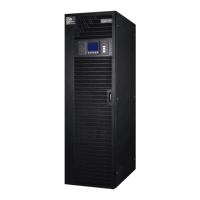
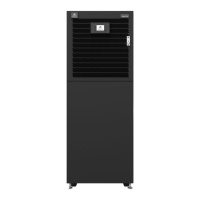
Technical specifications for the 300-500kVA Liebert EXL S1 models.
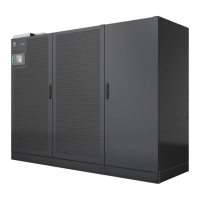
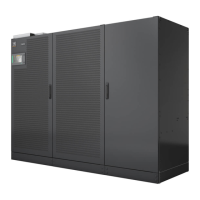
Technical specifications for the 600-1200kVA Liebert EXL S1 models.


 To Next Page


 General