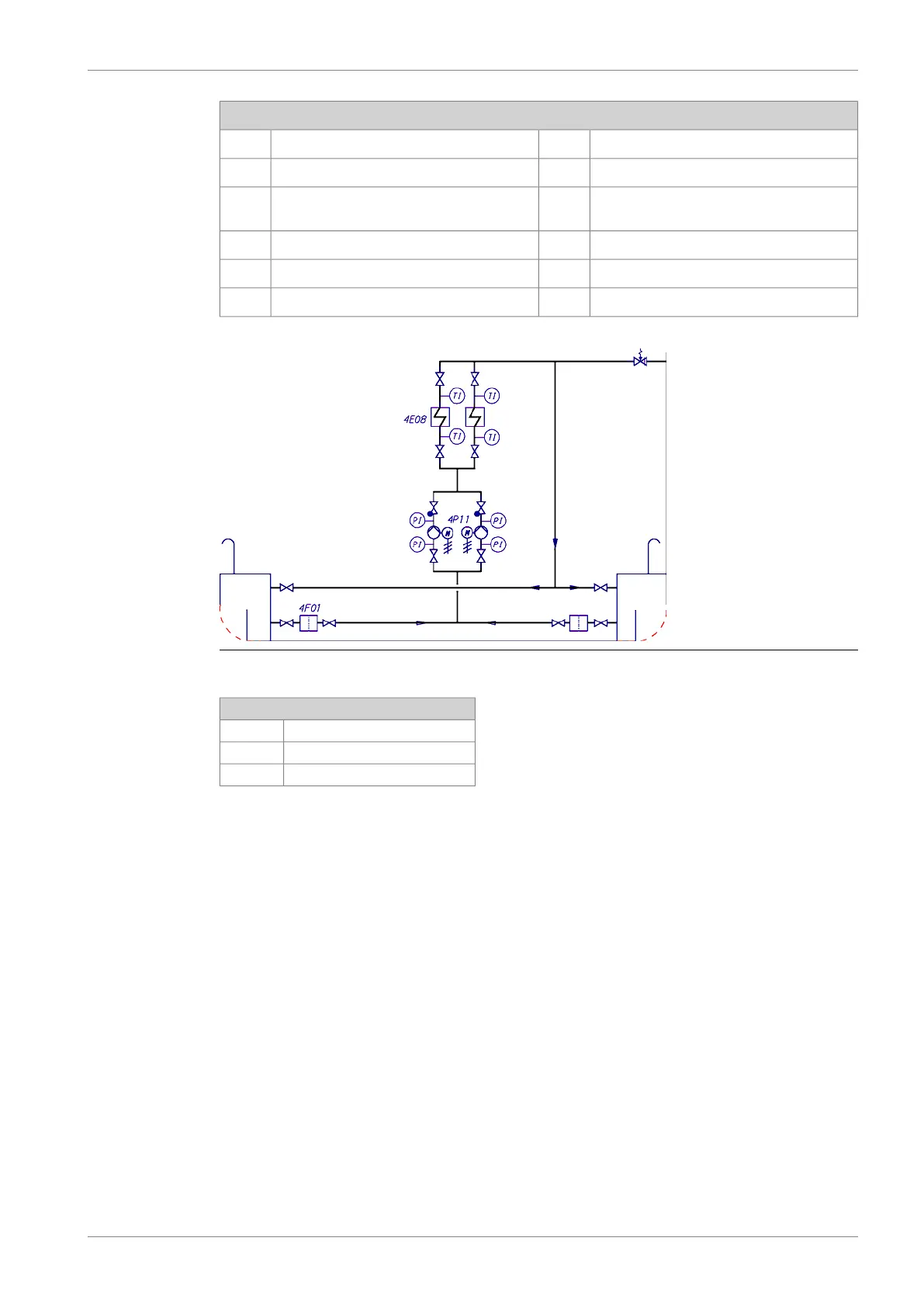
System components:
Drain tank4T04Evaporator unit4N02
Temperature control valve (HT)4V01Stand-by pump (HT)4P03
Temperature control valve (HT)4V01-
1
Circulating pump (preheater)4P04
Temperature control valve (LT)4V03Transfer pump4P09
Temperature control valv (charge air)4V09Circulating pump (HT)4P14
Circulating pump (LT)4P15
Fig 9-9 Sea water system DAAE020523
System components
Central cooler4E08
Suction strainer (sea water)4F01
Circulation pump (sea water)4P11
Ships (with ice class) designed for cold sea-water should have provisions for recirculation
back to the sea chest from the central cooler:
● For melting of ice and slush, to avoid clogging of the sea water strainer
● To enhance the temperature control of the LT water, by increasing the seawater temperature
● It is recommended to divide the engines into several circuits in multi-engine installations.
One reason is of course redundancy, but it is also easier to tune the individual flows in a
smaller system. Malfunction due to entrained gases, or loss of cooling water in case of
large leaks can also be limited. In some installations it can be desirable to separate the HT
circuit from the LT circuit with a heat exchanger.
The external system shall be designed so that flows, pressures and temperatures are close
to the nominal values in Technical data and the cooling water is properly de-aerated.
Pipes with galvanized inner surfaces are not allowed in the fresh water cooling system.
Some cooling water additives react with zinc, forming harmful sludge. Zinc also becomes
nobler than iron at elevated temperatures, which causes severe corrosion of engine
components.
DBAD209883 9-13
9. Cooling Water SystemWärtsilä 46DF Product Guide



 To Next Page