the same time, scanning (in MS mode) the background for all other components. This enables
fast characterization of potential matrix effects, providing a platform for more robust method
development.
1.7.5.1 Typical application
You typically use RADAR mode during method development prior to performing MRM or PICS to
quantify known analytes in complex samples. Typical applications include:
• Drug metabolite and pharmacokinetic studies
• Environmental, for example, pesticide and herbicide analysis
• Forensic or toxicology, for example, screening for target drugs in sports
MRM analysis with no associated RADAR or PICS operation does not produce a spectrum,
because only one transition is monitored at a time. As in SIR mode, a chromatogram is produced.
1.7.6 Constant neutral loss mode
Constant neutral loss mode detects the loss of a specific neutral fragment or functional group
from an unspecified precursor or precursors.
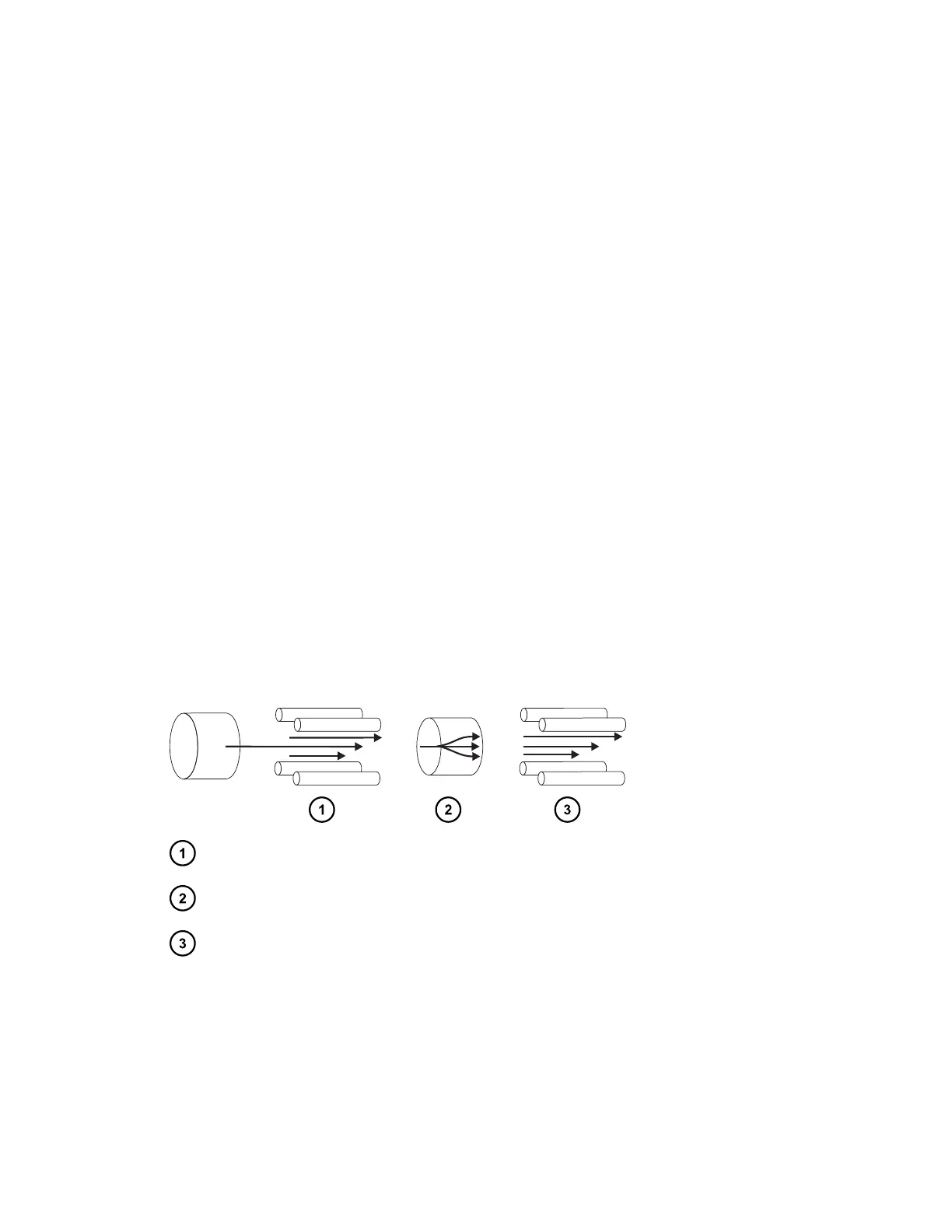
The scans of MS1 and MS2 are synchronized. When MS1 transmits a specific precursor ion,
MS2 determines whether that precursor loses a fragment of a certain mass. If it does, the loss
registers at the detector.
In constant neutral loss mode, the spectrum shows the masses of all precursors that lost a
fragment of a certain mass.
Figure 1–8: Constant neutral loss mode
MS1–Scanning (synchronized with MS2)
Collision cell–Fragment precursor ions and pass all masses
MS2–Scanning (synchronized with MS1)
1.7.6.1 Typical application
You typically use constant neutral loss mode to screen mixtures for a specific class of compound
that is characterized by a common fragmentation pathway, indicating the presence of compounds
containing a common functional group.
January 10, 2022, 715006200 Ver. 01 (previously released as Rev. A)
Page 35


 To Next Page