Need help?
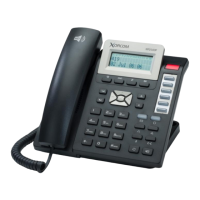
Do you have a question about the Xorcom XP0100P and is the answer not in the manual?
Lists all components included in the package for setup.
Step-by-step instructions for physically assembling the IP phone.
Accessing and configuring phone settings through a web browser interface.
Configuring network parameters like DHCP, static IP, and PPPoE for connectivity.
Configuring SIP server registration details and account parameters.
Setting up network and account configurations directly on the phone's keypad.
Detailed explanation of the IP phone's keypad layout and button functions.
Explains navigation, audio control, and hard feature keys on the phone.
Explains the various icons displayed on the phone's LCD screen.
Compares available settings between the phone UI and web UI.
Covers phone status, language, time, and date configurations.
How to enable and use the keypad lock feature for security.
Adjusting sender volume via web UI and receiver volume via phone UI.
Adjusting ringer volume and selecting ring tones via phone UI.
Information on supported audio codecs and how to configure them.
Managing contacts in the local directory and using the blacklist feature.
Configuring a specific key to act as the send key.
Configuring hot line numbers and enabling headset priority.
Setting up auto redial for busy numbers and auto answer for incoming calls.
Configuring Replace Rules, Dial Now rules, and Area Codes for call routing.
Preventing specific phone numbers from being dialed out from the IP phone.
Enabling feature key synchronization and configuring Push XML server settings.
Step-by-step guide on initiating calls using different methods and devices.
Enabling call completion and managing incoming calls (answering/denying).
Performing Mute, Call Hold, and Call Waiting operations during active calls.
Performing Blind, Attended, Semi-Attended Transfers and 3-way/Network Conferences.
Accessing voice messages and configuring voicemail settings.
Configuring advanced account parameters and Transport Layer Security.
Configuring DNS-SRV for SIP server discovery and PC port network settings.
Configuring VLANs for network segmentation and LLDP for network discovery.
Managing administrator access, passwords, rebooting, and factory resets.
Procedures for updating the phone's firmware.
Lists the various functions that can be assigned to DSS keys.
Configuring DSS keys for Line appearance and Speed Dial functionality.
Configuring DSS keys for Busy Lamp Field (BLF) monitoring and BLF list.
Configuring DSS keys for Voice Mail access and call pick up.
Configuring DSS keys for Call Park and Intercom features.
Configuring DSS keys for Prefix dialing, Local Group access, and Conference.
Configuring DSS keys for Call Forward, Transfer, and Hold functions.
Configuring DSS keys for DND, Redial, Call Return, and Recording.
Configuring DSS keys for URL recording and Multicast Paging.
Configuring multicast RTP streams and Group Listening via DSS keys.
Configuring DSS keys for Public/Private Hold and Shared Line appearances.
Configuring DSS keys for Automatic Call Distribution and Zero-sp-touch.
Assigning keys as URLs and configuring SNMP settings for network management.
Details on Action URL variables and configuring Action URIs for event handling.
Customizing frequency and time periods for various dial tones.
Configuring voice parameters like echo canceller, VAD, and CNG.
Resolving problems with server registration and obtaining an IP address.
Troubleshooting issues related to voice clarity and DTMF input during calls.
Guidance on updating firmware and setting up auto-provisioning for the phone.
 General
| Type | IP Phone |
|---|---|
| Speakerphone | Yes |
| Wall Mountable | Yes |
| Model | XP0100P |
| Audio Codecs | G.711, G.726 |
| Network Interface | 10/100 Mbps Ethernet |
| Power over Ethernet | Yes |
| Protocols | SIP |


 To Next Page