xvi
Outboard Rigging Guide - 2001 General Rigging Information
Fuel Pump/Fuel System Testing
When a fuel starvation problem is suspected (e.g.,
engine hesitation or engine stopping), perform the
following fuel system test:
Tool Required:
1 Vacuum Gauge
1 “T” Fitting (P/N 6E5-24378-00-00)
12” Clear Fuel Hose (5/16” or 8 mm ID)
1 Long Fuel Hose (10”-15”)
2 Hose Clamps or Quick Ties
Procedure:
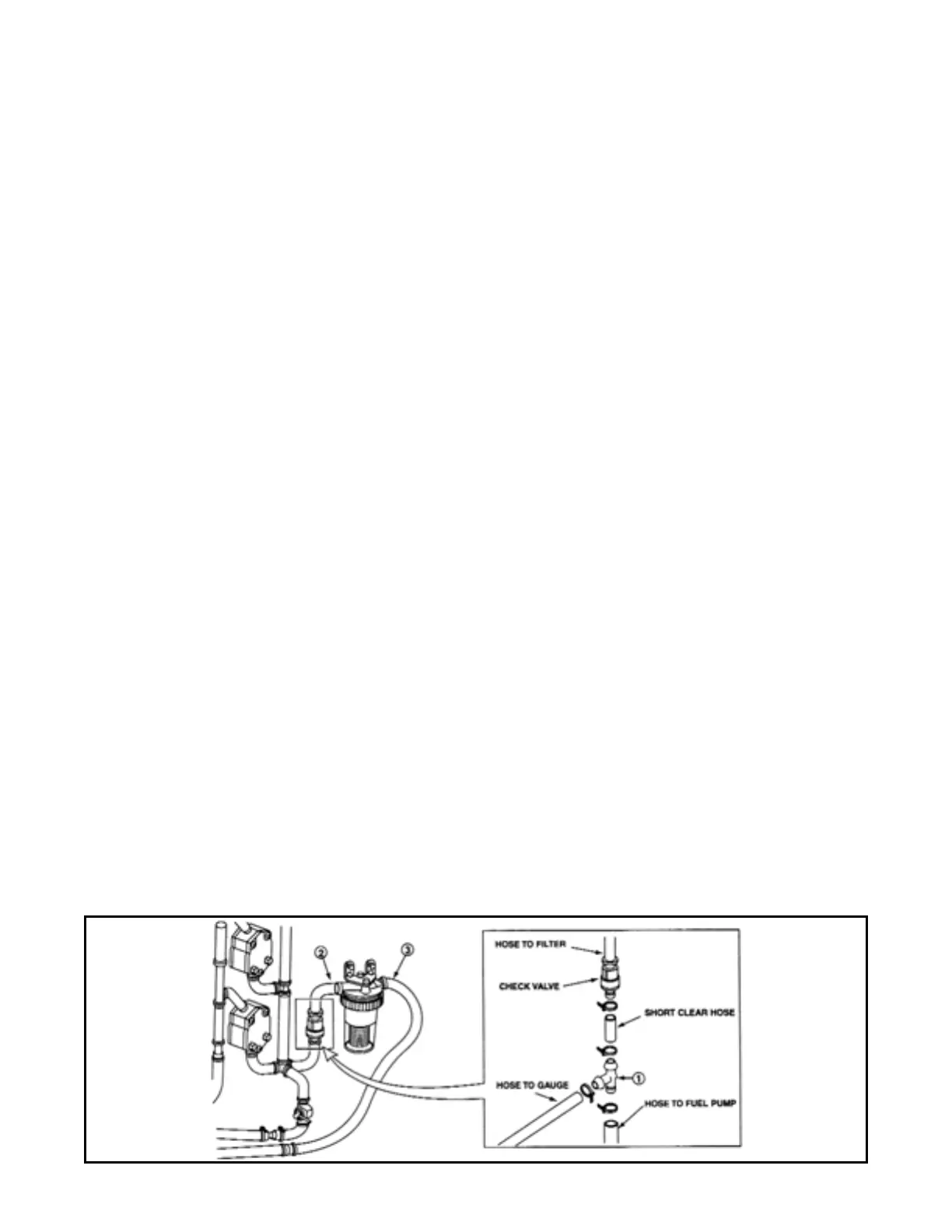
1. Connect the piece of clear fuel hose to a side
barb of the “T” fitting (1).
2. Connect the short piece of clear fuel hose to
the fuel check valve leading from the fuel fil-
ter. If a check valve does not exist, connect
the clear fuel hose directly to the fuel filter
(see illustration below).
3. Check the vacuum gauge reading after run-
ning the engine long enough to stabilize at
full power.
IMPORTANT: From idle rpm to WOT rpm, the
vacuum is not to exceed 4.5 inches for up to
200hp engines and 2.6L, 0X66 engines. The vac-
uum is not to exceed 6.0 inches for engines
greater than 200hp and all 3.1L, 0X66 engines
including the V200 3.1L EFI.
An anti-siphon valve (required if the fuel system
drops below the top of the fuel tank) will cause a
1.5 to 2.5 inches increase in vacuum.
Results:
High Vacuum - Move the “T” fitting to the fuel
filter outlet (2) and retest. Continue to the fuel fil-
ter inlet (3) and along the remaining fuel filter
system until a large drop in vacuum locates the
problem.
1. A good clean water separator fuel filter will
increase vacuum about 0.5 inch.
2. Small internal passages inside a fuel selector
valve, fuel tank pickup, or fuel line fittings
may cause excessive fuel restriction and high
vacuum.
3. Unstable and slowly rising vacuum readings
(especially with a full tank of fuel) usually
indicates a restricted vent line.
NOTE: If you have a low vacuum reading at
WOT rpm - 1 in Hg ~ 3 in Hg, check for air leaks.
NOTE: Bubbles in the clear fuel line section indi-
cate an air leak; making for an inaccurate vacuum
test. Check all fittings for tightened clamps and a
tight fuel filter.
NOTE: On EFI engines, install a fuel rail pres-
sure gauge.



 To Next Page