4-26
ABS (ANTI-LOCK BRAKE SYSTEM)
5. Fill:
• Brake master cylinder reservoir
• Brake fluid reservoir
(with the specified amount of the specified
brake fluid)
EWA13090
• Use only the designated brake fluid. Other
brake fluids may cause the rubber seals to
deteriorate, causing leakage and poor
brake performance.
• Refill with the same type of brake fluid that
is already in the system. Mixing brake fluids
may result in a harmful chemical reaction,
leading to poor brake performance.
• When refilling, be careful that water does
not enter the brake fluid reservoir. Water
will significantly lower the boiling point of
the brake fluid and could cause vapor lock.
ECA13540
Brake fluid may damage painted surfaces
and plastic parts. Therefore, always clean up
any spilt brake fluid immediately.
6. Bleed:
• Brake system
Refer to “BLEEDING THE HYDRAULIC
BRAKE SYSTEM (ABS)” on page 3-7.
7. Check the operation of the hydraulic unit ac-
cording to the brake lever and the brake ped-
al response. (Refer to “HYDRAULIC UNIT
OPERATION TESTS” on page 4-26.)
ECA14770
Always check the operation of the hydraulic
unit according to the brake lever and the
brake pedal response.
8. Delete the fault codes. (Refer to “[B-3] DE-
LETING THE FAULT CODES” on page
6-102.)
9. Perform a trial run. (Refer to “CHECKING
THE ABS WARNING LIGHT” on page 4-30.)
EAS30930
HYDRAULIC UNIT OPERATION TESTS
The reaction-force pulsating action generated in
the brake lever
and brake pedal when the ABS
is activated can be tested when the vehicle is
stopped.
The hydraulic unit operation can be tested using
the following two methods.
• Brake line routing confirmation: this test
checks the function of the ABS after the sys-
tem was disassembled, adjusted, or serviced.
• ABS reaction-force confirmation: this test gen-
erates the same reaction-force pulsating action
that is generated in the brake lever and brake
pedal when the ABS is activated.
Brake line routing confirmation
EWA13120
Securely support the vehicle so that there is
no danger of it falling over.
• For the brake line routing confirmation, use the
diagnosis mode of the Yamaha diagnostic tool.
• Before performing the brake line routing confir-
mation, make sure that no malfunctions have
been detected in the ABS ECU and that the
wheels are not rotating.
1. Stand the vehicle on a level surface by using
maintenance stand.
2. Turn the main switch to “OFF”.
3. Remove:
• Rider seat and passenger seat
Refer to “GENERAL CHASSIS (1)” in base
service manual B97-F8197-E0 on page 4-1.
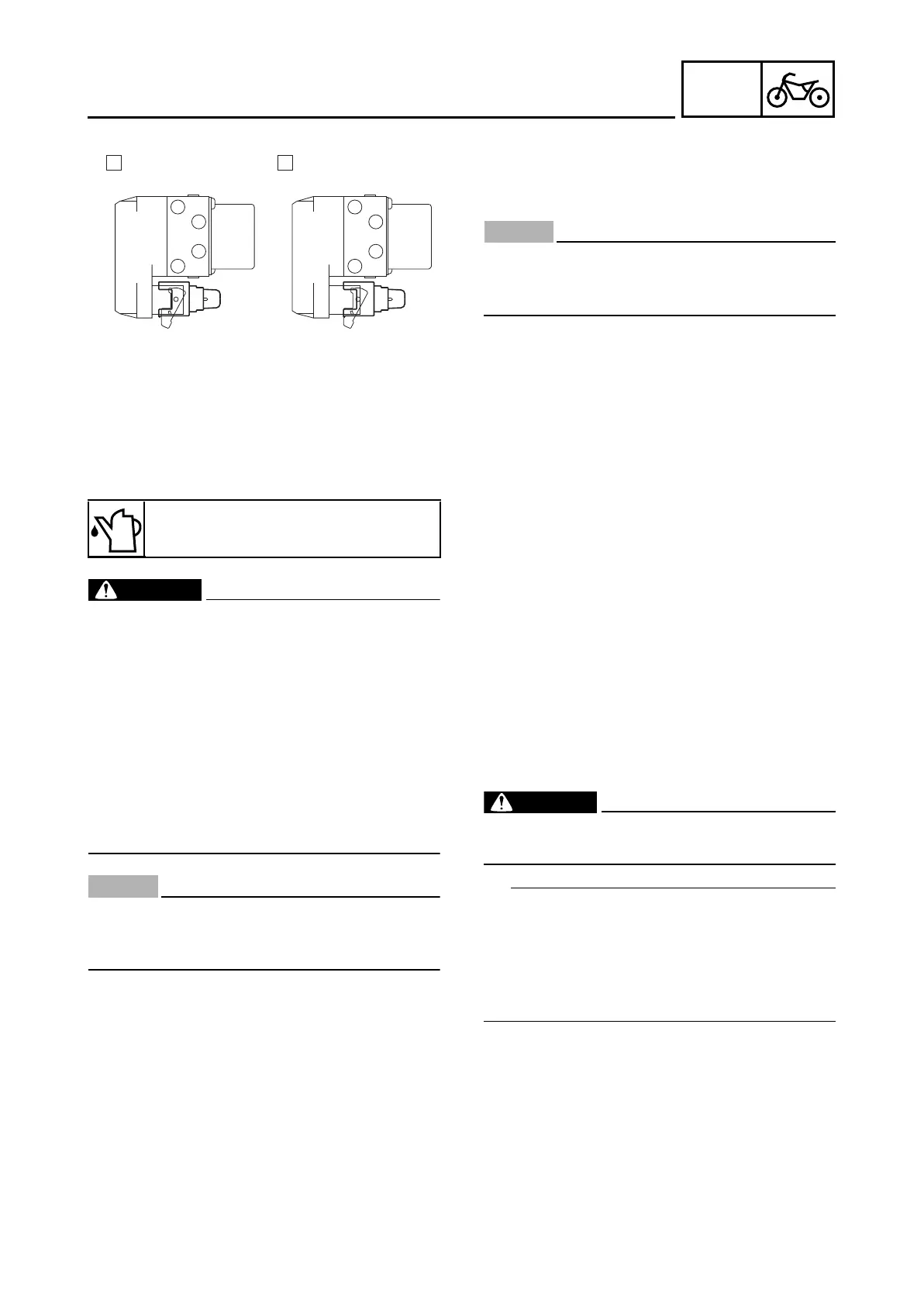
A. The ABS ECU coupler is connected correctly.
B. The ABS ECU coupler is not connected.
Specified brake fluid
DOT 4
B9X-F8197-E0.book Page 26 Thursday, July 16, 2020 2:28 PM


 To Next Page