EasyManua.ls Logo

Yamaha RX21 - Page 21

Yamaha RX21
59 pages
Print Icon
To Next Page IconTo Next Page
To Previous Page IconTo Previous Page
Loading...
a
DN
Beat
Exchange
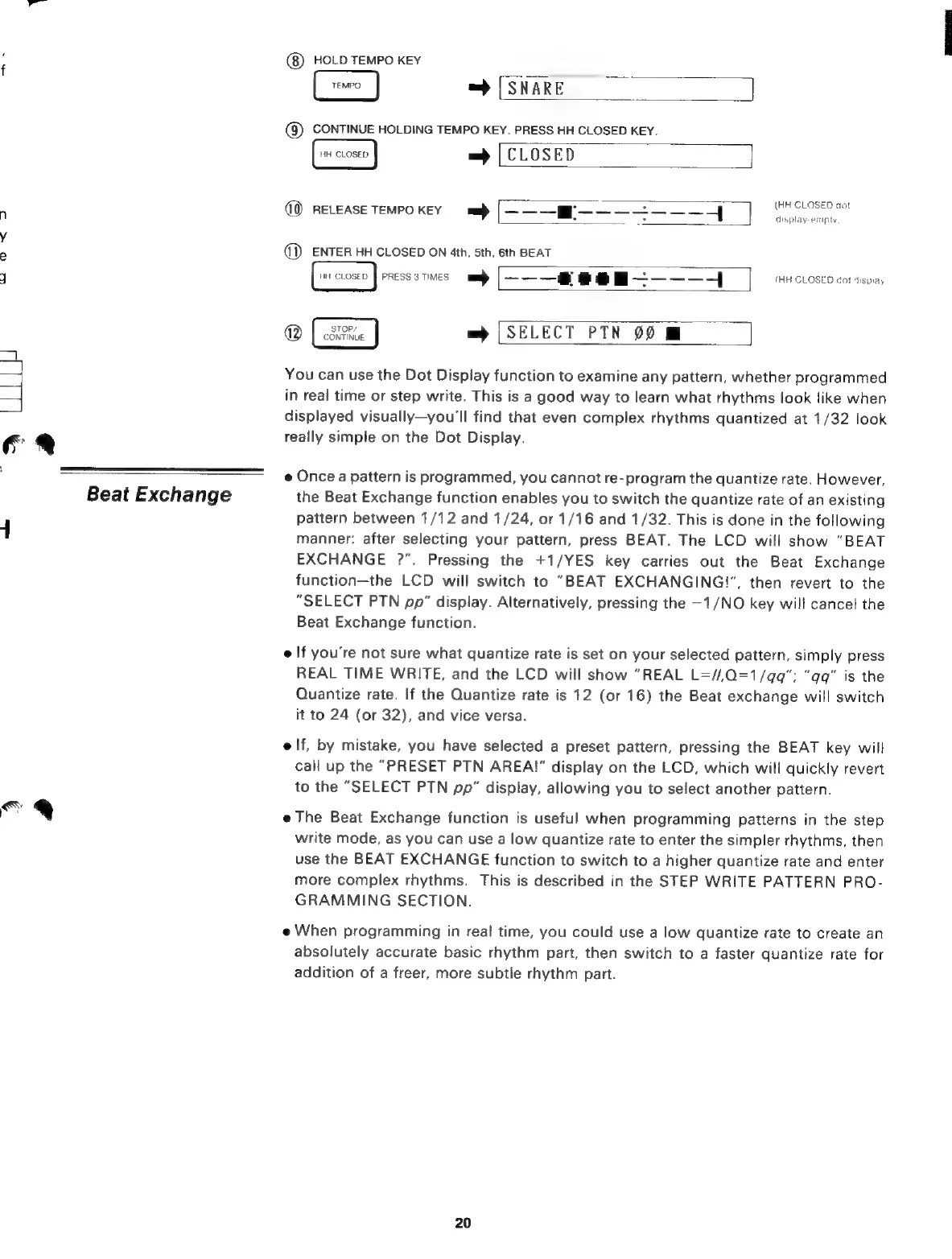
HOLD
TEMPO
KEY
=>
[SNARE
(8)
CONTINUE
HOLDING
TEMPO
KEY.
PRESS
HH
CLOSED
KEY.
=
[CLOSED
RELEASE
TEMPO
KEY
mw
[-——89-———-———4
CLOSE
display-empty!
QD
ENTER
HH
CLOSED
ON
4th, 5th,
6th
BEAT
PRESS
3
TIMES
шаў
[-——«
"8H————-|
ИНН
CLOSED
dot
dispiay)
®
=
[SELECT
PTN
00
M
You
can
use
the
Dot
Display
function
to
examine
any
pattern,
whether
programmed
in
real
time
or
step
write.
This
is
a
good
way
to
learn
what
rhythms
look
like
when
displayed
visually—you'll
find
that
even
complex
rhythms
quantized
at
1/32
look
really
simple
on
the
Dot
Display.
e
Once
a
pattern
is
programmed,
you
cannot
re-
program
the
quantize
rate.
However,
the
Beat
Exchange
function
enables
you
to
switch
the
quantize
rate
of
an
existing
pattern
between
1/12
and
1/24,
or
1/16
and
1/32.
This
is
done
in
the
following
manner:
after
selecting
your
pattern,
press
BEAT.
The
LCD
will
show
"BEAT
EXCHANGE
?".
Pressing
the
+1/YES
key
carries
out
the
Beat
Exchange
function—the
LCD
will
switch
to
"BEAT
EXCHANGING!",
then
revert
to
the
"SELECT
РТМ
рр”
display.
Alternatively,
pressing
the
—1/NO
key
will
cancel
the
Beat
Exchange
function.
e
If
you're
not
sure
what
quantize
rate
is
set
on
your
selected
pattern,
simply
press
REAL
TIME
WRITE,
and
the
LCD
will
show
"REAL
L-//,0-1/9q";
"qq"
is
the
Quantize
rate.
If
the
Quantize
rate
is
12
(or
16)
the
Beat
exchange
will
switch
it
to
24
(or
32),
and
vice
versa.
elf,
by
mistake,
you
have
selected
a
preset
pattern,
pressing
the
BEAT
key
will
call
up
the
"PRESET
PTN
AREA!"
display
on
the
LCD,
which
will
quickly
revert
to
the
"SELECT
PTN
pp"
display,
allowing
you
to
select
another
pattern.
e
The
Beat
Exchange
function
is
useful
when
programming
patterns
in
the
step
write
mode,
as
you
can
use
a
low
quantize
rate
to
enter
the
simpler
rhythms,
then
use
the
BEAT
EXCHANGE
function
to
switch
to
a
higher
quantize
rate
and
enter
more
complex
rhythms.
This
is
described
in
the
STEP
WRITE
PATTERN
PRO-
GRAMMING
SECTION.
e
When
programming
in
real
time,
you
could
use
a
low
quantize
rate
to
create
an
absolutely
accurate
basic
rhythm
part,
then
switch
to
a
faster
quantize
rate
for
addition
of
a
freer,
more
subtle
rhythm
part.
20

Related product manuals