Carl Zeiss Start-Up and Operation Primo Star / Primo Star iLED
30 M60-2-0011 v 08/2008
En
lish
3.4.6 Adjusting reflected-light fluorescence
To carry out examinations according to the reflected-light fluorescence method, the
Primo Star iLED microscope stand with reflected-light fluorescence illuminator is required.
The Primo Star iLED microscope with reflected-light fluorescence illuminator is provided with
an interlock function, which causes the built-in LED of the reflected-light illuminator to be
switched off as soon as the reflected-light illuminator is turned with regard to the stand or
detached.
• First, adjust the microscope as you do for
brightfield, see section
3.4.4.
• Turn the nosepiece to position the objective for
fluorescence application into the light path (e.g.
objective 40x).
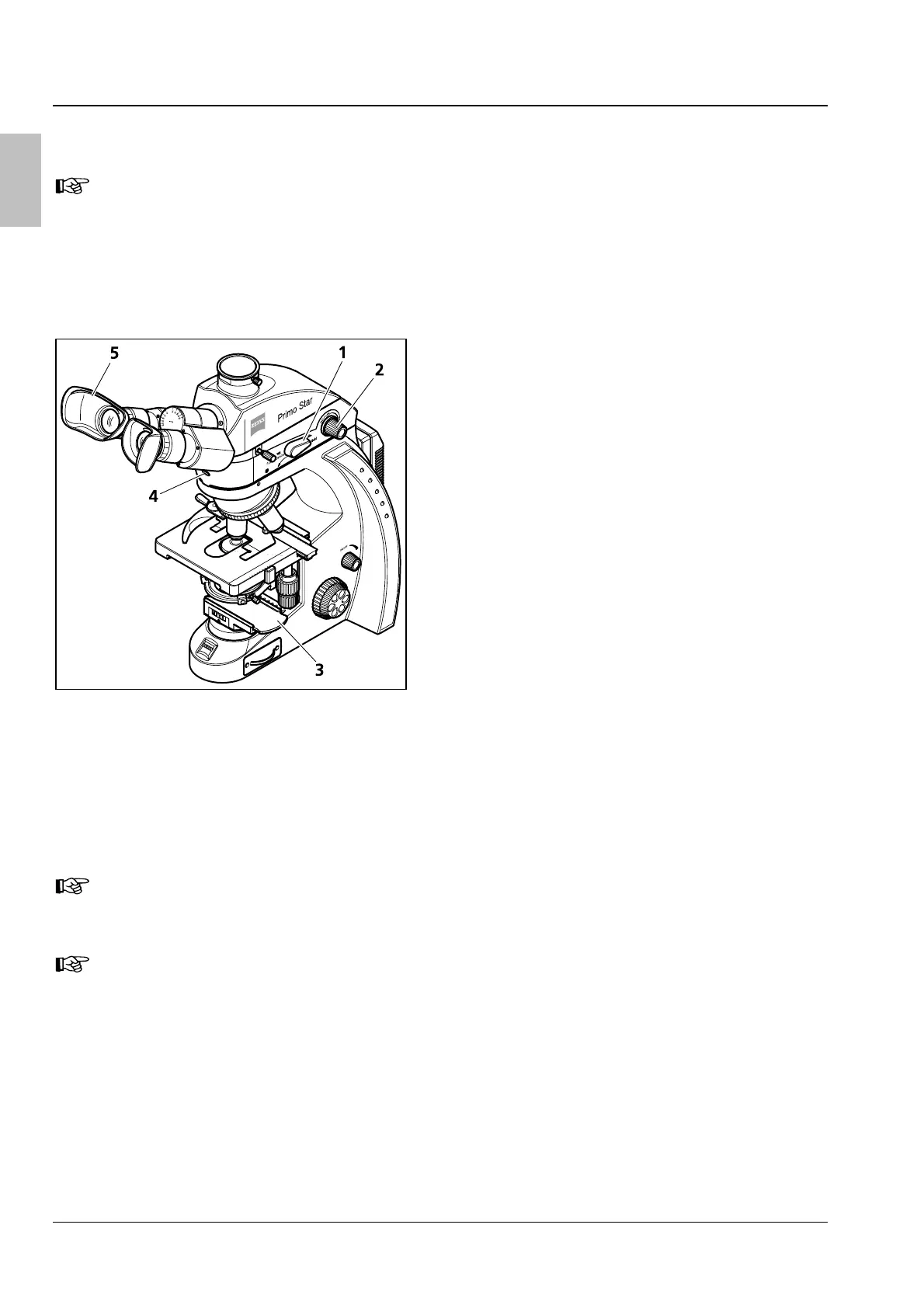
• Set the transmitted light / reflected light
changeover switch (
Fig. 25/1) to the reflected
light position (Fluorescence) (first turn it fully
upward).
• Switch on the reflected-light LED using the
rotary knob (
Fig. 25/2) of the reflected-light
illuminator and adjust the illumination intensity
to a level pleasant for observation. The pilot
lamp (
Fig. 25/4) at the front of the reflected-
light illuminator shows blue. The brightness of
the pilot lamp corresponds to the illumination
intensity adjusted for reflected light.
• Focus on the specimen using the focusing drive.
• To avoid interfering fluorescences (caused by
the transmitted-light LED), push the blocking
position of the slider (
Fig. 25/3) into the light
path.
If the slider is not available, about 90% of the interfering fluorescences can be eliminated by
closing the condenser aperture diaphragm.
Our special eyecups with light protection (
Fig. 25/5) can be used for microscopic
examinations in rooms which are not darkened. They are, however, not suitable for spectacle
wearers and must not be folded over because, otherwise, the required dimensional stability
would get lost.
Fig. 25 Adjusting reflected-light
fluorescence


 To Next Page
 Loading...