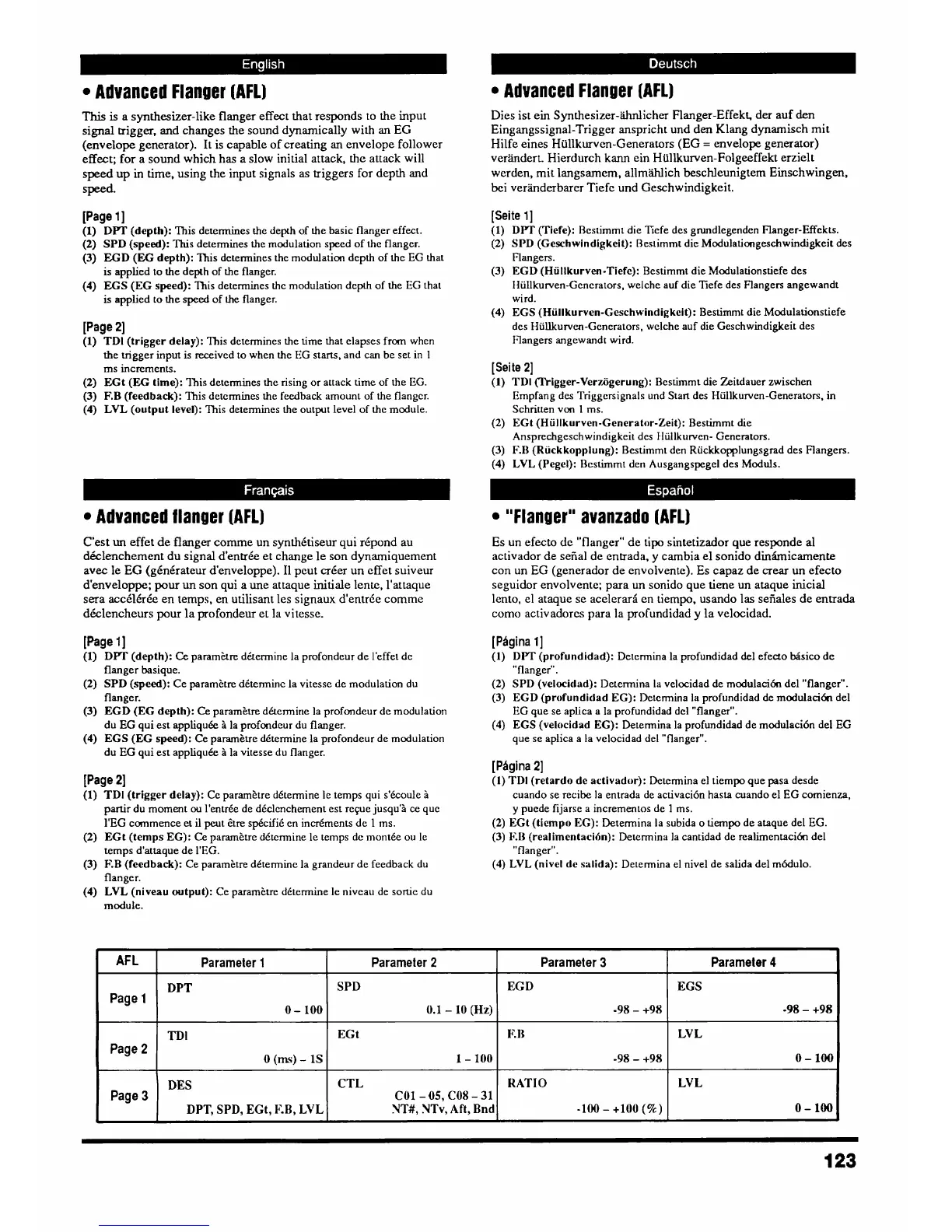
Advanced Flanuer (AFL)
-
-
-
-
Advanced Flanuer (AFL)
This
is a synthesizer-like flanger effect that responds to the input
signal trigger, and changes the sound dynamically with
an
EC
(envelope generator). It is capable of creating an envelope follower
effect; for a sound which has a slow initial attack, the attack will
speed
up
in
time, using the input signals as triggers for depth and
speed.
[Page
1
l
(1) DPT (depth):
'his determines the depth of the basic flanger effect.
(2)
SPD
(sped):
This determines the modulation speed of the flanger.
(3)
EGD
(EG
depth):
This determines the modulation depth of the EG that
is
applied to the depth of the flanger.
(4) EGS
(EG
speed):
This determines thc modulation depth of the EG that
is
applied
to
the
speed
of
the
flanger.
[Page
21
(1) TDI (trigger delay):
This determines the time that elapses from whcn
the trigger input
is
received to when the
EG
starts, and
can
be set in
I
ms increments.
(2) ECt
(EG
time):
This determines the rising or attack time of the BC.
(3)
EB
(feedback):
This determines the feedback amounl of the flangcr.
(4)
LVL
(output level):
This determines the output level of thc module.
Advanced flanoer
(AFL)
C'est
un
effet de flanger comme un syntllCtiseur qui rhpond au
&lenchement du signal d'entrh et change le son dynarniquement
avec le
EG
(gCnCrateur d'enveloppe). I1 peut crker un effet suiveur
d'enveloppe; pour
un
son qui a une attaque initiale lente, I'attaque
sera acc61Qh en temps, en utilisant les signaux d'entrtie comme
dklencheurs
pour
la profondeur et la vitesse.
[pv
11
(1) DPT (depth):
Ce
paramktre dhermine la profondeur de I'effet de
flanger basique.
(2) SPD (speed):
Ce paramktre ditcrminc la vitesse de modulation du
flangcr.
(3)
EGD (EC depth):
Ce
paramhtre dhcrmine la profondeur dc modulation
du
EG
qui est appliquk
?i
la profondeur du flanger.
(4) EGS
(EG
speed):
Cc paramhe &tennine la profondeur de modulation
du EG qui est appliquh
i
la vitesse du flanger.
[Page
21
TDI (trigger delay):
Ce pararnhre dktermine
le
temps qui s'koule
?i
partir du moment
w
l'en&z
de dtclcnchement est ripe jusqu'i
ce
que
1'EG
commence et
il
peut etre spdcifii cn inaiments de
1
ms.
EGt (temps EG):
Ce
paramhe dttcrmine le temps de montk ou
le
temps d'attaque de 1'EG.
EIB
(feedback):
Ce paramhe dtterminc la grandeur de feedback du
flanger.
LVL
(niveau output):
Ce paramktre dttermine le niveau de sortie du
module.
Dies ist ein Synthesizer-iihnlicher Flanger-Effekt, der auf den
Eingangssignal-Trigger anspricht und den Klang dynarnisch mit
Hilfe eines Hiillkurven-Generators (EG
=
envelope generator)
verandert. Hierdurch kann ein HUllkurven-Folgeeffekt erzielt
werden, mit langsarnem, allrniihlich beschleunigtem Einschwingen,
bei veraderbarer Tiefe und Geschwindigkeit.
[Seite
l]
(1) DPT (Tiefe):
Rcstimmt die Tiefe des gmdlegenden Flanger-Effekts,
(2)
SPD
(Geschwindigkeit):
Bes~immt die
Modulationgeschwindigkeit
des
Flangers.
(3)
EGD (Hiillkurven-Tiefe):
Bestimrnt die Mcdulationstiefe des
IJiiUkurven-Gcncrators, welche auf die Tiefe des Flangers angewandt
wird.
(4)
EGS
(Hiillkurven-Geschwindigkeit):
Bestimmt die Modulationstiefe
des HiiUurven-Generators, wclche auf die Geschwindigkeit des
Iqangers angewandt wird.
[Sei te
21
(l)
TDI
(lkigger-Ver7,ijgerung):
Bcstimmt die Zeitdauer zwischen
Empfang des Triggersignals und Start des Hiillkurven-Generaton,
in
Schriuen vcm
1
ms.
(2)
EGt
(Hiillkurven-Generator-Zeit):
Bestimmt die
Ansprechgeschwindigkeit des Hiiilkurven- Generators.
(3)
F.B
(Riickkopplung):
Bestimmt den Riickkopplungsgrad des Flangers.
(4)
LVL (Pegel):
Bestirnmt den Ausgangspegel des Moduls.
"Flangerm avanzado
(AFLI
Es un efecto dc "flanger" de tip sintetizador que responde a1
aclivador de seiial de entrada,
y
carnbia el sonido dinhicarnente
con un EG (generador de envolvente). Es capaz de crear un efecto
seguidor envolvente;
para
un
sonido que time un ataque inicial
lento, el ataque se acelerarh en tiempo, usando las seiiales de entrada
como activadorcs para la profundidad
y
la velocidad.
[Phgina
l]
(1)
DPT
(profundidad):
Determina la profundidad del efeao Msico de
"flanger".
(2)
SPD (velocidad):
Determina la velocidad de modulacih del "flanger".
(3)
EGD (profundidad
EG):
Determina la profundidad
de
modulaci6n del
EG
que se aplica a la profundidad del "flanger".
(4) EGS (velocidad EG):
Determina la profundidad de rnodulaci6n del
EG
que se aplica a la velocidad del "flanger".
[Phgina
21
(1)
TDI (retardo de activador):
Determina el tiempo que pasa desde
cuando se recibe la entrada de activaci6n hasla cuando el
EG
comienza,
y
puede fijarse a incrementos de
1
ms.
(2)
EGt
(tiempa
EG):
Determina la subida o
tiempo
de ataque del
EG.
(3)
E'.B
(realimentacibn):
Determina la cantidad de realimentaci6n del
"flanger".
(4) LVL (nivel de salida):
Delermina el nivel de salida del m6dulo.
AFL
Page
l
Page
2
Page
3
Parameter
1
DPT
0
-
100
TDI
0
(m$)
-
1s
DES
DPT, SPD,
EGt,
F.B,
LVL
Parameter
2
SPD
0.1
-
10
(Hi)
EG
t
1
-
100
CTL
C01
-
05,
C08
-
31
NT#,
NTv, Aft,
Bnd
Parameter
3
EGD
-98
-
+98
IT.
n
-98
-
c98
RATIO
-100
-
+l00
(%)
Parameter
4
EGS
-98
-
+98
LV
L
0-100
LVL
0-100


 To Next Page
 Loading...