....
you
can
see a number
oflines
which have to be repeated
at
various points in
the
program, for example
the
section from line 260 to 31
0.
Let's make
that
section into
a sub-routine
and
add the instruction
RE
T
URN
at
the
end. Then, we'll call the
sub-routine using
the
command
GOSUB
260 whenever we
want
to use it. The
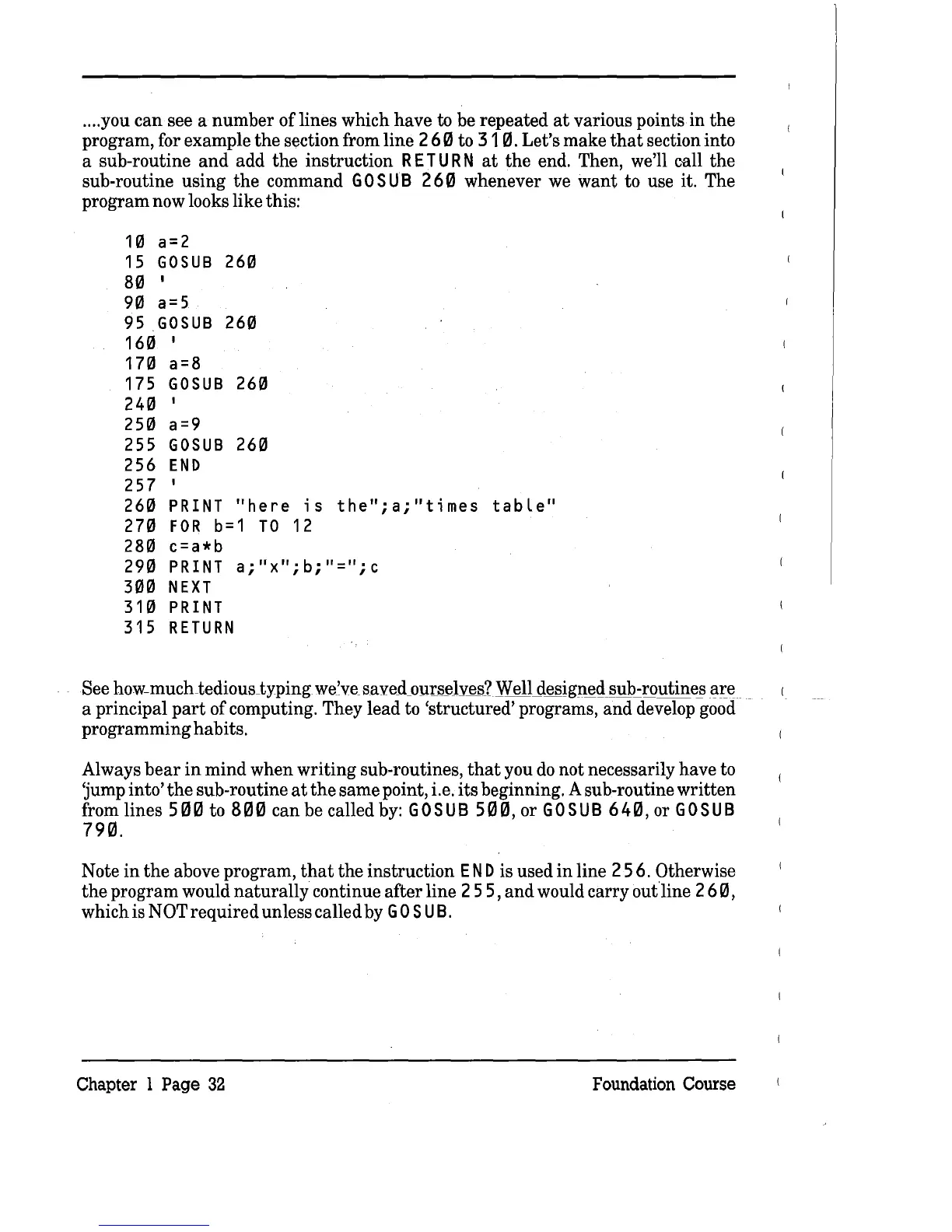
program now looks like this:
10
a=2
15
GOSUB
260
80
I
90 a=5
95.GOSUB
260
160
I
170 a=8
175
GOSUB
260
240
I
250 a=9
255
GOSUB
260
256
END
257 I
260
PRINT
"here
is
the";a;"times
tabLe"
270
FOR
b=1
TO
12
280 c=a*b
290
PRINT
a;"x";b;"=";c
300
NEXT
310
PRINT
315
RETURN
See how-much-tedious_typing we've
sayed_ours~lyeslWell
JiesigIlJl(L~mb:l'()utine§
are
a principal
part
of computing. They lead to 'structured' programs, and develop good
programming habits.
Always
bear
in
mind when writing sub-routines,
that
you
do
not necessarily have to
Jump into'
the
sub-routine
at
the
same point, i.e. its beginning. A sub-routine written
from lines 5
00 to
800
can be called by: G 0
SUB
5 0
0,
or G 0
SUB
640, or G 0
SUB
790.
Note
in
the
above program,
that
the instruction
END
is used
in
line 256. Otherwise
the
program would
naturally
continue after line 2 5 5 , and would carry
outline
2 60,
which is NOT required unless called by
GO
SUB.
Chapter 1 Page
32
Foundation Course


 To Next Page