42
SECTION 7
MAINTENANCE INFORMATION
7.3.6 EMERGENCY/PARKING BRAKE ADJUSTMENT
Adjusting the Emergency/Parking Brake
ADM
There are 8 positions on the hand brake lever. The cable
should be adjusted to have the 5th position (click) as fully
engagedwithnormal rmeort(extraeortrequired for
6th). A properly adjusted cable with the hand lever fully
down should allow the parking brake disk to turn easily
between the pads while rocking the vehicle slightly back and
forth. If the cable is too tight the brake will be engaged and
the operator may experience a sluggish vehicle and cause the
pads to wear prematurely. If the 5th position (click) does not
providefullengagementwithnormalrmeort(extraeort
for the 6th) adjust the cable accordingly. Loosen the jam nut
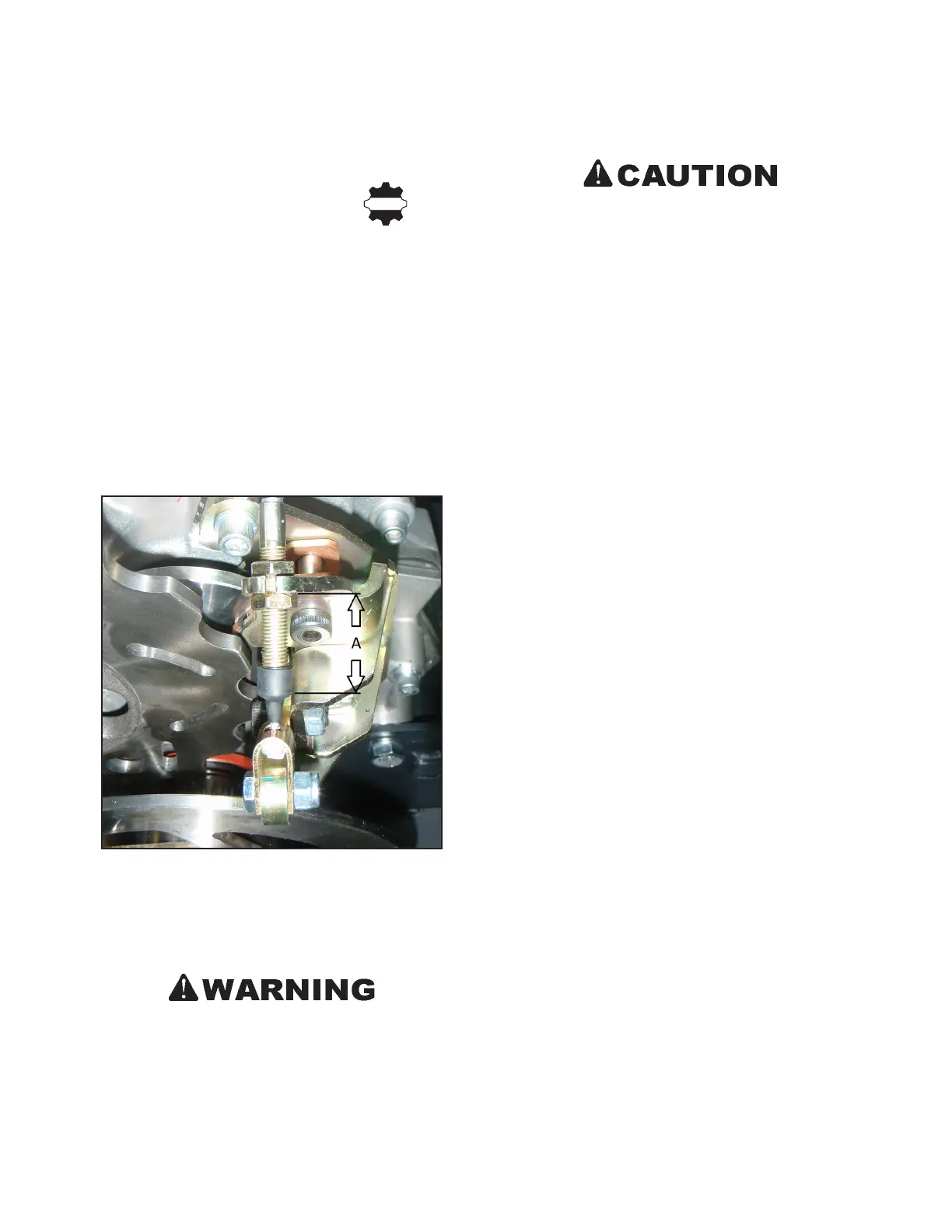
at the caliper and adjust as needed. Reduce distance "A" to
provide more braking force or increase distance "A" if brake
does not turn freely. Figure 7-28.
Figure 7-28. Adjusting the parking brake.
The emergency/parking brake system has been factory adjust-
edtoensureproperbrakingeectiveness.However, before
the vehicle is used for the rst time, and after every 25 hours
of operation, the adjustment of the brake must be inspected
The use of an improperly adjusted emergency/parking
brake is a serious hazard, and could lead to vehicle
damage or personal injury.
The hand brake lever should be adjusted such that when pulled
uprmlyitiscapableofholdingthevehiclefromrollingon
a grade. It should also ensure a good braking response when
applied to stop the vehicle during normal operation.
If the emergency/parking brake system is adjusted too
tight when the lever is in the down position, overheating
of the brake system will occur due to drag between brake
pads and brake discs.
7.3.7 BRAKE PLUNGER ADJUSTMENT
IMPORTANT
It is critical that the master cylinder pistons are adjusted
properly when the steering handlebars are in the cen-
tred position. Overheating of the brake system could
occur due to an improperly adjusted brake system. Any
suspected issues related to the steering performance of
your vehicle should be immediately addressed by a local
authorized ARGO dealer.
7.3.8 BRAKE COOLING SYSTEM
Some vehicles with hydraulic brakes may have a 12 volt fan
forcing cool air from outside the engine compartment onto
the brake components to protect the system from overheating.
Overheating can damage the hydraulic brake components.
Make sure the brake cooling fan is operating when the vehicle
is being driven. The fan operates when the ignition switch is
in the “run” position. Keep the brake cooling system in good
working order by:
• cleaning debris from the air intake screen and ducts.
• keeping electrical connections tight and components se-
curely mounted.
7.3.9 ENGINE COOLING & EXHAUST SYSTEM
Engine cooling air is drawn in on the right side of the engine
compartment and expelled with the exhaust on the left side.
Keep all ducting and screening in place.
Coolant Recommendations - Kohler Aegis L/C Only
Use equal parts of ethylene glycol (anti-freeze) and water only.
Distilled or deionized water is recommended, especially in ar-
eas where the water contains a high mineral content. Propylene
glycol based anti-freeze is not recommended.
This mixture will provide protection from -37º C (-34º F) to
108º C (226º F). For protection and use outside the indicated
temperature limits, follow the anti-freeze manufacturers
instructions on the container, but do not exceed 70% anti-
freeze.
DO NOT use anti-freeze with stop-leak additive(s), or put any
other additives in the cooling system.






 To Next Page