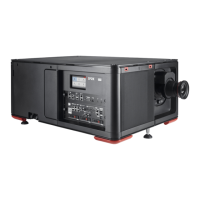
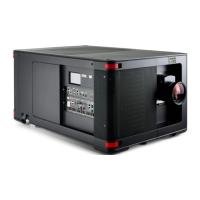
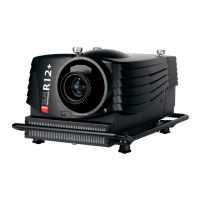
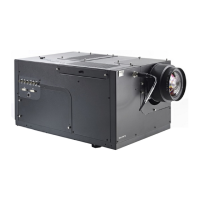
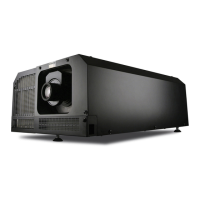
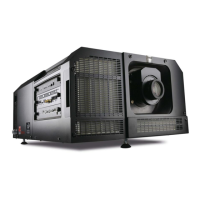
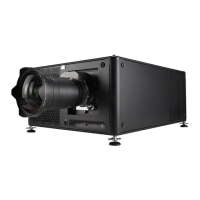
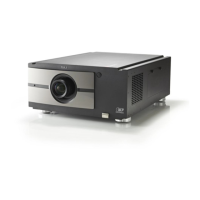
The provided document is an installation manual for the Barco SP2K-C series projector, which includes models SP2K-25C and SP2K-20C. This manual details the installation process, safety guidelines, technical specifications, and maintenance procedures for these digital cinema projectors.
Function Description
The Barco SP2K-C projector is a high-brightness digital cinema projector designed for professional use. It utilizes laser light technology to project images onto a screen. The projector integrates a Cinema Controller and can be equipped with an optional Integrated Cinema Processor (ICMP-X) or ICP-D for content management and playback. It supports various power configurations (single-phase or three-phase) and offers advanced features for image alignment, color calibration, and remote control.
Important Technical Specifications
Environmental Conditions:
- Ambient Temperature: Operating: 10°C (50°F) to 40°C (104°F); Non-Operating: -15°C (5°F) to 60°C (140°F).
- Air Cleanliness: Clean office environment (ISO 14644-1 ISO Class 9).
- Humidity: 5% RH to 85% RH Non-Condensed (operating and non-operating).
- Altitude: Operating: -60 (-197 ft) to 4,000 m (13,125 ft); Non-Operating: -60 (-197 ft) to 10,000 m (32,810 ft). For altitudes exceeding 2,500 m (8,202 ft), the maximum ambient temperature should be reduced.
- Minimum Airflow: SP2K-25C/SP2K-20C: 400 CFM at 25°C (77°F), 650 CFM at 35°C (95°F).
Power Requirements:
- Three-phase power net:
- 200-240V/346-415V, 3W+N+PE, 9A, 50/60Hz (Y configuration).
- 200-240V, 3W+PE, 11A, 50/60Hz (Δ configuration).
- Single-phase power net: 200-240 VAC, L1+N+PE, 14A, 50/60Hz.
- Power Cord: Cross-sectional area of conductors not less than 4 mm² (10 AWG). Rating: min 300V (mono phase/Δ config), min 500V (Y config). Cable gland clamping range: 11-21 mm.
- UPS (Uninterruptible Power Supply) for electronics: Output voltage 200-240 V at 50/60 Hz, output current 5 A. UPS inlet cord: min 1.50 mm² (14 AWG), min 300V.
- Circuit Breakers: Max 16A for UPS, max 40A for complete unit.
Physical Specifications:
- Weight: ±103 kg (±227 lbs) without lens. Requires minimum 4 people for carrying.
- Dimensions: Detailed dimensions are provided for the projector, universal pedestal, flat-packed pedestal, and projector with exhaust adapter (optional).
- Air Flow: Three air inlets (front, rear, bottom) and one air outlet (top).
Safety:
- Risk Group: RG3 (Risk Group 3) IEC EN 62471-5:2015.
- Hazard Distance (HD): Distance from the projection lens where light intensity becomes unsafe for direct exposure.
- Restriction Zone (RZ): Area where access to the projected beam is restricted. Minimum separation height (SH) of 2.0 meters (or 3.0 meters in unrestrained environments) and lateral separation width (SW) of 1.0 meter (or 2.5 meters in unrestrained environments) are required.
- Exclusion Zone (fire hazard): Not less than 40 cm (16”) around all external surfaces of the projector.
Usage Features
Lens System:
- Available Lenses: A range of HB (High Brightness) lenses with various throw ratios (e.g., 0.80–1.16, 1.09–1.40, 1.2–1.81, 1.4–2.05, 1.6–2.5, 1.95–3.2, 2.4–3.9).
- Lens Selection: Barco's website provides a lens calculator tool to determine the best lens for specific setups.
- Motorized Lens Adjustment: Features motorized lens shift, zoom, and focus.
- Shift Range (C-Lens holder): 30% up, 70% down, 15% left, 15% right for all throw ratios.
- Scheimpflug Adjustment: Allows fine-tuning of the lens plane to ensure a sharp focus plane across the screen, especially when the projector is tilted.
Control and Connectivity:
- Web Communicator: A built-in web application for projector setup and control, accessible via a web browser (Chrome recommended) on iOS and Android devices.
- Web Commander: Screen management system for Barco Alchemy projectors, offering an intuitive user interface for streamlined operation.
- Touch Display (optional): Provides local control and status indication.
- Cinema Controller Ports:
- LAN (2 ports): 10/100/1000 base-T Ethernet for projector control and automation (not content streaming).
- WAN (1 port): 10/100/1000 base-T Ethernet for network connection, allowing remote access via Web Communicator.
- GPO (General Purpose Output) ports: RJ45 connectors for sending trigger signals to other devices.
- GPI (General Purpose Input) ports: RJ45 connectors for receiving trigger signals from other devices, operational in Standby mode for remote wake-up.
- 3D Interface port: For connecting external 3D devices.
- USB port (Type A): For firmware updates and log file downloads.
- ICMP-X (Integrated Cinema Processor - Direct) Ports:
- AUDIO-AES (2 RJ45 ports): Sixteen configurable audio signals.
- GPO (2 RJ45 ports): For sending trigger signals.
- GPI (2 RJ45 ports): For receiving trigger signals.
- SYNC IN/OUT: Coaxial cable (50Ω) for multiple-projector synchronization.
- LAN (2 ports): For content transfer (dedicated Data network recommended for optimal performance).
- USB 2.0 (2 ports) & USB 3.0 (2 ports): For loading content (DCP), keys (KDM), or software updates. USB 3.0 ports are recommended for faster ingest and external device power.
- HDMI A/B (2 ports): HDMI 2.0 connectors for video sources.
- 3G-SDI A/B (2 ports): SDI connectors for video sources.
Power Cycle Management:
- Power States: Mains power off, OFF mode, ECO mode, READY mode, ON mode, Going to ECO mode, each with distinct LED indicators.
- Switching ON: Locally via power button/touch display, or remotely via Web Communicator/GPI3.
- Switching OFF: Preferred method is ECO mode (via touch display or Web Communicator). Direct OFF mode is achieved by pressing the power button or sending a GPI3 signal for more than six seconds.
Content Management (ICMP-X):
- HDD Configuration: Three HDDs in a RAID 5 configuration for local storage, providing redundancy for one disk failure.
- Degraded Mode: Continues operation with one disk failure, but prompt replacement is crucial.
- RAID Recovery: Automatic process when a new HDD is detected.
- HDD Swaps: Detailed procedures and implications for replacing HDDs, including compatibility with GEN1/GEN2 storage controllers and data preservation.
- Device Certificate: Digital certificate (*.pem) required for ordering KDMs, retrievable via QR code or control software.
Maintenance Features
General Maintenance:
- Air Filter Cleaning/Replacement: Regular cleaning is essential to prevent overheating.
- Lens Cleaning: Use a soft dry cloth for anti-reflective coated lenses. Avoid liquid or aerosol cleaners.
- Software Updates: Firmware updates can be performed via Web Communicator or USB device.
- Internal Clock Settings (ICMP-X): Manual correction via Web Communicator or automatic synchronization with an NTP server.
Cover Removal/Mounting:
- Front Cover: Can be removed for filter checks without turning off the projector.
- Rear Cover: Can be removed for filter checks without turning off the projector.
- Operator Side Cover: Removal requires removing front and rear covers.
- Light Source Side Cover: Removal requires removing front and rear covers.
- Top Cover: Removal requires removing four screws.
- Sealed Compartment: Procedures for opening and closing for convergence adjustments.
Calibration:
- Color Calibration: Process includes creating lens position files, 3D files (if applicable), white point calibration, light sensor calibration, and color gamut calibration.
- White Point Calibration: Adjusts the projector's native white point to match the DCI standard, using laser power calibration. Requires a spectroradiometer.
- Color Gamut Calibration: Corrects the projector's color space to match the desired target color gamut (e.g., DCI standard), using measured primary color coordinates.
- Convergence Adjustment: Manual correction of Red and Blue DMDs relative to the Green DMD using control knobs. Each knob provides 6–8 pixels maximum displacement. Requires removal of top and side covers of the Light Processor compartment.
Troubleshooting:
- ICMP-X HDD Status LEDs: Provide visual indicators for HDD I/O activity, RAID status (OK, degraded, broken), and errors.
- Troubleshooting Tables: Provide solutions for common HDD-related issues like single disk failure, multiple disk failure, and "local storage not available" errors.
- ICMP-X Reset: Options include rebooting via Web Communicator or hardware reset button (use as a last resort to avoid data damage).

 Need help?

 To Next Page
 General