20 en | Planning INTEGRUS
2023-01 | V01 |
User manual
Bosch Security Systems B.V.
4 Planning
4.1 IR radiation
The Integrus system is based on transmission by modulated infrared radiation. Infrared
radiation forms part of the electromagnetic spectrum, which is composed of visible light, radio
waves and other types of radiation. It has a wavelength just above that of visible light. Like
visible light, it is reflected from hard surfaces, yet passes through translucent materials such
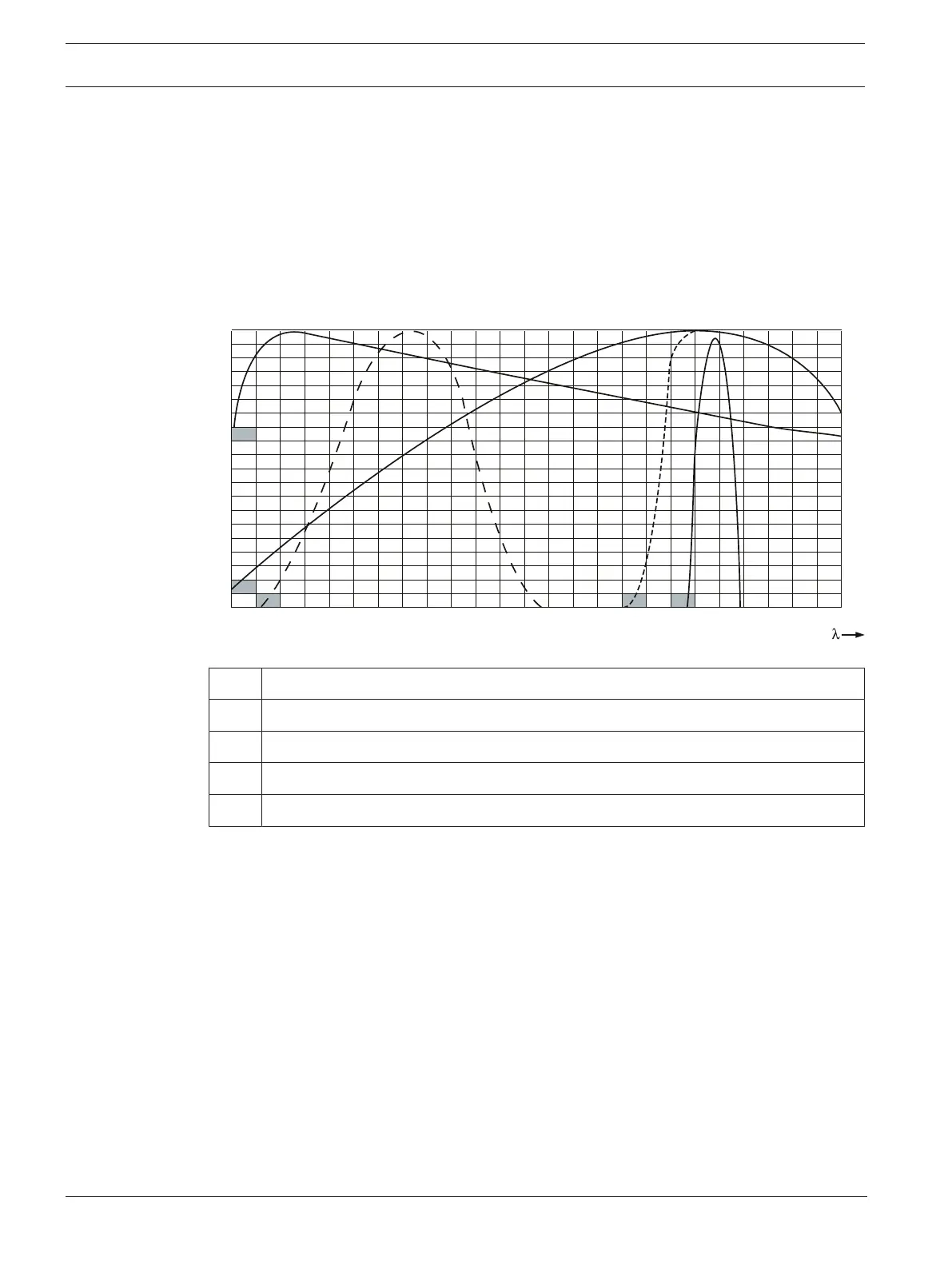
as glass. The infrared radiation spectrum in relation to other relevant spectra is shown in the
next figure.
100
75
1
4
2
50
25
0
400 500 600 700 800
5 3
900 1000 nm
%
Figure4.1: Infrared radiation spectrum in relation to other spectra
1 Daylight spectrum
2 Sensitivity of the human eye
3 IR radiator
4 Sensitivity of IR sensor
5 Sensitivity of IR sensor with daylight filter
4.2 Aspects of Infrared distribution systems
A good infrared distribution system ensures that all delegates in a conference venue receive
the distributed signals without disturbance. This is achieved by using enough radiators, placed
at well planned positions, so that the conference venue is covered with uniform IR-radiation of
adequate strength. There are several aspects that influence the uniformity and quality of the
infrared signal, which must be considered when planning an infrared radiation distribution
system. These are discussed in the next sections.
4.2.1 Directional sensitivity of the receiver
The sensitivity of a receiver is at its best when it is aimed directly towards a radiator. The axis
of maximum sensitivity is tilted upwards at an angle of 45 degrees (see the next figure).
Rotating the receiver will decrease the sensitivity. For rotations of less than +/- 45 degrees
this effect is not large, but for larger rotations the sensitivity will decrease rapidly.












 To Next Page