The WTS is a weight measurement system designed for industrial applications, offering detailed information about its setup, commissioning, and operation. This manual provides comprehensive instructions to ensure safe use and proper measurement system functionality.
Function Description
The WTS system is designed to measure weight using load cells and provide various outputs and control functionalities. It supports both semi-automatic tare (NET/GROSS) and preset tare operations. The system can be configured for different weight units, divisions, and measurement ranges. It features a digital display for showing weight values, setpoints, and system parameters.
Key functionalities include:
- Weight Measurement: Accurate measurement of weight from connected load cells.
- Tare Functionality: Supports semi-automatic tare (NET/GROSS) and preset tare, allowing for the subtraction of container weight or other known weights.
- Setpoints: Programmable setpoints with hysteresis for controlling external devices based on weight thresholds.
- Outputs: Provides analog and digital outputs for integration with PLCs, control systems, or other equipment.
- Communication: Supports RS485 serial communication (Modbus RTU, ASCII, continuous transmission protocols) and RS232 for remote control and data exchange.
- Calibration: Offers theoretical calibration, real calibration with sample weights, and zero value manual entry for precise adjustment.
- Filtering: Includes a digital filter to stabilize weight readings, especially in environments with vibrations or disturbances.
- Peak Hold: Displays the maximum weight value reached.
- Power-on Zero Setting: Automatically sets the zero point at power-on.
- Tracking: Maintains the zero point within a specified range.
Important Technical Specifications
The WTS system operates within specific electrical and environmental parameters to ensure optimal performance and reliability.
- Power Supply and Consumption (VDC): 12 - 24 VDC +/- 10%; 5 W.
- No. of Load Cells in Parallel and Supply: Max 8 (350 ohm); 5VDC/120mA.
- Linearity / Analog Output Linearity: < 0.01% F.S.; < 0.01% F.S.
- Thermal Drift / Analog Output Thermal Drift: < 0.0005 % F.S. /°C; < 0.003 % F.S./°C.
- A/D Converter: 24 bit (16.000.000 points).
- Max. Divisions (with measurement range): +/- 999999.
- Measurement Range: +/- 19.5 mV.
- Max Sensitivity of Usable Load Cells: +/-3 mV/V.
- Max Conversions per Second: 80 conversions/second.
- Display Range: - 999999; + 999999.
- No. of Decimals / Display Increments: 0 - 4 / 1 x 2 x 5 x 10 x 20 x 50 x 100.
- Digital Filter / Readings per Second: 10 levels / 5 – 80 Hz.
- Digital Logic Outputs: N.2 - max 24 VDC; 60mA.
- Digital Inputs: N.2 - optoisolated 5 - 24 VDC PNP.
- Serial Ports: RS485.
- Baud Rate: 2400, 4800, 9600, 19200, 38400, 115200.
- Humidity (non-condensing): 85%.
- Storage Temperature: - 20°C + 80°C.
- Working Temperature: - 20°C + 60°C.
- Optoisolated Analog Output: 0-20 mA; 4-20 mA (max 300 ohm); 0-10 VDC; 0-5 VDC; +/- 10 VDC, +/- 5 VDC (min 10 kohm).
- IP67 Box Versions: Available with transparent cover, external keypad, and integrated power supply, all with six M16x1.5 cable glands.
- Communication Protocols: Modbus RTU, ASCII bidirectional protocol, continuous transmission.
Usage Features
The WTS is designed for user-friendly operation with a clear menu structure and intuitive controls.
- Display and Keypad: The device features a digital display and a keypad for navigating menus, entering data, and performing operations. The display shows weight, setpoints, and various system parameters.
- Menu Navigation: The "MENU Enter" key is used to access and confirm menu entries, while the "ESC" key allows exiting menus or canceling operations. The "PRINT" key is used to confirm and save settings or to display gross weight temporarily. The "TARE" key performs tare resetting.
- Setpoint Programming: Setpoints can be configured with specific weight values and hysteresis to control outputs. This allows for automated processes based on weight thresholds.
- Unit Selection: The system supports various units of measure, including kilograms, grams, tons, pounds, newtons, litres, bar, atmospheres, pieces, and kilogam meters, providing flexibility for different applications.
- Filter Adjustment: The digital filter can be adjusted to optimize stability and response time, making the system suitable for various environmental conditions.
- Serial Communication: The RS485 and RS232 interfaces enable integration with external systems for data logging, remote control, and automation. Different communication protocols and baud rates are supported.
- Test Functions: Built-in test functions allow users to check inputs, outputs, analog signals, and load cell response in mV, aiding in troubleshooting and verification.
- Error Messages: The system provides clear error messages to indicate issues such as load cell errors, AD converter malfunctions, or weight exceeding limits.
Maintenance Features
Proper maintenance is crucial for the longevity and accuracy of the WTS system. The manual provides guidelines for installation, calibration, and general care.
- Installation Guidelines:
- Keep away from heat sources and direct sunlight.
- Repair the instrument from rain (except special IP versions).
- Do not wash with water jets (except special IP versions).
- Do not dip in water.
- Do not spill liquid on the instrument.
- Do not use solvents to clean the instrument.
- Do not install in areas subject to explosion hazard (except special Atex versions).
- Earthing: Proper earthing of the weighed structure and the instrument is essential to prevent electrostatic charges and ensure accurate measurements. The manual provides detailed diagrams and instructions for earthing configurations.
- Cable Protection: Use water-proof sheaths and joints to protect cables from environmental damage.
- Mechanical Restraints: Use hoses and flexible couplings with open mouthpieces for rubber protection; in case of hard pipes, place the pipe support or anchor bracket as far as possible from the weighed structure (at a distance at least 40 times the diameter of the pipe).
- Connecting Several Cells in Parallel: Connect several cells in parallel by using, if necessary, a watertight junction box with terminal box. The cell connection extension cables must be shielded.
- Welding: Avoid welding with the load cells already installed. If this cannot be avoided, place the welder ground clamp close to the required welding point to prevent sending current through the load cell body.
- Calibration: Regular calibration is recommended to maintain accuracy. The system supports various calibration methods, including theoretical calibration, real calibration with sample weights, and zero value entry.
- Firmware Updates: The device stores firmware version and other identification data, which can be checked for maintenance purposes.
- Disposal: The product contains a sealed lead acid battery that must be recycled properly. The device itself is electrical/electronic equipment and cannot be disposed of as municipal solid waste; it must be delivered to a recycling center.
The manufacturer emphasizes that any modifications or improvements to the product must be carried out by authorized personnel to maintain warranty and prevent damage. Regular checks and adherence to the manual's guidelines will ensure the WTS system operates efficiently and reliably.

 Need help?
 General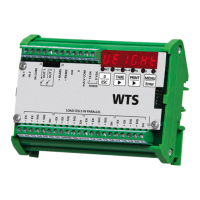

 To Next Page