User manual WTS Ver.1.16
Seite 17 von 52
9.2 REAL CALIBRATION (WITH SAMPLE WEIGHTS)
After having performed the THEORETICAL CALIBRATION and TARE WEIGHT ZERO
SETTING, this function allows correct calibration to be done using sample weights of
known value, if necessary, any deviations of the indicated value from the correct value
to be corrected.
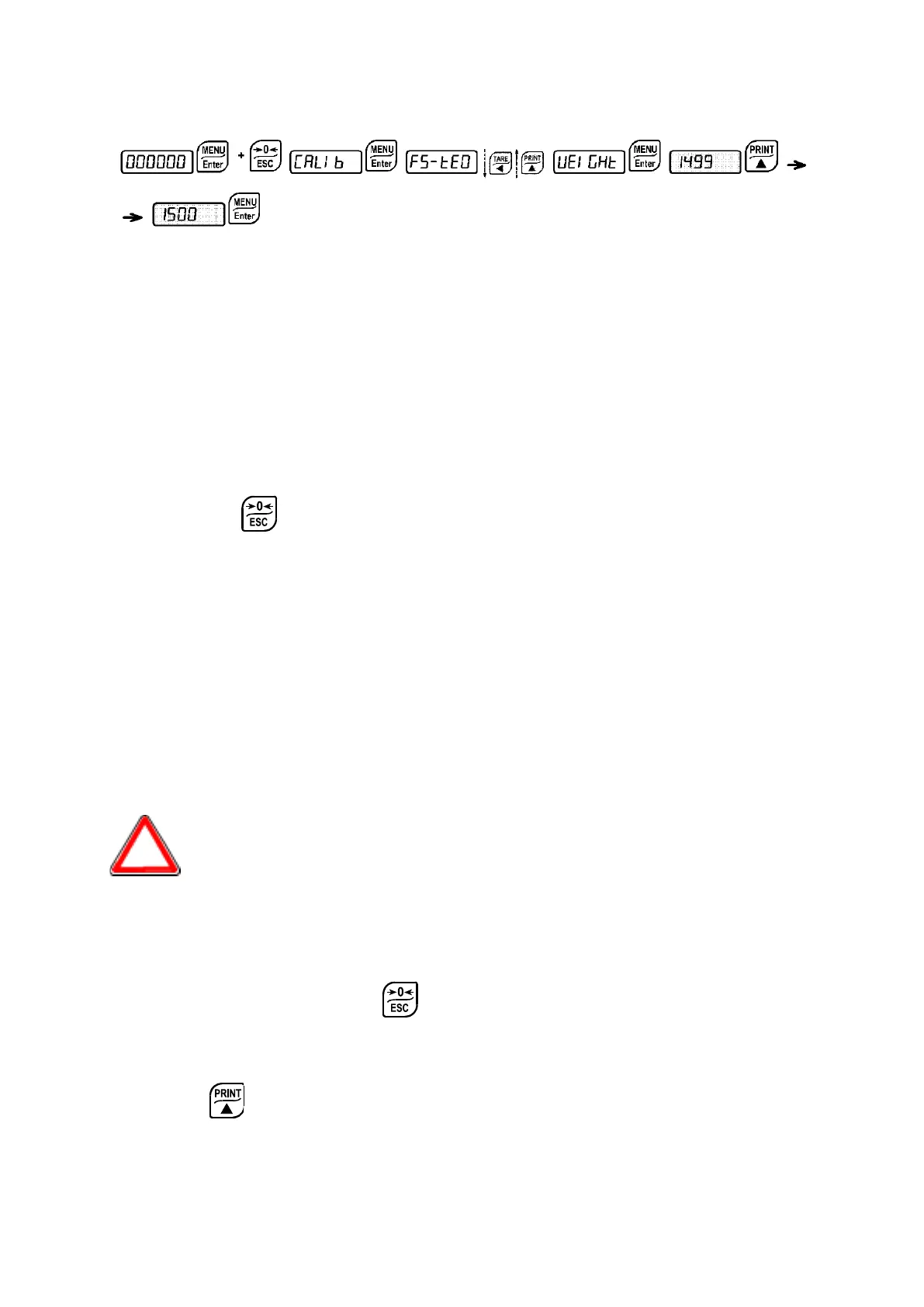
Load onto the weighing system a sample weight, which must be at least 50% of the maximum
quantity to be weighed.
By confirming the message
the flashing value of the weight currently on the system is
displayed. In this phase all of the LEDs are off. Adjust the value on display by using the arrow
keys if necessary. After confirming, the new set weight will appear with all the LEDs flashing.
After an additional confirmation, the message
will be restored and by repeatedly
pressing the key the weight will once again be displayed.
Example: for a system of maximum capacity 1000 kg and 1 kg division, two sample
weights are available, one of 500 kg and the other one of 300 kg. Load both weights onto
the system and correct the indicated weight to 800. Now remove the 300 kg weight, the
system must show 500; remove the 500 kg weight, too; the system must read zero. If this
does not happen, it means that there is a mechanical problem affecting the system
linearity.
CAUTION: identify and correct any mechanical problems before repeating the
procedure.
- If theoretical full scale and recalculated full scale in real calibration are equal, it
means that the theoretical calibration is currently in use; otherwise, the real
calibration based on sample weights is in use.
- If the correction made changes the previous full scale for more than 20%, all the
parameters with settable weight values are reset to default values.
LINEARISATION OPTION ON MAX 8 POINTS:
It is possible to perform a linearisation of the weight repeating the above-described
procedure up to a maximum of eight points, using eight different sample weights. The
procedure ends by pressing the button or after entering the eighth
value; at this
point it will no longer be possible to change the calibration value, but only to perform a new
real calibration. To perform a new calibration, should return to the weight display and then re-
entering into the calibration menu.
By pressing after having confirmed the sample weight that has been set, the full scale
appears, recalculated according to the value of the maximum sample weight entered and
making reference to the cell sensitivity set in the theoretical calibration (
).


 To Next Page