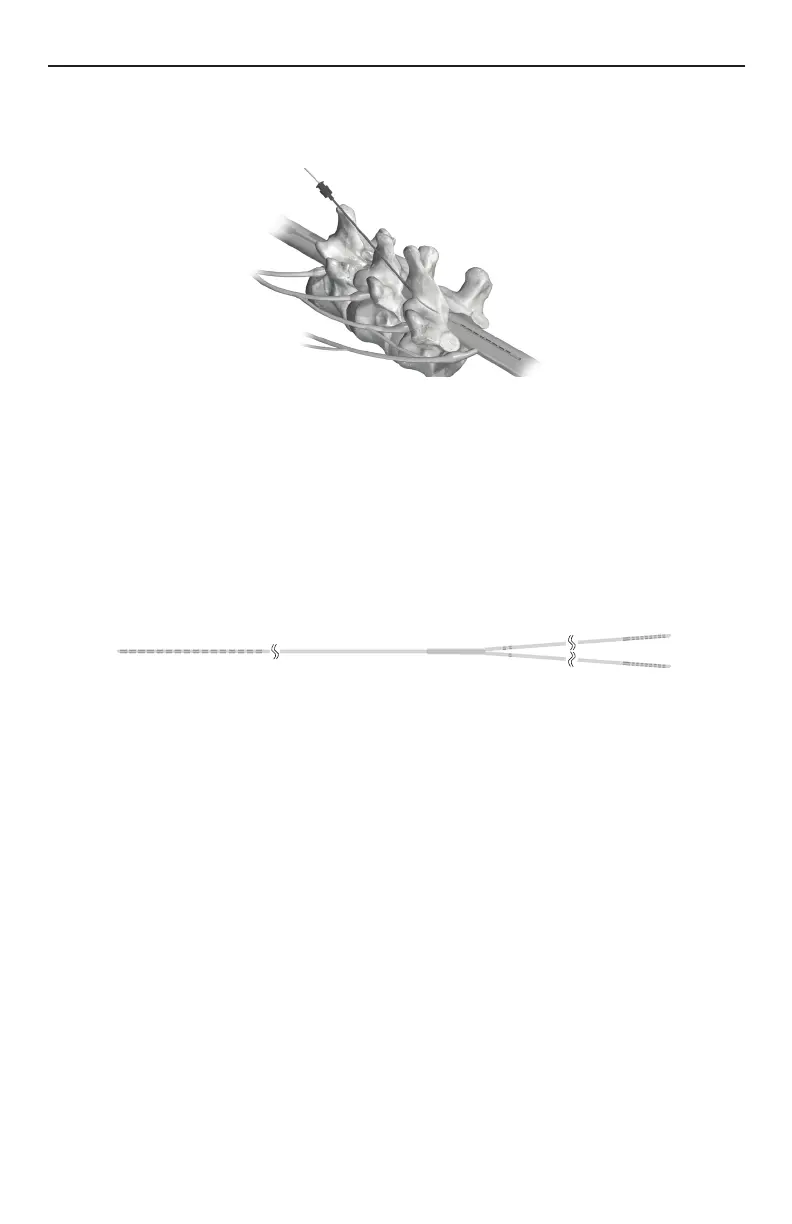
Percutaneous Lead Placement in the Epidural Space
Clinician Manual
97035873-01 21 of 75
WARNING: If the lead stylet is removed and reinserted, do not use excessive force when inserting the
stylet into the lead. The use of instruments, such as forceps, to grasp the stylet during insertion is not
recommended as this could result in applying excessive force and could increase the risk of lead and
tissue damage.
7. Advance the lead to the appropriate vertebral level under uoroscopic guidance. A sufcient length of lead
(i.e., at least 10 cm, or approximately three vertebrae) should reside in the epidural space to aid in lead
stabilization.
8. If use of a splitter is desired or you are using the Innion™ 16 lead, continue to “Lead Connection to
Splitter” on page 26. Otherwise, continue to “Connecting the OR Cable Assembly” on page 29.
Innion CX Lead Placement in the Epidural Space with Entrada™ Needle
Innion CX Lead
The Innion CX Lead has two tails to enable insertion into 8-contact IPG ports without the use of a Splitter
2x8. The two tails will not t through a standard 14 gauge insertion needle or Epimed needle, therefore these
needles are not compatible with the Innion CX Lead. Do not use a standard 14 gauge introducer or
Epimed needle to introduce the Innion CX Lead.
Use only the Entrada Needle with peelable sheath to introduce the Innion CX Lead into the epidural space.
An anchor must be pre-loaded on the distal end of the Innion CX Lead prior to inserting the lead into the
Entrada Needle. When using an anchor or suture sleeve with the Innion CX Lead, the stylet may be in place
within the lead when the anchor is loaded on the lead. Ensure that stylet is removed from the lead prior to
securing the anchor.
Entrada™ Needle
The Entrada Needle with peelable sheath is required to insert the Innion CX Lead into the epidural space
and may be used with all percutaneous leads with the exception of the Avista™ MRI Percutaneous Leads.
Reusing the same Entrada Needle to insert a second lead is not recommended.





 To Next Page