2-2 100-214-239 Rev. A
Introduction to the Digital Sonifier
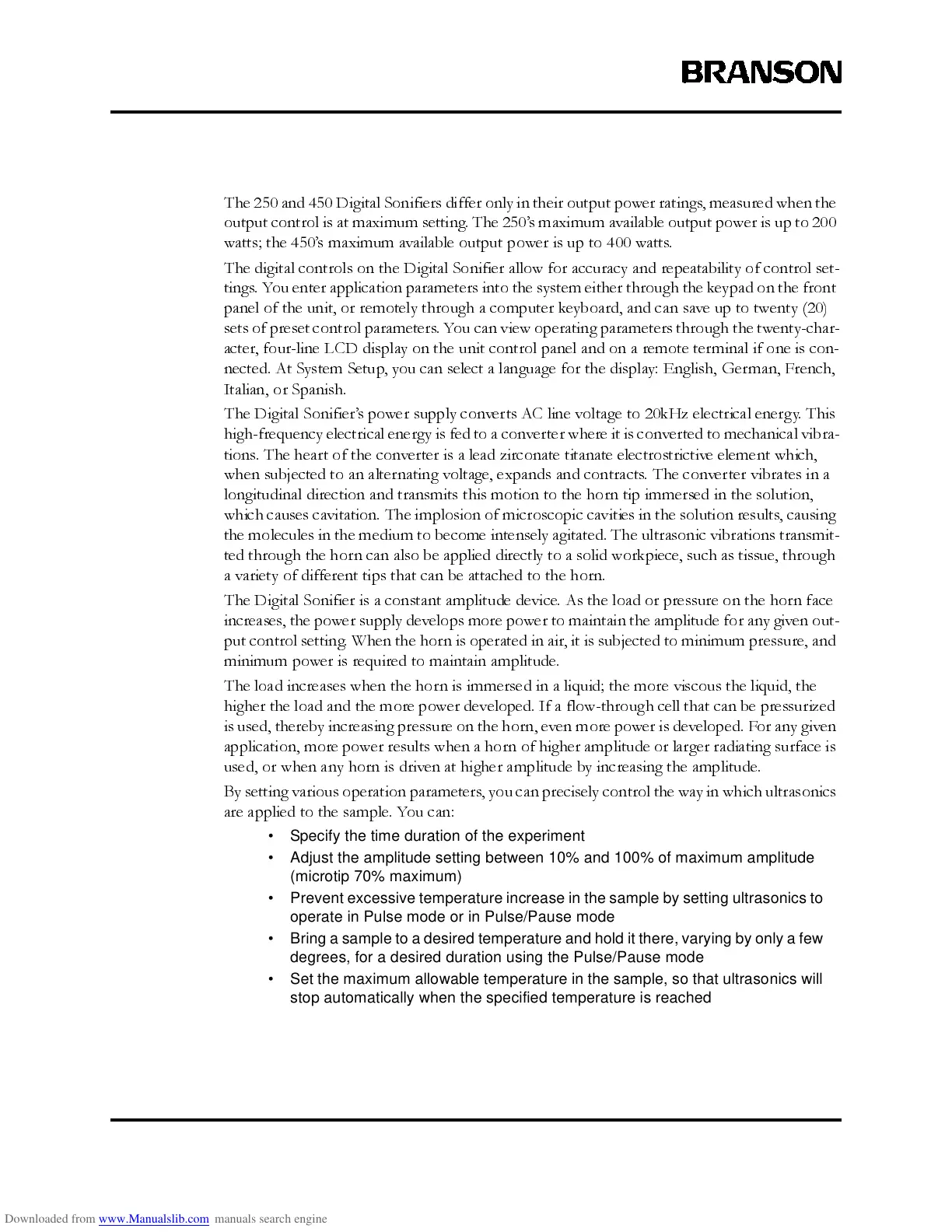
The 250 and 450 Digital Sonifiers differ only in their output power ratings, measured when the
output control is at maximum setting. The 250’s maximum available output power is up to 200
watts; the 450’s maximum available output power is up to 400 watts.
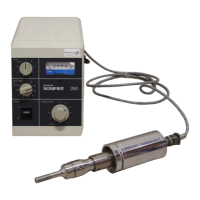
The digital controls on the Digital Sonifier allow for accuracy and repeatability of control set-
tings. You enter application parameters into the system either through the keypad on the front
panel of the unit, or remotely through a computer keyboard, and can save up to twenty (20)
sets of preset control parameters. Y ou can view operating parameters through the twenty-char-
acter, four-line LCD display on the unit control panel and on a remote terminal if one is con-
nected. At System Setup, you can select a language for the display: English, German, French,
Italian, or Spanish.
The Digital Sonifier’s power supply converts AC line voltage to 20kHz electrical energy. This
high-frequency electrical energy is fed to a converter where it is converted to mechanical vibra-
tions. The heart of the converter is a lead zirconate titanate electrostrictive element which,
when subjected to an alternating voltage, expands and contracts. The converter vibrates in a
longitudinal direction and transmits this motion to the horn tip immersed in the solution,
which causes cavitation. The implosion of microscopic cavities in the solution results, causing
the molecules in the medium to become intensely agitated. The ultrasonic vibrations transmit-
ted through the horn can also be applied directly to a solid workpiece, such as tissue, through
a variety of different tips that can be attached to the horn.
The Digital Sonifier is a constant amplitude device. As the load or pressure on the horn face
increases, the power supply develops more power to maintain the amplitude for any given out-
put control setting. When the horn is operated in air, it is subjected to minimum pressure, and
minimum power is required to maintain amplitude.
The load increases when the horn is immersed in a liquid; the more viscous the liquid, the
higher the load and the more power developed. If a flow-through cell that can be pressurized
is used, thereby increasing pressure on the horn, even more power is developed. For any given
application, more power results when a horn of higher amplitude or larger radiating surface is
used, or when any horn is driven at higher amplitude by increasing the amplitude.
By setting various operation parameters, you can precisely control the way in which ultrasonics
are applied to the sample. You can:
• Specify the time duration of the experiment
• Adjust the amplitude setting between 10% and 100% of maximum amplitude
(microtip 70% maximum)
• Prevent excessive temperature increase in the sample by setting ultrasonics to
operate in Pulse mode or in Pulse/Pause mode
• Bring a sample to a desired temperature and hold it there, varying by only a few
degrees, for a desired duration using the Pulse/Pause mode
• Set the maximum allowable temperature in the sample, so that ultrasonics will
stop automatically when the specified temperature is reached


 To Next Page