2 Safety
6 R-220 Pro Continuous Operation Manual, Version A
2 Safety
This chapter highlights out the safety concept of the instrument and contains general rules of behavior
and warnings from direct and indirect hazards concerning the use of the product.
For the users' safety, all safety instructions and safety messages in the individual chapters shall
be strictly observed and followed. Therefore, the manual must always be available to all persons
performing the tasks described herein.
2.1 User qualication
The instrument may only be used by laboratory personnel and other persons who on account of
training and professional experience know of the potential dangers that can develop when operating
the instrument.
Untrained personnel, or persons who are currently being trained, require careful supervision by a qual-
ied person. The present Operation Manual serves as a basis for training.
2.2 Proper use
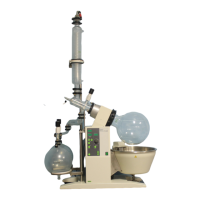
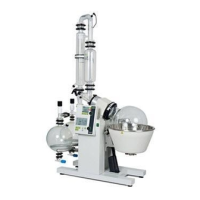
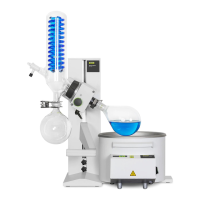
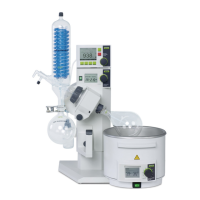
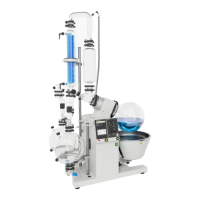
The rotary evaporator has been designed for use in technical laboratories and in production. It is
authorized for use in applications that work with the evaporation and condensation of solvents.
• Evaporation of solvents and suspensions
• Synthesis and cleaning of rened chemicals
• Reactions under reux
• Recycling and concentration of solvents
• Re-crystallization
• Drying of powders and granulates
2.3 Improper use
Applications not mentioned in section 2.2 are considered to be improper. Applications which do not
comply with the technical data (see section 3 of this manual) are also considered to be improper.
The operator bears the sole risk for any damages or hazards caused by improper use!
The following uses are expressly forbidden:
• Use of the instrument in explosive environments
• The production and processing of materials that can cause spontaneous reactions (e.g. explosives;
metal hydrids or solvents that can form peroxides)
• Processing with explosive gas mixtures
• Working without the evaporating ask being immersed in the water bath (risk of breakage)
• The drying of hard, brittle materials (e.g., stones, soil samples) that might cause damage to the
receiving ask
• Shock-cooling of the evaporating ask and other glass parts
• Installation or use of the instrument in rooms, which require ex-protected instruments
• For safety reasons, only original spare parts must be used
• Using the ask handler installed on the heating bath to lift or lower an evaporating ask


 To Next Page
 Loading...