EasyManua.ls Logo

Canon Canovision8 E50E - SAFETY PRECAUTIONS; Leakage Current Checks

Canon Canovision8 E50E
179 pages
Print Icon
To Next Page IconTo Next Page
To Previous Page IconTo Previous Page
Loading...
SAFETY
PRECAUTIONS
The
following
precautions
should
be
observed
when
servicing.
1,
Since
many
parts
in
the
unit
have
special
safety-related
characteristics,
always
use
genuine
CANON
replacement
parts.
Especially
critcal
parts
in
the
power
circuit
block
should
not
be
replaced
with
other
makes,
Critical
parts
are
marked
with
A\
in
the
schematic
diagrams.
The
primary
source
of
X-ray
radiation
in
this
viewfinder
is
the
picture
tube.
The
cube
used
in
the
viewfinder
is
especially
constructed
to
limit
X-ray
radiation
emission.
For
continued
X-ray
radiation
protection,
the
replacement
tube
must
be
same
type
as
the
original,
CANON
approved
one.
When
servicing,
observe
the
original
lead
dress.
If
a
short
circuit
is
found,
replace
all
parts
which
have
been
oberheated
or
damaged
by
the
short
circuir.
After
servicing,
see
to
it
that
all
the
protective
devices
such
as
insulation
barriers,
insulation
papers
shields
are
properly
instalied.
After
servicing,
make
the
following
leakage
current
checks
to
prevent
the
customer
from
being
exposed
to
shock
hazards.
5-1
Leakage
Current
Cold
Check
1)
Unplug
the
AC
cord
and
connect
a
jumper
between
the
two
prongs
on
the
plug.
2)
Measure
the
resistance
value,
with
an
ohmmeter,
between
the
jumpered
AC
plug
and
each
exposed
metalic
cabinet
part
on
the
equipment
such
as
screwheads,
connectors,
control
shafts,
etc.
When
the
exposed
metalic
part
has
a
return
path
to
the
chassis,
the
reading
should
be
between
1M2
and
5.2M%.
When
the
exposed
metal
does
not
have
a
return
path
to
the
chassis,
the
reading
must
be
%
~
5-2
Leakage
Current
Hot
Check
1)
Plug
the
AC
cord.directly
into
the
AC
outlet.
Do
not
use
an
isolation
transformer
for
this
check.
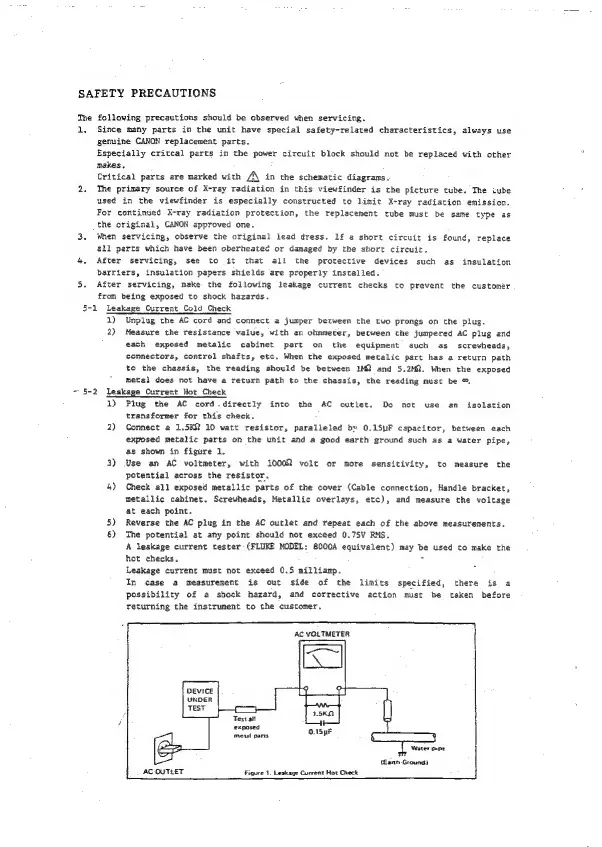
2)
Connect
a
1.5KS
10
watt
resistor,
paralleled
by
0.15yF
capacitor,
between
each
exposed
metalic
parts
on
the
unit
and
a
good
earth
ground
such
as
a
water
pipe,
as
shown
in
figure
1.
3)
Use
an
AC
voltmeter,
with
10002
volt
or
more
sensitivity,
to
measure
the
potential
across
the
resistor.
4)
Check
all
exposed
metallic
parts
of
the
cover
(Cable
connection,
Handle
bracket,
metallic
cabinet.
Screwheads,
Metallic
overlays,
etc),
and
measure
the
voltage
at
each
point.
5)
Reverse
the
AC
plug
in
the
AC
outlet
and
repeat
each
of
the
above
measurements.
6)
The
potential
at
any
point
should
not
exceed
0.75V
RMS.
A
leakage
current
tester
(FLUKE
MODEL:
8000A
equivalent)
may
be
used
to
make
the
hot
checks.
Leakage
current
must
not
exceed
0.5
nilliamp.
In
case
a
measurement
is
out
side
of
the
limits
specified,
there
is
a
possibility
of
a
shock
hazard,
and
corrective
action
must
be
taken
before
returning
the
instrument
to
the
customer.
AC
VOLTMETER
Water
pine
(€anh-Ground)
AC
OUTLET
Figure
1.
Leakage
Current
Hot
Check

Table of Contents

Related product manuals