Need help?
Do you have a question about the Centa CENTAX-L and is the answer not in the manual?
The CENTAX-L, specifically model 016L-00050...00090-FS10, is a highly elastic coupling designed for power transmission, emphasizing reliability and innovation. This device is engineered to compensate for torsional vibrations and impacts without wear, making it suitable for applications requiring robust and maintenance-friendly operation.
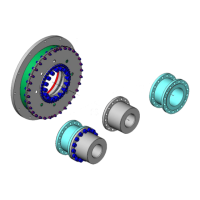
The CENTAX-L coupling serves to connect shafts, transmitting torque while accommodating axial, radial, and angular misalignments. Its design incorporates rubber elements that are crucial for its highly elastic characteristics, allowing it to dampen vibrations and impacts effectively. The assembly process involves mounting hubs onto shafts, followed by the installation of link flange assemblies and the links themselves. The coupling is designed for specific rotational directions, either clockwise (cw) or counterclockwise (ccw), which is determined during installation. The overall function is to provide a reliable and smooth power transmission, protecting connected machinery from excessive stresses due to misalignments and dynamic loads.
The CENTAX-L coupling is characterized by several key technical specifications that ensure its performance and compatibility. It offers compensation for major axial, radial, and angular displacement, which is critical for maintaining operational integrity. The coupling is designed for low-maintenance operation, with easy visual inspection of components. Fast exchange of components is a feature, simplifying repairs and reducing downtime. The design is protected by international patents, and the type approval comes from leading classification agencies. The coupling is tested and proven over thousands of hours in tough daily operation since 1992, attesting to its durability and reliability.
Specific alignment tolerances are provided for axial, radial, and angular misalignments. For axial alignment, the permissible axial alignment tolerance (ΔKA max) is 0.5 mm. Radial alignment tolerances (ΔKR max) vary depending on the coupling size and Shore hardness of the rubber elements, ranging from ±0.15 mm to ±1.2 mm for Shore A hardnesses of 45/50 to 70. Angular alignment tolerances (SW max) are also specified, varying with SAE J620 DIN 6288 sizes and R values, from 0.7 mm to 1.9 mm.
The coupling components, particularly the hubs, require specific heating temperatures (170° - 200°C) for mounting onto shafts, ensuring a secure interference fit. The use of hydraulic pumps for mounting and dismounting is recommended, with specific oil viscosities (300 mm²/s at 20°C for mounting, 900 mm²/s at 20°C for dismantling) and maximum pressures (3000 bar for expanding the hub and 1500 bar for expanding the hub during dismantling).
The CENTAX-L coupling is designed for straightforward assembly and operation, though adherence to specific instructions is crucial for safety and optimal performance.
Maintenance of the CENTAX-L coupling focuses on regular inspection and timely replacement of worn components to ensure continuous safe and efficient operation.
 General
| Brand | Centa |
|---|---|
| Model | CENTAX-L |
| Category | Industrial Equipment |
| Language | English |

 To Next Page