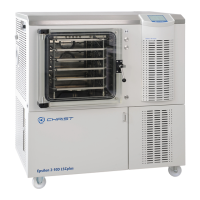
Freeze-dryer Alpha 1-4 LDplus
Freeze-dryer Alpha 2-4 LDplus
2 Layout and mode of operation
Version 11/2006, Rev. 2.2 of 17/10/2016 • sb
Translation of the original operating manual
2.2.2.4 Final drying
Final drying is an option whenever one requires a product with minimal
residual moisture. In the physical sense, this process is a desorption
process, i.e. the removal of adsorptively bound water. Final drying is
performed under the lowest possible final pressure that depends on the ice
condenser temperature in accordance with the vapour pressure curve
above ice as well as on the final vacuum of the vacuum pump that is used.
The process is supported by a higher shelf temperature.
Pos: 36 /010 Uni versalmodule/ Leerzeile @ 0\mod_120 2116244500_ 0.docx @ 11 4 @ @ 1
Pos: 37 /200 Chri st/360 GT-BA Labor-Pilot (ST ANDARDMODU LE)/020 A ufbau und Wirkungs weise/020-0 020-0020-005 0 Trocknungs ende und Belüftu ng @ 25\m od_140498326147 6_68.docx @ 183145 @ 4 @ 1
2.2.2.5 End of drying and aeration
The end of the drying process is reached when both the product and shelf
temperature are clearly in the positive range (+15 to +20°C) and if their
difference is not greater than 5 K.
Another indication of the end of the drying process is the behaviour of the
vacuum and of the ice condenser temperature. The ice condenser is no
longer subject to load and reaches the final temperature of approximately -
55°C or -85°C. The pressure in the drying chamber decreases in
accordance with the ice condenser temperature.
The vacuum pump will be switched off and the drying chamber will be
aerated via a rubber valve or via the aeration valve. The aeration valve can
also be used to flood the unit with nitrogen or another inert gas instead of
ambient air.
Then, the product can be removed from the unit.
Pos: 38 /010 Uni versalmodule/S eitenwechsel @ 0\mod_120 2116244312_ 0.docx @ 105 @ @ 1


 To Next Page